Mercedes-Benz A-class review – the Audi A3-rivalling hatchback Mercedes can’t afford to kill
The current A-class is now almost a decade old. Happily, it still looks and feels relatively fresh
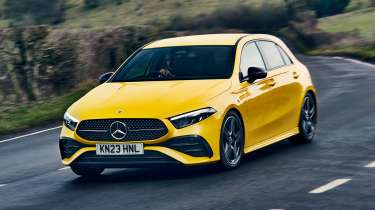
This wasn’t a part of the original plan. Had things gone the way Mercedes-Benz expected, the Mercedes A-class hatchback would not still be in production. But the wild predictions for the future of electrification in the early 2020s did not come to pass and so the now eight-year-old A-class continues to be a strong contributor to the German brand’s bottom line. Not only does the A-class survive but it’s set for replacement in 2029 by the next-generation car. This model is expected to be offered as an EV with the option of a hybrid, a-la the current Mercedes CLA with which it’ll share the MMA platform.
That means the current Mercedes A-class has another two years to endure and will have by the end of its tenure, seen-off three generations of Volkswagen Golf, two generations of BMW 1 series and two generations of Audi A3 (the latter also getting a stay of execution for similar bottom line-preserving reasons).
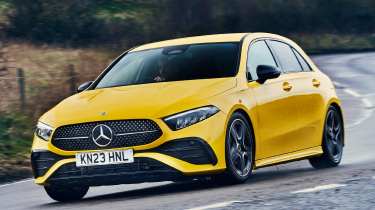
The question then, is whether a car that was first conceived in the late 2010s is still up to it in 2026. At least in terms of design, it still looks properly sharp, retaining the sporty headlights and overall design language the flagship SL would in 2022 adopt. Isn’t it usually the cooking model that gets trickle-down features and styling? Oh well. Either way, none are looking at the A-class thinking it’s old hat.
Engines, gearbox and performance
- Rationalised range of powertrains
- Renault-collab 1.3 is harsh
- A35 and A45 are ballistic if a little industrial
More reviews
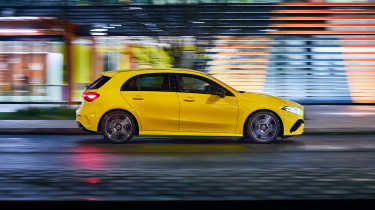
Though consolidated compared to before the facelift, the powertrain lineup is varied enough to satisfy differing tastes but also contemporary in terms of electrification. There are petrol engines (including the potent A35 and A45 S), a plug-in hybrid and even a diesel remains. The range opens with the A180, featuring a slightly apologetic 1.3-litre mild hybrid four-cylinder engine with just 134bhp and 170 lb ft. That means the 0-62mph sprint happens in a somewhat lethargic 9.2sec, while top speed is 134mph. In other words, a base A-class would struggle against a 1990s E-class and as such, we’d almost always upgrade to the A200.
The A200 uses the same 1.3-litre engine – a co-development with Renault, that replaced the old 1.6 at the bottom of the range – but boosted here to output a healthier 161bhp and 199lb ft, allowing 0-62mph in 8.2sec and a 140mph top speed. Both the A180 and A200 petrols share a seven-speed gearbox and have a certain harshness to them when exercised. This is unfortunate as given their slightly weedy outputs, that’s something that happens often.
This engine is also used in concert with a plug-in-hybrid system in the A250 e for 215bhp in total. This model manages 0-62mph in 7.4sec, but uses an eight-speed DCT transmission instead.
The only diesel is now the A200d, which is the only instance in the range where the engine’s size actually corresponds with the badge on its boot. Power of 148bhp doesn’t sound like much but typically of a diesel, 236lb ft offers a sense of strength in-gear, with an unremarkable but acceptable 8.3sec 0-62mph time. It shares the eight-speed transmission also found in the PHEV but being a diesel, is at the opposite end of the spectrum to the PHEV in terms of refinement and serenity in urban driving.
The AMG models live on, though they are not long for this world, with the ballistic A45s ' remarkable M139 2-litre turbo four facing the axe due to looming regulation changes. The A35 engine isn’t a dedicated AMG lump but with 302bhp and 295lb ft, it’s plenty potent enough, allowing 0-62mph in 4.7sec and a 155mph top speed. It’s effective and strong up top, if not an enthusiastic engine in the mid-range.
The A45 S is an even more aggressive animal, with 415bhp and 369lb ft, allowing supercar-baiting performance, with 0-62mph arriving in 3.9sec on the way to a 168mph top speed. It’s an engine that bristles with energy when in the A45’s more intense drive modes, with eye-opening strength. Nonetheless, it loses out to Audi’s RS3 where a feeling of exoticism is concerned. Both the A35 and A45 use the newer, more responsive eight-speed dual-clutch transmission and 4Matic all-wheel drive. The A45 S gets a dual-clutch pack on the rear axle for drift mode, while the A35 torque vectors using the ESP.
Ride and handling
- A-class still rides harshly, especially in lower specs
- A35 now gets adaptive dampers as standard
- A35 and A45 massively upgraded and much more involving to drive
Mechanically, the A-class is fairly unremarkable, with a steel structure and MacPherson struts with passive dampers at the front. The rear setup varies depending on spec, with Sport models getting a torsion beam, while Premium Plus models and all A250 e variants gain a multi-link rear. While the passive dampers are standard, the A35 now gets adaptive dampers without the need to pay more. All versions use variable-ratio, electrically-assisted rack-and-pinion steering.

For the A35 virtually no suspension component is carried over from the regular A class, with re-designed joints and lower wishbones combined with careful development of the bushes and even the use of metal bearings on the lower front arms for more steering precision. The rear subframe is now solidly mounted to the body, while the steering rack is also new for the A35, as are the beefy brakes with monoblock four-piston calipers up front. There’s a stiffer structure to work with, too, courtesy of an aluminum shear under-panel beneath the engine, assisted by bracing bars.
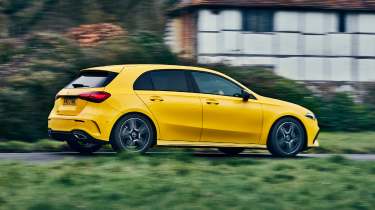
Something the current A-class never made real progress with is ride quality. The higher-spec multi-link cars (standard on the A250 e) are more adept at dealing with broken and rough road surfaces than the torsion beam models lower down the range which clonk and shudder more readily. On the AMG Line’s larger wheels, both setups feel unsettled on all but the smoothest surfaces, rumbling noisily over patchy tarmac and thudding over harsher bumps.
This firmness does translate to good body control and roll is kept to a minimum, backed up by strong levels of lateral grip. The steering is reasonable too, with a responsive and well-weighted feel once past a slightly dead zone around the straight-ahead, and once you’re up to a decent speed and sending greater loads through the front axle. There’s a typical Mercedes slickness to the steering too, even if the suspension’s struggle to contain bumps sometimes sends vibrations through the rim.
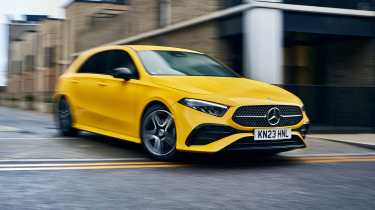
With little feedback though, the A-class lacks involvement, so there’s not much fun to be had slotting the A-class down a twisting section of road, even though it’s capable of doing so with speed and composure.
However, the A35 proves that there's actually a solid base underneath the A-class. With the Golf R’s fall from grace, and iterations made with the A35’s facelift, it’s edged ahead of the venerable Volkswagen in terms of engagement. The steering is quick and accurate, if relatively low on road feel, but there's more substantial weighting than you'll find in the Golf, which is actually quite confidence-inspiring on unfamiliar roads.
There's plenty of turn-in bite, particularly in the dry when the grip feels near-endless. There's also a feeling the front and rear axles are working together, giving the car a lovely four square stance. The four-wheel drive transmission's switch from front-wheel drive to 50-50 torque split is so quick (it's already priming the centre diff before you've got on the throttle) you can fire out of corners with your right foot buried without fear of falling off.
Body control in the A35 is superb too. There's very little to choose between the Comfort, Sport and Sport+ driving modes (even Comfort gets a little agitated over most surfaces), with the middle setting just about offering the best fast road compromise between comfort and composure. The brakes deserve special mention, offering both tireless stopping power and beautifully judged pedal progression.
Interior and tech
- Interior tech doesn’t yet feel dated
- Quality is reasonable if not on the level of some newer Mercedes models
- Tech is intuitive once you learn it, but haptic controls irritating
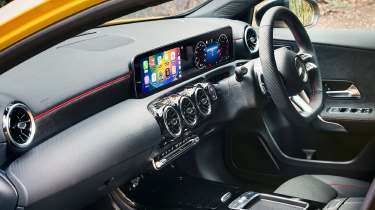
When the current A-class debuted, its neat horizontal layout to the dashboard, wide instrument panel display and simplified centre console made everything else in the class seem staid and unimaginative. Yet now, even just a few years later, it's a design theme that's been picked up across the industry. This process has drawn attention away from the shiny screens and slick graphics in the A-class, and makes you focus more on the actual quality of materials.
Dig deep and there are perhaps too many different types of material on display and the traditional Mercedes steering column-mounted gear selector (and its combined wipers and lights stalk on the other side) both looks and feels oddly cheap. Being a last-generation Mercedes cabin, it’s not beyond the odd creak from its swathes of piano black plastic either. Despite this, the layout and appearance remain appealing and the absence of bulky mouldings lends an airy feel, despite the gloomy black trim of the AMG Line cars. A range of adjustment to the wheel and seats and well-placed pedals make for a comfortable driving position, too.
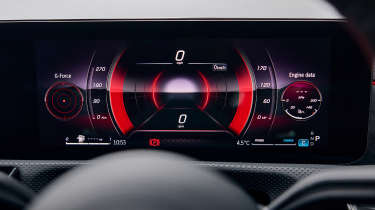
Technologically it’s right on the button. At its flashiest the A-class cabin uses a pair of 10.25-inch displays, with the central display now touch-sensitive. That’s just one of the ways you can now control it, the others being a touchpad in the centre console, buttons and touch-sensitive pads on the steering wheel spokes, and voice commands as part of what Mercedes calls MBUX.
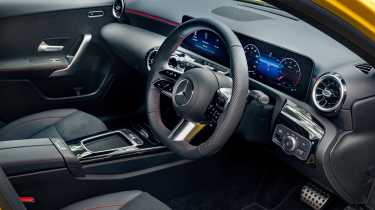
All methods work surprisingly well, and the voice control system is among the best we’ve tried. It’s still unfamiliar with some commands, but by and large it’s quite easy to set navigation destinations, change radio stations, adjust the interior temperature or just change the ambient lighting colour with simple spoken instructions. As a means of distraction-free control of infotainment, it’s better than any touchscreen.
The various displays are, of course, multi-configurable and the touch-sensitive elements allow you to use smartphone-style pinching, swiping and scrolling movements, with simple “back” buttons present on all surfaces. The latter is a useful shortcut to whatever screen you were on before, so you don’t end up eight menus away from your navigation directions or other similarly irritating predicaments.
Once you’ve spent a good while prodding and swiping at the steering wheel buttons and the central touchscreen you’ll eventually settle on an instrument layout that suits you - virtually every element of both screens can be configured to suit, or you can just select one of the themes Mercedes has already programmed in. There’s a sporty layout, one themed around economical driving and another that removes virtually all visual elements from the screen for distraction-free driving.
One really neat touch is the augmented reality sat-nav directions. Approach a junction or a roundabout and the map on the centre screen is replaced by the view from the front-facing camera, which is then overlayed with an arrow showing your route. It's a brilliantly simple and intuitive piece of kit.
MPG and running costs
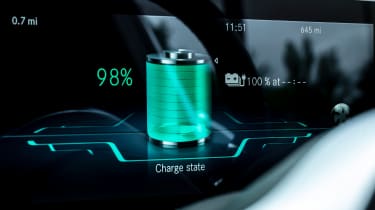
The current A-class justifies its retention in the Mercedes range with perfectly contemporary efficiency figures. Even the PHEV offers impressive electric range when you consider the age of this platform – 52 miles from a 15.6kWh battery, on the smaller wheels.
The 1.3-litre petrol when working alone is claimed to be good for over 48mpg in A180 form and 47.9mpg overall in A200 form. The difference is so negligible you’re really better off opting for the A200 for a little extra performance, if funds permit.
The diesel A200 d looks almost like an anomaly in the range in 2026 but if your miles are plentiful and taken at consistent high speeds, its 57.7mpg average economy will be ideal. Live and drive in the urban sprawl, rarely cracking 35mph? The petrol is the better choice and better yet, if you can charge at home or at work, the PHEV.
A nasty surprise for A-class buyers could come in the form of the expensive car supplement, which will be payable on models as low in the range as the A180 AMG Line Premium Plus.
Price and rivals
A-class prices vary enormously depending on powertrain and specification but even the cheapest isn’t that cheap. The A180 sport, with under 140bhp and its torsion beam rear axle, is a £31,870 proposition. Prices rise via Sport Executive, AMG Line Executive, AMG Line Premium specs, to the £40,315 A180 AMG Line Premium Plus. That adds the larger AMG Line wheels and sportier bodywork, electrically adjustable memory seats, panoramic roof, head-up display, ambient lighting, parking package with 360-degree camera and more. Nonetheless, the Sport is well-equipped, with LED headlamps, MBUX infotainment, climate control, heated front seats and more.
A200 prices range from £34,805 to £41,865, while A200 d prices range from £35,800 to £42,965, though both also get ambient lighting as standard. The A250 e PHEV begins at AMG Line Executive spec and a sturdy starting price of £41,340, rising to £46,175 for AMG Line Premium Plus. We’d probably opt for the A200 AMG Line Premium, which comes in under £40,000 (avoiding the expensive car supplement) but still with sportier styling, extra equipment and the multi-link rear axle.
The AMG A35 begins from £50,145, while the A45 did start from well over £64,000, though it’s now disappeared from Mercedes-Benz’s configurator.
The A-class faces direct competition from the BMW 1 series and Audi A3. The Audi starts a little cheaper, from £30,895, though its base powertrain is even weedier, with less than 120bhp. The BMW is priciest, from £32,640 but is the most powerful in bottom spec form, with over 160bhp. The S3 and M135 are priced in line with the Mercedes A35, as is the RS3 with the A45 S.
Mercedes-Benz A-class history
The first two Meredes-Benz A-class iterations were clever and sold well, but the tall and narrow styling caused Mercedes some stability headaches at the first car’s launch. Like the Audi A2 it was a brilliantly packaged machine that aimed to combine the traditional Merc traits of space and quality, but in a package that was more VW Golf in its size and running costs. While it sold well, conventional rivals sold even better.
By the time the second-generation A-class had arrived, Audi and BMW’s own small cars - the A3 and the 3 series compact (and later 1 series) had nailed the balance of a premium feel and compact size that an increasing number of customers craved. leaving the intelligent but ungainly A-Class out of favour with buyers now more concerned with image than intelligence.
If you can’t beat ‘em, join ‘em. The third-generation A-class ditched the sandwich floor and lofty seating position and went down the conventional two-box hatchback route. Sales went gangbusters (particularly in the UK, the world’s biggest A-class market) and diversification into saloons and estates (with the CLA line), mini-MPVs (B-class) and hot hatchbacks (the AMG A35 and A45) strengthened its position further.