Audi Quattro, RS2 and RS3: five-cylinder icons head-to-head
Audi’s five-cylinder engine is a legend nearing its end. We take a journey through its history, from the original Quattro to the celebrated RS2 and the latest RS3, on the spectacular roads of the French Pyrenees

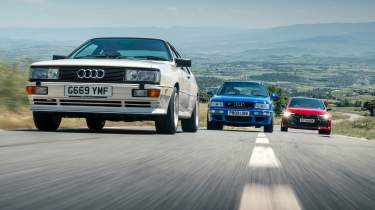
This is quattro country. The road never rests, climbing and weaving its way up to high altitude with the Pyrenees breaking through the haze on the left, and dense pine forest towering above on the right. Corners come thick and fast, most of them unsighted over crests or hidden around grass mounds. Between them the RS2’s five-pot ingests the crisp mountain air, spools its turbo and lunges forwards with a deep, full-bodied howl that, for a moment, might trick you into thinking you’re Mr Röhrl on a tarmac stage.
A co-driver and pace notes would be helpful here, but I have what is probably the next best thing: evo’s hard-charging photographer Aston Parrott to follow as a reference, in the latest RS3. It’s a formidable combination, one that the RS2 and I are having a hard time keeping in view. The pace gradually quickens as the road unfurls, giving the RS3 more opportunity to flex its muscles, and me more work to do with a manual gearbox and an engine that doesn’t do much below 3000rpm. But I have size on my side, the slender RS2 cutting tidy lines and keeping momentum as the RS3 bulges out of its lane. Soon we’re into a wonderful flow, the road evolving and the scenery becoming even more spectacular with every mile.
More reviews
Group tests
- Ravage Alpine A110: France's perfect sports car made even more perfect
- Alpine A390 v Hyundai Ioniq 5 N – are these EV crossovers fun as well as fast?
- Ariel Atom 4R v Ariel Nomad 2 – is grip more fun than slip?
- Ariel Atom 4R v Caterham Seven ‘evo25’: power-to-weight heroes go head-to-head
- Who makes the best GT car? Aston Martin v Bentley v Maserati
- BMW 230i M Sport v Volkswagen Golf GTI Clubsport
- Caterham Super Seven 600 v Super Seven 2000
- Great Ferrari hypercars driven: 288 GTO, F40, F50 and Enzo head-to-head
- Hardcore Ferrari V8 specials go head-to-head
- GMA T.50 v McLaren F1 – has the best car in the world been dethroned by its successor?
In-depth reviews
- Abarth 600e review – electric hot hatch with surprising character
- Alfa Romeo Junior review – small Italian crossover to rival Ford's Puma
- Alpine A110 R (2023 - 2026) review – the flawed but fantastic Porsche Cayman GT4 alternative
- Alpine A390 review – France's flawed rival to the Porsche Macan
- Alpine A110 review – the sports car Lotus should be building
Long term tests
- How lowering the roof on the Abarth 695C is a threat to my driving licence
- Alpina B10: Alpina B10: end of term report
- Alpina B10
- My £200k Aston Martin DBX707 comes with a built-in shower I didn't ask for
- The subtle trick that makes Audi’s old interior better than a touch screen
- My Audi S8 can’t make me hate it, even if its safety systems are often terrible
- Living with this £40k Caterham Seven even makes the KFC drive-thru memorable
- Caterham Seven evo Edition revealed – bespoke 420R joins the Fast Fleet
- It has a VW Golf R engine, but the Cupra Leon is quietly old-school
- Cupra Ateca VZN Fast Fleet test – four months with Cupra's hot crossover
Reviews
- Abarth 695 (2012-2024) review – why we’ll miss Italy’s Mini Cooper S rival
- Abarth 500e 2023 review
- AC Cobra 289 review – British sports car with an American V8 heart built to fight Ferrari
- AC Cobra 378 Superblower MkIV 2021 review – another V8 Cobra, but with a GM heart this time
- Acura Integra Type S 2024 review – a Honda Civic Type R with added restraint
- Alfa Romeo 33 Stradale 2025 review – a rare Italian jewel beyond compare
- Alfa Romeo Tonale 2023 review – 276bhp Speciale version tested
> Audi’s first Formula 1 design officially revealed
Eventually we slow for a herd of donkeys blocking our path in the distance, bringing a surreal few minutes of driving to an end. Some moments later, a voice of reason crackles over the radio. ‘Um, lads, have you got enough fuel for the shoot?’ asks editor-in-chief Stuart Gallagher as he calmly rolls up behind in a white 20V Quattro. ‘The next station is 50 miles up the road.’ Ah. Aston mumbles something about having 30km of range left, and the needle in the RS2 has dropped below a quarter. Cue a clumsy, fifteen-cylinder three-point turn to head back to the previous town. No matter, it’s a chance to do it all over again…
Audi’s five-cylinder engine isn’t long for this world, and that’ll come as sad news to anybody who has experienced one at full cry. They’ve been the heart of many of Ingolstadt’s most celebrated cars for nearly fifty years, bringing them to life and being as central to the experience as a straight-six in a BMW or an Alfa Romeo Busso engine. Nothing sounds or feels like a five-pot, but it’s getting harder and harder to keep them within ever-tightening emissions regulations.
The last survivor of the five-cylinder breed is the RS3. Over the years its engine has been honed to be more powerful but also cleaner, yet when this generation of the model bows out in a few years’ time, Audi is unlikely to commit to a like-for-like replacement for such a rare-breed power unit when it has six- and eight-cylinder plug-in hybrids on the way. Perhaps there’s an outside chance of the five-pot returning in an electrified form at some point, but being heavier, more space-sapping and less efficient than a four-cylinder, we wouldn’t bet on it. These three cars, Quattro, RS2 and RS3, are a snapshot of Audi’s five-cylinder history, and a reminder of what we’ll be missing.
You could credit the five-cylinder engine for making Audis cool, but it first found itself in quite ordinary surroundings – the second-gen 100 saloon from 1976. Rather than turning it into a hot saloon, the move to five cylinders was designed to elevate the 100’s premium status against the BMW 5-series of the time. Five cylinders were smoother and more powerful than four but lighter than six, and Audi was able to base the motor around its existing EA827 four-pot, saving costs. It was also short enough to be mounted transversely in front-wheel-drive applications to aid packaging. This first version was naturally aspirated with a modest 134bhp, but there was also a non-turbo diesel putting out 70bhp. Which must barely move.
But then came the Quattro, a proper performance car. A game-changer in fact. It shook the car world when it arrived in 1980, using a turbocharged 2.1-litre five pot with 197bhp and four-wheel drive. It made big performance accessible to anyone (if you had £14,500), in any conditions, all the time. And the formula stuck, the Quattro defining fast Audis to come and spawning a string of world-beating rally cars. With everything wrapped in box-arched bodywork it had the looks, performance and pedigree of a surefire icon, and today there’s a magnetism and romance about the Quattro that’s impossible to deny. Of the three cars here, it’s the one that people smile at and flock towards the most, by far.
This is the same, more powerful 220bhp 20V example that featured in our 1980s evo Eras test in issue 334, and one of the surprises is that the cabin is a bit flaky and un-Audi-like. The doors shut with a tinny clang, there are rattles here and there and some of the trim is heavily worn away. The small-diameter wheel looks racy but the column seems to have been mounted in the wrong place, offset heavily to the left. Twist the key and the fully digital dash wakes up, split into three LCD sections like an old Casio. For all its quirks it’s still a special place to be, and it’s a relief to not have any modes to mess with, no warning bongs, nor a huge mass of dashboard to look past as you would in something modern. You just slot into gear and go.
Straight away, this isn’t a car that hides its age like a contemporary BMW might. If you’re used to modern cars, some elements, like the free movement in the suspension, slow steering and lack of bite from the brakes, might come as a surprise. They were for me. But give it time and you naturally adjust to how the Quattro wants to be driven. It engages a different part of your brain, forcing you to be deliberate and think about the basic actions of driving, rather than tearing up the road in a frenzy. Push too hard too quickly and things get sloppy – it’s an old car after all – but settle into a relaxed cruise through a hauntingly pretty landscape with the windows down, and life feels pretty good in the Quattro.
The performance must have felt mighty in 1980, and even today you can string the Quattro along at a truly impressive pace. On the open sections of autoroute the RS2 and 3 stroll away into the distance, but off the motorways, ducking and diving through the trees and around hairpins, the Quattro is right with them, provided you time your shifts perfectly and don’t scrub off momentum. The motor is smooth, tractable and pulls well when the single turbo wakes, adding extra zip above 3000rpm. It’s not a manic rush to the red line but a satisfying surge, with a bit of mechanical thrash up front and a muted howl from the exhaust behind. Muted is the right word, because even when wrung out that signature tone never fills the cabin – blame the noise-sapping catalytic converters of this later example.
The Quattro has the guts to stay with modern metal, but the chassis and brakes have a tougher time of it. Corners that seem to barely register in the RS2 and RS3 ahead have the Quattro leaning at comedy angles, and there’s a whiff of hot brakes after tackling a series of downhill switchbacks. It’s nose heavy and far from pinpoint precise, but the harder you drive, the more you realise it’s totally benign and seriously capable for its age. Feed it in, let it roll, and there’s good grip to lean on from the plump 15-inch tyres, plus dogged stability once settled in a corner and peerless traction on the way out. It’s all about picking the right lines, anticipating the roll and making sure the boost is ready to haul you out the other side. I’m finding plenty to enjoy in the Quattro. You just need to run at its pace.
We pull in for lunch and it’s a chance to take in all three shapes at once. If the Quattro is all about understated attitude, the RS3 is the opposite, shouting about its potential with wide tracks, carbon add-ons and tailpipes you can stick your hand into. The bodywork bulges out to cover that extra width and, strangely, the rear tyres are narrower than the fronts, which from behind makes it look like it’s crabbing along the road. It’s a mutant of a hatch.
The clean, slim-bodied RS2 is oh so subtle by comparison, apart from the Smurf blue paint. A deep front bumper, tastefully lowered ride height and twin tailpipes barely give the game away, but those in the know will spot Carrera Cup wheels, door mirrors from a 911 and, for the extreme geeks, 993 indicator repeaters. Because yes, this is far from an ordinary estate – it’s the first ever Audi RS model and one developed by Porsche to boot. I’m itching to drive it, and as we start to sizzle under the midday sun I’ve timed it perfectly by swapping out of the Quattro, the only car without air-con. Sorry, Stu.
Fifteen years separate the Quattro and RS2, but it feels like it could be double that. In terms of quality, detailing and depth of engineering the later car feels like it’s from a different planet. It starts as soon as you drop into the seat – a wonderfully supportive Recaro with electric height adjustment, big bolsters and grippy blue suede centres. Ahead there’s a bank of crisp black-on-white dials and, surprisingly, carbonfibre inserts on the dash and door cards, with subtle strands of blue running through the weave. Everything is tough, substantial and feels built to last the lifetime of the car. Which in this case has clearly been a pampered one, with less than 8000 miles registering on the dash. Time to add a few more.
Get rolling and it’s a tighter, more cohesive car than the Quattro. Better supported on its suspension, with heavier steering and a weightier, more precise gearchange. By ’90s standards it’s firm riding but still nicely judged for the road – as you’d expect with Porsche tuning the dampers and roll bars. The engine was also given the Zuffenhausen touch, the 2.2-litre unit gaining a bigger KKK turbo, uprated injectors, a modified exhaust cam and revised engine management, among other changes. The result was a quite astonishing 315bhp – more than a Ferrari 348, and enough to enable the RS2 to match a contemporary 911 Carrera to 62mph.
This is turbocharging the old-school way, and at low revs the response is a bit limp – the fireworks only come when you hang on to gears for longer and sink deep into the throttle. At 3000rpm the motor wakes up, and then from 4000rpm the delivery becomes a fervent rush, building to a smooth rasp overlayed by turbo flutter when you lift for the next gear. At full noise the RS2 is a seriously fast car, but an interactive one too. There’s a bigger penalty for dropping off boost than in the Quattro, but the rewards are higher for slotting the right gear and keeping the engine in that frenzied zone. That smaller sweet spot is highlighted when following the Quattro on a steep, twisting descent back towards civilisation. It’s littered with surprise second-gear corners, which repeatedly catch the RS2 off boost. It chugs away from turns while the Quattro finds better drive, and when the big turbo eventually starts closing the gap it’s time to slow for the next one. The net result is that the older car slowly but surely edges ahead.
Faster sections are a different story. Here you can stay in the upper reaches for longer, dipping in and out of all that power and finding a flow with the RS2. There’s still roll to manage but it’s more controlled than the Quattro, with less work to do at the wheel to thread it along at speed. It’s satisfying and involving, but dig deeper and some undesirable Audi DNA comes through. With the engine ahead of the front wheels the nose doesn’t snap into line crisply and always gives up grip before the rear, and there isn’t much you can do to shift the balance the other way, even with a big mid-corner lift. Not a livewire thriller then, but still a deeply desirable car, unexpectedly so. Stu’s already browsing the classifieds.
Aston, meanwhile, has found a promising road on Google Maps, winding its way from the town of Sazos, climbing through a valley and ending at a closed ski resort, which should mean no traffic. I opt to jump in the RS3 – the only car with satnav – and lead the way. ‘It feels alien after the other two,’ notes Stu. ‘It’s almost like you’ve forgotten how to drive. It took me ages to recalibrate and start again.’ I see what he means. Having tuned into the slow response rates of the old timers, the RS3 is a shock to the system. A bit like turning the mouse sensitivity right up on your computer, all of your inputs seem amplified. But there’s energy bubbling through it from the moment it starts up; the motor is a commanding presence, with more than a hint of Lamborghini V10 in its multi-layered tone.
The 2.5-litre unit in this RS3 traces its roots to the TT RS from 2009, and puts out 394bhp in what is sure to be its final iteration. It’s never been wanting for power or charisma, but for years it didn’t have a package around it to do it justice. That changed when this generation of RS3 arrived in 2021 with a few tricks up its sleeve, namely a more advanced quattro system, with a Torque Splitter rear diff that shuffles drive between the wheels to bring the dynamics to life. The package was further honed last year with tweaks to the chassis, design and interior. Sadly, the last of those meant a new square steering wheel with haptic controls on the spokes. I lose count of how many times I accidentally turn up the radio mid-bend.
We’ve hit the jackpot with this road. Shadowed by hills either side of the valley it climbs and climbs, folding back on itself with wide, inviting hairpins connected by fast sweepers, and steep drops at the tarmac’s edge to focus the mind. The RS3 is in its element. It doesn’t have the sensory rewards of the older cars, but out here, given space to use its potential, it takes you to a higher plane altogether. For driving at a calm pace the RS2 is the sweet spot – it has the right blend of performance, interactivity and sense of occasion – but I know that on this road, Stuart and Aston behind will be twirling their arms, fumbling for gears and wishing for a bit more precision, higher ultimate returns. The RS3 delivers that and then some.
The engine is still central to everything. It feels born of the same DNA but has a broader operating band, more muscle and an even fuller noise. It’s so much more special than a four-pot, and such is its flexibility that you rarely stretch to the red line. Instead you enjoy the pulling force and exotic beat in the mid-range, accompanied by subtle whooshes and flutters from the turbo. Having two pedals and a pair of puny plastic paddles does limit your connection with the engine, but it’s still a joy to feel it romping through the hills with no pause in its delivery.
The leap in precision and sophistication over four decades is stark. The RS3 is so easy to drive quickly, but go looking for that last edge and it’s anything but prescriptive. It’s a complex car and you feel that in how it takes the road apart: the tyres hop over the surface looking for grip, the wheel tugs at your hands and the four-wheel-drive system tweaks the attitude all the way through corners. The Torque Splitter is the key ingredient, overdriving the outside rear to keep the car on a tight line, and even pushing the tail into a slide with more power and commitment. Clawing out of these long hairpins with the rear squirming and the motor at full noise is the RS3 at its very best, and it’s a thrill you won’t find in any of its predecessors.
It’s an intense, breathless ascent and we don’t pass another car for miles, eventually rounding the last bend and pulling up at the empty ski resort. We’re buzzing as we climb out. The vista is spectacular, the road draped over the terrain like a tangled shoelace with towering summits and jagged peaks filling the backdrop. The cars aren’t bad either. Two nailed-on performance icons, and a superb hot hatch that could be Audi’s farewell to the five-cylinder engine. That it’ll struggle to survive into our more heavily emission-controlled, electrified future is a real shame, but it goes out at the peak of its powers. Enjoy it while you can.
Specs
| Audi RS3 Sportback | Audi Quattro 20V | Audi RS2 Avant | |
| Engine | In-line 5-cyl, 2480cc, turbocharged | In-line 5-cyl, 2226cc, turbocharged | In-line 5-cyl, 2226cc, turbocharged |
| Power | 394bhp @ 5600-7000rpm | 220bhp @ 5900rpm | 315bhp @ 6000rpm |
| Torque | 369lb ft @ 2250-5600rpm | 228lb ft @ 1950rpm | 302lb ft @ 3000rpm |
| Weight | 1565kg | 1300kg | 1595kg |
| Power-to-weight | 256bhp/ton | 170bhp/ton | 201bhp/ton |
| Tyres as tested | Pirelli P Zero R | Uniroyal RainSport | Dunlop Sport Maxx |
| 0-62mph | 3.8sec | 6.2sec | 5.4sec |
| Top speed | 155mph (optional 174mph) | 143mph | 163mph |
| Basic price | £62,120 | £32,995 (1989) (£87,488 today) | £45,705 (1994) (£96,641 today) |
This story was first featured in evo issue 338.