Skip advert
Advertisement
In-depth reviews

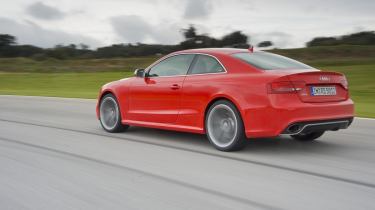
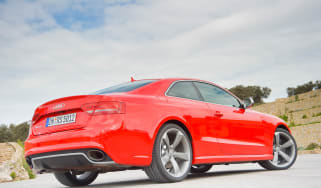
Audi RS5 (2017 - 2024) review – deceptively docile with ballistic performance

The RS5 offered huge performance and refinement, but BMW's M4 always beat it as the choice for a focused, entertaining sports coupe

Evo rating
  • Covers ground effortlessly; superb build quality and refinement
  • Lacks the excitement and precision of its rivals; muted soundtrack

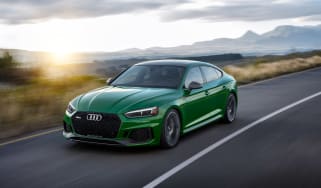
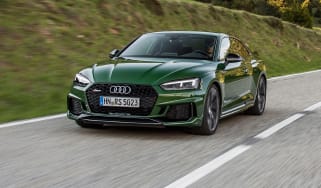
You’ll probably spend your first few miles in an Audi RS5 wondering whether you should’ve bought a BMW M4 instead. There’s almost no drama; its twin-turbocharged V6 is quiet and refined, and with a supple ride and calm responses it feels much more GT than sports car. Stick with it though, because Audi's muscled-up sports coupe has a more aggressive alter ego and exceptional bandwidth that make it fantastic to live with.

Advertisement - Article continues below

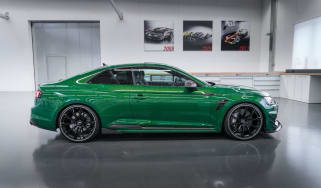
The second-generation RS5 debuted in 2017 and has come to the end of its life (a brand new four-door RS5 is on the way soon). But even today, it remains a desirable and multi-faceted coupe – Audi has always been keen to stress that the RS5 has been designed to cover a wider brief than its rivals, and as a fast, all-weather performance GT it's as convincing as ever.

> The Audi RS6 saloon could be making a return to fight BMW's M5

The trouble is, BMW's M4 is currently at its strongest too, and comes with four-wheel drive, a turbocharged six-cylinder engine and all the usability you could want from an everyday sports coupe. That begs the question: is the RS5 still relevant in its twilight years, or have its newer rivals shifted the goalposts? 

Engine, gearbox and technical highlights

Under the RS5’s crisp bonnet you’ll find a familiar twin-turbocharged 2.9-litre V6. The 2894cc hot-V unit was co-developed with Porsche, and finds a home in an array of Audi and Porsche products, most recently being the sidekick to hybrid offerings in the Porsche Panamera and Bentley Flying Spur ranges. It’s this factor that puts into context precisely what sort of engine the V6 is.

Advertisement - Article continues below
Skip advert
Advertisement
Advertisement - Article continues below

Unlike AMG’s M177 or BMW’s S58, there’s not much in the way of high-end performance components – it’s very technologically advanced, yes, but also fairly unstressed and not designed specifically for the job of making the car it’s in a brilliant sports car. In the RS5, it delivers the same 444bhp as the RS4, and torque sits at 442lb ft available right across the rev band between 1900 and 5200rpm.

As is now common practice in this class, the transmission is an eight-speed torque converter auto, a ’box that shifts very cleanly, and when Sport Manual mode is selected accompanied by a nice little thump in the back, but it’s nothing like as dynamic as the previous dual-clutch, and the unit in BMW’s M4 Competitions seems to have a response advantage, too.

As is usual in high-performance Audis, the quattro four-wheel-drive system splits the engine’s torque 40/60 front to rear, but the system can send up to 70 per cent of the output to the rear axle in extreme situations.

There’s no doubting the V6’s effectiveness when it comes to outright performance, but it can’t match rivals from AMG and Lexus for visceral appeal. This is partly down to the engine’s delivery, and partly the drama-dulling effects of four-wheel drive and a slick, seamless gear change. Also playing its part is the muted soundtrack, which in our post-WLTP era is all too common an issue.

Advertisement - Article continues below
Skip advert
Advertisement
Advertisement - Article continues below

There is something of a muted growl when you really start to work it, but it’s not a noise that has you deliberately holding on to each gear just to hear it again. You are further discouraged from doing this by the small, cheap-feeling plastic paddles on the wheel, which are a far cry from the gorgeous aluminium items on the Alfa Romeo Giulia Quadrifoglio.

The transmission slurs unobtrusively up the gears as quickly as possible. Yet with so much torque available at such low revs, the Audi still accelerates strongly. As a car to use every day on everything from scarred city streets to smooth motorways, the cultured Audi is unrivalled.

Selecting the car’s Dynamic mode sharpens the gear changes, plus it adds some bass to the engine note, as well as a more obvious exhaust rasp on upshifts. It also initiates a strange noise on the overrun that sounds like there’s someone trapped in the boot and they’re playing the drums to attract your attention.

Performance and 0-60mph

The latest RS5 is no more powerful than the original with 444bhp, but it’s both lighter and more torquey, making it significantly quicker both on paper and in real life. For instance, Audi claims the 0-62mph sprint can be covered in just 3.9sec, but we recorded our own 0-62mph time of 3.6sec. For comparison, both the new rear-drive M4 Competition and Mercedes-AMG C63 S will hit the same 3.9sec figure despite their extra power, but this requires ideal and dry conditions. The new M4 xDrive then gets its own back, doing the same sprint in just 3.5sec on paper, and like the Audi, is known to beat this figure with surprising ease in rain, hail or shine.

Advertisement - Article continues below
Skip advert
Advertisement
Advertisement - Article continues below

However, it’s fair to say the RS5 never feels as dramatic as the figures suggest. Make no mistake, the Audi is a seriously quick car that can cover ground with truly indecent haste. Yet the extremely linear power delivery (peak torque of 442lb ft is delivered at 1900rpm) means you’re treated to a smooth and relentless increase in pace, rather than the more exciting top-end frenzy of, say, the M4.

Like all fast German machines, the RS5 is limited to a top speed of 155mph. Yet if you’re willing to fork out an extra £1450 then Audi will raise this figure to 174mph – useful if you live just down the road from an autobahn.

Ride and handling

Audi made a big song and dance about how much effort it put into this generation of RS5 becoming a genuine driver’s car, moving the front wheels forward in the chassis and stiffening the body. A further key aim of the development process was weight reduction, resulting in a 1707kg kerb weight.

The use of aluminium and high-strength steel in the structure means that the body is 15kg lighter than the previous V8-powered RS5. The front and rear axle assemblies are 6kg and 5kg lighter respectively, while the electro-mechanical steering gear shaves a further 3.5kg.

Advertisement - Article continues below
Skip advert
Advertisement
Advertisement - Article continues below

The good news for Audi is that its rivals’ weights have continued to creep up over the years, somehow making the RS5 the lightest car in its class this side of the Giulia Quadrifoglio, with the M4 Competition weighing in at 1725kg.

Elsewhere, the RS5 features a specially developed version of the brand’s quattro all-wheel-drive system. It’s permanently engaged with a standard torque split of 40/60 front to rear – a set-up that’s claimed to deliver more agile handling. Yet it has the ability to vary the torque channelled to either axle depending on the conditions, with the front able to take up to 85 per cent of the engine’s effort and the rear 70 per cent. More importantly, this process now happens more quickly, helping to promote more natural handling characteristics.

Also included on all UK cars is the Sport rear differential, which can shuffle power across the rear axle and, in extreme situations, overdrive the outside wheel for a more rear-wheel-drive feel.

Leave the car to its own devices in Auto mode (there’s also Comfort, Dynamic and Individual, where you can pick ‘n’ mix your favourite engine, steering, suspension and transmission settings) and the RS5 is impressively easy-going. The optional adaptive dampers soak up bumps that would send a shudder through the M4 and C63.

Advertisement - Article continues below
Skip advert
Advertisement
Advertisement - Article continues below

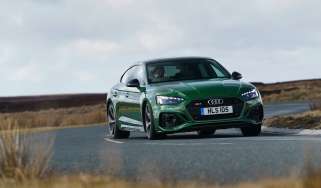
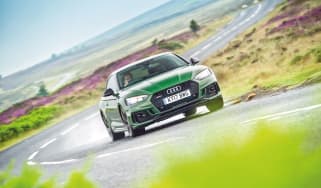
Turn into a corner and it’s immediately clear the RS5 feels light on its feet. There’s prodigious grip up front, and while the steering rack has little to no feedback, there’s a progressive build-up of weight. There’s not the innate precision of an M4 Competition, though, and while there’s relatively good lateral stability to support the steering response, it can feel a little flacid and vague.

Still, the RS5 turns in more eagerly, while the firmed-up dampers help keep it on an even keel during hard cornering. And with the benefit of four-wheel-drive traction, the Audi fires out of corners with the sort of rocket-propelled energy that its rear-drive rivals can’t match.

It’s most certainly all-wheel drive, though. Power hard out of a tight corner and there’s a tiny sense the rear axle is helping rotate the tail, reducing understeer and helping you carry more speed down the next straight. Be more aggressive and in slippery conditions the car will start to slide – but it’s nothing like as playful as the new BMW M4 Competition xDrive, and in dry conditions it can sometimes undermine the RS5’s ultimate body control.

The Audi RS5 isn’t as throttle adjustable as its rivals, either, meaning you have fewer options into and out of corners. Carry a little too much speed into a bend and you get mild understeer, which can be cancelled out by lifting off. However, try to tighten the car’s line with a little more throttle and the Audi washes even further wide.

To really appreciate the Audi’s deep reserves of talent you’ve got to put the dampers into their sportiest settings and really drive it hard. It’s at this point that you can appreciate the cast-iron body control, limpet-like grip and impressive balance. No, it’s not as exciting as its rear-wheel-drive rivals, but as a way to cover ground quickly, effortlessly, and with a modicum of engagement, it’s in a class of its own.

Advertisement - Article continues below
Skip advert
Advertisement
Advertisement - Article continues below

Of course, this requires the use of Audi’s clever Dynamic Ride Control system. Where the standard car can feel a little ragged at the edge under hard cornering, DRC hydraulically connects each of the four dampers to keep the body more controlled. There’s not quite the same night and day difference in feel as in the larger RS6 and RS7 (the system replaces an air-spring set-up in those cars, explaining the bigger difference in feel), but it is a worthwhile addition that helps the RS5 feel more like an RS model and less like just another fast Audi.

Ultimately, the RS5 was never a class leader, treading more of a super GT path compared to the F82 M4 and C63 Coupe it rivalled at its introduction. The latest G22 M4 has taken things to the next level, leaving the RS5 feeling undernourished in terms of capability and speed, but then covering its previous flaws with a brilliant all-round package. The Audi, on the other hand, feels like a project that could and should have been taken forward with more power, more grip and less conservatism to its handling balance.

Interior and tech

Inside, the RS5 builds on the foundations of the standard A5, which means it retains the last of Audi’s previous-generation design language. This means it focuses on exceptional build quality, clarity of controls and haptic feedback beyond that of a digital display. There has been one concession to the touchscreen generation, that being the removal of the old car’s click-wheel interface for the MMI system, which is at least clear and easy to navigate.

Advertisement - Article continues below
Skip advert
Advertisement
Advertisement - Article continues below

The slick interior design is enhanced by some carefully chosen upgrades, including perforated leather around the steering wheel and gear selector, a smattering of RS5 badges and some supremely supportive high-backed seats.

Tech fans can revel in the now familiar Virtual Cockpit, which is standard. Featuring a 12.3-inch configurable TFT screen, it features a host of useful functions, plus a barrage of performance data, such as turbo boost pressure and a G-meter. It’s a quiet and comfortable place to be, too. With the driver modes set to Comfort there’s very little wind and road noise, while the engine settles to a barely audible background hum.

Used price and buying checkpoints

Early 2017 RS5s with around 60,000-70,000 miles on the clock can now be bought for £30,000 – much less than half what a brand-new one will set you back today. Desirable options include the aforementioned DRC dampers and ceramic brakes, but while the latter do provide a useful reduction in unsprung mass, they are ruinously expensive to replace. 

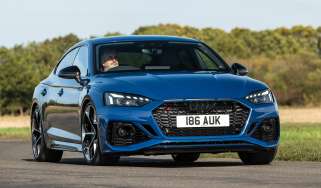
In 2020, the RS5 gained a mid-life update with (very) subtle design changes and a revamped infotainment system, along with configurable RS1 and RS2 drive mode buttons (taking inspiration from BMW M products, no doubt). The pathetic plastic gearshift paddles were replaced by more tactile aluminium items, too. The changes aren’t transformative, mind, and you’ll pay an additional £8000-9000 for a facelifted car. 

Few reliability concerns have cropped up during the RS5’s time on the market, but one potential failure point is the rocker arms inside the engine. The problem isn’t especially common, but cars built before 2019 can be affected. Replacement of the rocker arms with upgraded units, along with a full engine service and a new water pump, can cost up to £4000.

Skip advert
Advertisement
Skip advert
Advertisement