Audi RS7 Sportback Performance (2023–2025) review – an antidote to the hybrid BMW M5
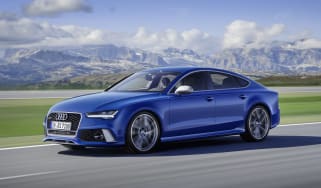
Meaningfully faster, sharper and more involving than its predecessors, the RS7 Performance bowed out as one our favourite modern fast Audis – and a genuine BMW M5 alternative
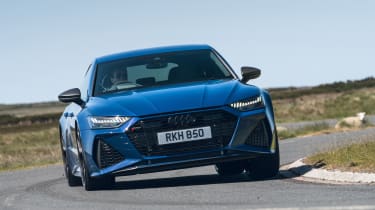
The second-generation RS7 was something of a dark horse; a deeply talented supersaloon (or hatchback, technically speaking...) which proves that big, fast Audis needn't be dull to drive. Having spent a few months with one on evo's Fast Fleet, we really enjoyed its shockingly urgent performance, sky-high quality and the way it seemed to suck up poor road surfaces with no fuss at all to deliver a sense of unstoppable, irresistible omnipotence. Later, we discovered it still tended towards understeer on track and its easy sense of control started to finally unravel, but for the most part the RS7 charmed and impressed.
Later in its life, to add extra drama, noise and performance, Audi updated the RS7 with a Performance derivative. It replaced the standard model in the UK and brought extra bite to the RS7's fiendishly advanced chassis, which includes active differentials and clever hydraulically cross-linked dampers. Naturally, the Performance treatment squeezed even more power from the 4-litre twin-turbo V8, too.
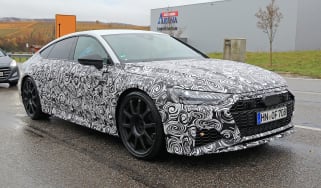
Despite having a relatively short two year lifespan, the Performance made a big impression. While not quite as deft as the F90-generation BMW M5 it competed with at launch, it has an appealing simplicity next to the current hybrid-powered (and much heavier) M5. It went off sale in 2025 to make way for Audi’s next generation of hybrid-powered Performance cars, and its most convincing big supersaloon yet.
Engine, gearbox and technical highlights
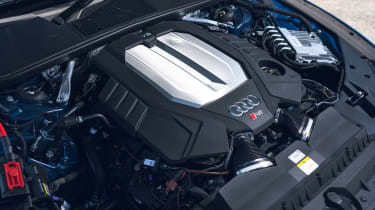
- 4-litre V8 with over 600bhp and mild-hybrid assistance
- Quattro four-wheel drive with rear Sport differential
- Choice between air suspension or a more focused coil spring setup
More reviews
The RS7 Performance’s power comes from a revised version of Audi’s 4-litre, twin-turbocharged V8 TFSI unit, with cylinder-on-demand technology and a 48V mild-hybrid system to reduce fuel consumption.
The Performance-spec V8 gains bigger turbos than before, with power now up to 621bhp – a gain of 29bhp – and torque rated at 627lb ft. The engine is still attached to an eight-speed Tiptronic automatic transmission, with power sent to all four wheels through a mechanical centre diff and a locking ‘Sport differential’ at the rear axle to apportion drive. The standard torque split is 40:60 front-to-rear, while the centre diff can delegate up to 70 per cent of drive to the front wheels or 85 per cent to the rear if the situation calls for it.
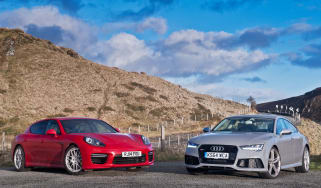
Top speed is pegged at 174mph, although given how massively potent the RS7 feels, you get the sense it could smash through that and on to a much higher maximum with the limiter removed. Its 3.4sec 0-62mph is undeniably quick, but comparable versions of the Porsche Panamera – and the F90 M5 Competition – were even more accelerative on paper.
The mild-hybrid technology – a glorified term for a belt-driven starter-alternator – is primarily there to reduce load on the powertrain, rather than providing any real assistance, but combined with cylinder-on-demand tech is good for fuel savings of around a fifth of a gallon every 62 miles.
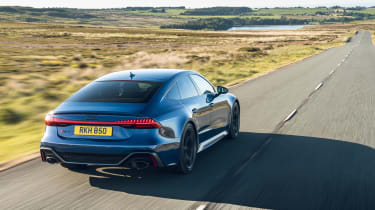
The RS7 Performance was offered with two suspension options that quite dramatically alter the way it feels on the road. The standard set-up is an air spring and adaptive damper combination, with adjustable ride heights depending on driver mode. It’s the optional Dynamic Ride Control system that is unique to RS7s and RS6s of this generation, though, with a combination of hydraulically cross-linked dampers and steel coil springs giving the RS7 more resolute control. Weight saving measures such as reduced sound deadening and lighter 22-inch alloys trim the Performance model down to 2065kg – hardly a flyweight, but comparable to contemporary rivals.
The RS7's axles are 80mm wider across both ends than the standard A7’s, so too are the suspension mounting points, while there are much stiffer bushes in the wheel carriers and upper suspension arms. The layout is actually quite simple, lacking the double-wishbone front suspension design of key rivals, but the set-up is so beefy it hardly seems to matter.
The ceramic brake package pairs massive 420mm front discs with ten-piston callipers; the rears have a smaller 380mm disc and six-piston combination. There's also four-wheel steering, which is fully 3D mapped so isn’t just programmed to give you a certain angle at certain speeds, as earlier systems did.
Now its behaviour changes constantly depending on load, steering input, speed and a multitude of other factors. Depending on how you’re cornering, in other words, those rear wheels could be pointing in the same direction, or the opposite direction to the fronts – whatever is optimal for a given scenario.
Driver’s note
‘The way the RS7 gets into and out of a corner – the sense of it finding front-end grip then pausing slightly to square the apex, hunker down and punch out onto the straight – is a real Audi hallmark.’ – Richard Meaden, evo Editor-at-Large
Performance, ride and handling
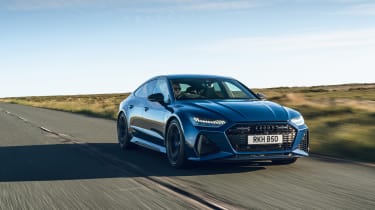
- More vocal and aggressive than the non-Performance version
- Sensation power and surprising agility for a two-ton saloon
- Four-wheel drive system isn’t as adaptable as BMW’s xDrive
The RS7's engine is an absolute force of nature. There’s a bit more lag than the previous non-Performance model due to the bigger turbos, but you only really notice it in Efficiency and Comfort modes, where the programming for the eight-speed automatic gearbox is set very conservatively. Utilise the paddles and that problem disappears.
There’s so much torque and the delivery has a steely, pulverising energy as the revs increase. And yes, there’s more aural drama than before thanks to less sound deadening. It’s now somewhere between a rollicking AMG soundtrack and the subtler BMW M5’s, which feels like a great balance for a car of this type. It imbues the RS7 with character even at everyday speeds.
Amazingly, the RS7 rides really nicely even on the optional Dynamic Ride Control chassis, and the electronically adjustable dampers and steel springs provide a much greater sense of connection and control than the standard air springs.
In Comfort mode, the RS7 Performance is a shade louder than the standard car and the engine certainly feels more present than before, but it’s still a deeply refined saloon; and there’s a palpable sense of massive potential just lurking beneath the surface.
Not everything is rosy, though. The four-wheel steering certainly makes manoeuvring very easy but the rack is too light, conveys very little real information and creates a jumpy, unnatural feeling. It improves as you ramp up through the modes (there’s Efficiency, Comfort, Auto and Dynamic, plus customisable RS1 and RS2 options) but the digitised sensation never disappears entirely.
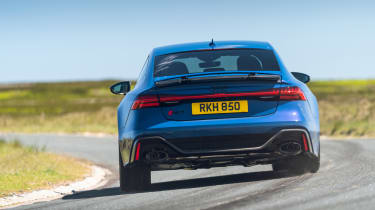
Similarly, body control from the Dynamic Ride Control Chassis is lacking in Comfort mode when you start to push, but cycle up to Dynamic and the ride deteriorates markedly, the supple, light-touch character becoming stiff and the car skittering across crumbling roads.
Our test car was equipped with Pirelli P Zero tyres rather than the Continental SportContact 7s Audi highlights in its press material, but grip and accuracy were not lacking. Just as before, the outright balance on the road is fantastic. The steering is perhaps a bit too quick for such a big car but it does create fantastic responsiveness, and whilst the ride can be unforgiving the body stays spookily flat.
Understeer? You’ll simply never encounter it on the road with 285/30 ZR 22 tyres. The RS7 just grips and goes where it’s pointed. In fact, the Sport Differential makes the RS7 Performance feel more tail-led, as it pins the front axle to the road every time you load it up with torque. It’s a lovely sensation. If only that athleticism was followed through at the limit.
The M Division’s xDrive system is the benchmark in this space and its natural, progressive feel easily shades the RS7’s tendency to hang on hard, then tie itself in knots as it shuffles grip around. Where you crave fluidity, instead there’s an oddly jumpy, uncomfortable feeling as each corner fights for traction. Efficient but brutal, and at odds with the RS7 Performance’s usual MO.
Driver’s note
‘The RS7 has a choice of modes and settings, but they aren’t quite so granular as a G90 BMW M5’s, and the changes don’t make such fundamental shifts in the car’s character and behaviour. They are meaningful, however – the Dynamic setting for the Sport Differential especially, which dials in a welcome degree of agility.’ – Richard Meaden, evo Editor-At-Large
MPG and running costs
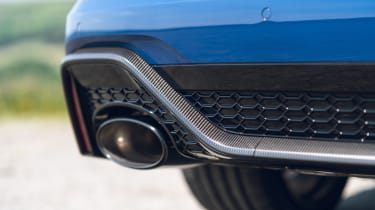
While a 621bhp two-ton supersaloon is never going to be efficient, all of Audi’s little eco-minded details do add up to something that’s merely thirsty, rather than irritatingly so. Stay at a cruise, leave the drive-select mode in Auto and it’ll schlep up and down motorways and even potter around town while returning nearly 30mpg. Put your foot in it though and things change very quickly, diving down into the teens when you make full use of the loud pedal.
Consumables are another matter, as the RS7 will not be an inexpensive car to run thanks to the big tyres, brakes and engine. If the near-£10,000 price of those ceramic brakes turns you off, at least you’ll theoretically not need to change them any time soon, however stick to the still huge steel discs and come change day it’s likely to be a painful bill. The 22-inch Continental SportContact 7 tyres will also take a beating thanks to the forces exerted on them.
Interior and tech
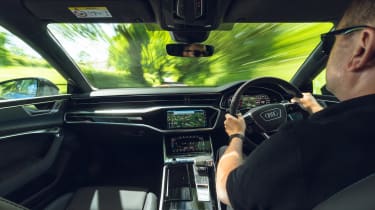
The interior is typical of Audis of this period, more tactile and less digital heavy than what you’ll find in newer models. While it may share an awful lot with far less expensive A6 and A7 derivatives, its slick tech integration and overall build quality are strong enough to not be an overriding problem.
All RS7s come with pattern-stitched leather seat trim as standard, with optional carbonfibre trim inlays lifting the otherwise minimalist cabin design. Audi's RS Design package brings a blend of alcantara and leather trim for the major surfaces and moves the cabin a step beyond the previous non-Performance model, which could feel a touch bare inside as standard.
Though the tech isn’t especially advanced by modern standards, it is relatively intuitive to use. With a bit of familiarity, the twin-screen infotainment system is clear and responsive enough to become second nature, and integrates all the basic features you’d need without being bewildering to work with.
Audi RS7 long-term test
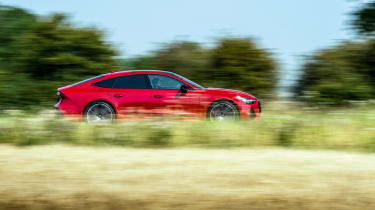
There were many times during the nine months with our Audi RS7 that when you let the (£650) power-close frameless door shut and sank into its diamond-stitched seat, a much-needed barrier between you and the outside world was formed, a calmness washing over you, secure in the knowledge that, a stage from the Group B era of the World Rally Championship aside, Audi Sport’s five-door coupe wasn’t going to be phased by anything it might stumble across. And that was despite it being the non-Performance version.
Knowing you had the key to the telephone box red Audi to take you home at the end of a challenging day or a long flight rarely led to negotiations to swap into something a little more hardcore. The fastest of the Audi Sport coupes blended its violent performance with restrained sophistication and a chassis that made for not only one of the best driver’s cars Audi has produced outside of the R8, but one of the best supersaloons on sale, too. In short, there were more times than not when the RS7 proved itself to be worthy of its place on the evo Fast Fleet, even if there were some who would rather it had been an example of its more famous RS6 brother instead.
A number of things contributed to the RS7’s great appeal. Its twin-turbocharged V8 lacked for nothing in the horsepower and torque stakes, with 592bhp and 590lb ft respectively. Wound up and let off its leash it could arrive at the horizon far quicker than any car the wrong side of 2000kg had any right to. Yet despite the V8’s willingness to rev to the higher echelons of its range, it always felt more natural when you operated around its mid-range, surfing that torque and dipping into the more flamboyant power when required rather than all the time.
A good supersaloon has always managed to deliver its sizeable performance advantage over its more restrained siblings without drawing unnecessary attention to itself and this was where the RS7 excelled. Its ability to clear slower traffic with such efficiency made the process not only effortless but also safe, your time exposed to danger reduced to the minimum. Add in the ability to run with the exhaust valves closed regardless of the engine mode selected and you could do so in relative silence, too.
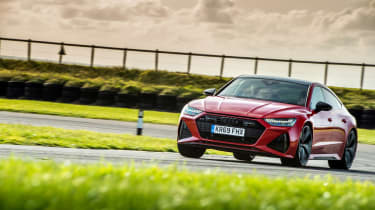
Not that a Tango red RS7 blended in. In a more subtle shade it would have been far less overt and shouty, and a better match for the interior, which blended some fine materials with a design and ergonomics that just seemed to work. There was no standout element to why this was, it just did, with a simplicity that felt so natural.
While the seat didn’t drop you low in the cabin like those of a Panamera, you did feel you were sitting in rather than on the RS7, which added a great deal to the feeling of connection and isn’t always a given today. Only the lacklustre gearshift paddles let the side down. The powertrain responded so well to the driver using manual mode, the shift speeds snappy once you’d dived into the Drive Select software, but the paddles felt like cheap buttons rather than an extension to a sophisticated eight-speed gearbox; Audi needs to put a call in to Lamborghini’s supplier and order the Huracán’s paddles.
It’s what’s under the RS7’s skin that made it capable of stepping out of the shadows of its more famous rivals, though. Our example was equipped with the optional RS Sport Suspension Plus with Dynamic Ride Control and carbon-ceramic brakes, these two adding £11,000 to the car’s 2019 £97,090 list price, which includes four-wheel steering and a torque-vectoring rear differential as standard.
By ditching the standard air suspension in favour of fixed-rate springs and three-way adjustable dampers interlinked via diagonally opposed oil lines, KR69 FHX was the most dynamically tuned RS7 available. There was no trade-off in ride quality and the combined chassis tech resulted in a big, fast Audi that was genuinely engaging to drive. It didn’t make you work for the rewards or go looking for its ability, either, it was just always on. One minute you could be meandering along a high street, backside being chilled, V8 barely ticking over, the next you were alone on a road you know well and the RS7 was ready for whatever you threw at it. Alert, responsive, light on its 22-inch Pirellis; a car in complete control.
It had an unexpectedly welcome level of body control, it turned in with a keenness that’s lacking in the supposedly more dynamic RS4 and RS5 models, and its steering, especially in Dynamic mode, reacted exactly as expected with no surprises and none of the numbness and remote feeling of Audis of old. It always felt like a totally resolved car. Until it went on track, that is, where its bulk worked against it, turning a lithe road car into a rather blunt instrument, as we discovered at eCoty in 2019.
Then again, you wouldn’t buy an RS7 as a trackday car. You would, however, buy one if you were looking for a do-everything family performance car.
Prices, specs and rivals
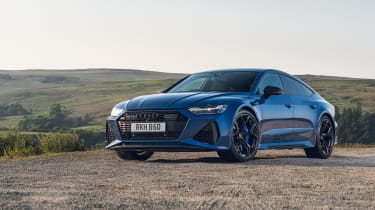
At the end of its life the RS7 Sportback was available in three forms in the UK, each in Performance spec. The base car certainly wasn't cheap at £115,225, but then it did come fully loaded from the outset, with 22-inch wheels, laser-assisted matrix LED headlights and all the other usual high-end German-car fodder. In terms of performance hardware, standard RS7s ride on adaptive air suspension as standard, with Audi’s Sport Differential also included.
Upgrades for the higher Carbon Black trim were mostly aesthetic, with carbon inlays, grey detailing inside and matte black styling accents. Carbon Vorsprung added to this some high-end options such as a panoramic sunroof and Audi's Dynamic Ride Control DRC suspension system.
Today you’ll need to spend just over £50k for a second-hand base RS7 with sensible miles, with later Performance models costing just under £80k. That’s a huge range in which some very desirable supersaloons sit, such as the F90-generation BMW M5 Competition and the last Mercedes-AMG E63 S. For something more subtle but even more potent, there’s the Panamera Turbo S E-Hybrid from Porsche, too.