The best all-season tyres 2021
Our comprehensive test aims to help you choose the best all-season tyre
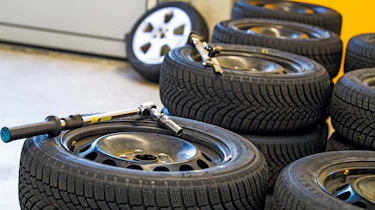
As their name suggests, all-season tyres are designed to operate across a wide range of weather conditions and temperatures. This makes them ideally suited to the UK, where sometimes it can seem as if we get all four seasons in the space of a month, let alone a year.
Come sun, rain or snow, then, all-season tyres should have you covered. They could even render winter tyres obsolete (in the UK at least), negating the need for a second set of tyres. This is made possible thanks to a combination of unique compounds and tread patterns that prevent the tyres from hardening in colder temperatures (unlike summer tyres), bringing greater levels of grip and traction in such conditions.
However, all-season tyres are also inherently compromised due to their remit; dedicated winter tyres will better handle the extremes of a British winter, while a good set of summer tyres will deliver more grip and traction in warmer, drier conditions.
How we tested them
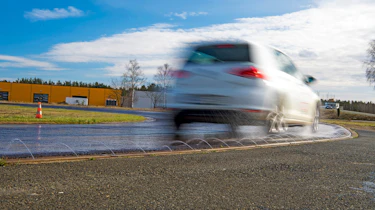
We visited two test facilities – one in Finland, the other in Germany – to assess the eight tyres – all measuring 205/55 R16 – across two dozen metrics. The former location provided a more extreme environment in which to test the tyres, at and over the limit, while the latter offered conditions akin to the UK’s. To contextualise the results we exposed a summer and a winter control tyre to the same tests, too.
Each tyre was attributed a percentage score in each of the individually weighted categories. The winner in each test was awarded 100 per cent and the rest were graded in reference to it. The scores of each tyre were then totted up to provide an overall average score for that tyre.
The tests
Snow braking and traction
We looked at these two factors in one combined test, by recording times for acceleration from 12 to 31mph, and then the distance required to slow back down to 6mph. Each tyre was subjected to several runs, and an average of the results was used. The tests were carried out at Hankook’s Technotrack facility in Finland.
Snow handling
Compressions, cambers, tight turns and long sweepers on this snow-covered track put the tyres to the test. The tyre that enabled the fastest lap was the winner here, implying the best balance and best lateral grip and traction in turns. Average lap times were taken.
Straight aquaplaning
We moved to the Contidrom test facility near Hanover for our wet tests, and the aquaplaning performance was measured on a rail system with one tyre in 9mm of water while the other gripped dry tarmac. Multiple runs were carried out to find the speed where the tyre in the water lost grip – measured as the point where it was spinning 15 per cent faster than the dry tyre.
Curved aquaplaning
Water depth was reduced to 6mm for this test, and the car was driven at increasing speeds through one flooded section of a full circle. We measured G-force at the point that grip was lost.
Wet braking
The Contidrom’s rail system was employed again to make sure all the tyres braked on the same patch of tarmac. Stopping distances were measured from 50mph, over a repeated series of runs.
Wet handling
We completed a series of timed laps of the handling circuit at the Contidrom facility, and took average times to gauge relative performance over the track’s challenging twists and turns.
Wet circle
Continuous circuits on a slippery, watered-covered surface allowed us to get a comparison for pure lateral wet grip.
Dry braking
We hit the brakes at 62mph and measured the distance taken for the car to come to a halt.
Dry handling
Unfortunately Covid-related travel restrictions meant we were unable to carry out dry handling tests.
Rolling resistance
This measures the force needed to turn a tyre, which has a direct impact on fuel economy. The more force required, the more fuel the car will use.
Cabin noise
We hooked up a sound meter on the car to measure noise levels as the car drove at 62mph over smooth tarmac.
Price
Price had a small influence on the overall result, with the emphasis placed on performance. Prices came from Blackcircles and were correct at the time of publishing.