Is Bosch's new AI 'track assistant' the ultimate cheat code for lap times?
A system that gets inside your car’s electronics to help you nail the perfect lap is being developed by Bosch. We put it to the test

We’re really motoring now, on the fastest part of the track approaching a hairpin turn. Above the sound of the Aston DB12’s V8, my passenger, Pascal, shouts: ‘Don’t brake, let the car do it!’ I’d be reluctant if I hadn’t already experienced the interventions of this trackday system that’s trying to help me find the perfect corner speeds and lines around this circuit. So I simply back off where I’d normally go for the brake and the automated braking instantly takes over, slowing the Aston on the cusp of anti-lock to the ideal speed for the left-hander as I steer for the apex. If you think that’s strange, I could have done the whole lap with my foot planted on the throttle.
Bosch calls this new system Track Performance Assist, though until very recently it went by the more colourful moniker of Track BEAST: Built and Engineered Application Suite for Tracks, if you will. It’s not yet production-ready, partly I think because Bosch hasn’t decided the best use for it. It leverages the German firm’s expertise in software, satellite navigation, cloud computing and vehicle systems such as stability control. First you need to know the car’s ability in detail: its performance and braking potential, lateral grip, active damping and any aero effect. This is used to create a Kamm’s Circle, a 3D model of its capability. You also need a precise map of the circuit, including its topography, then AI combines car and track and generates the perfect lap.
Plugged into the car’s CAN bus, Track Performance Assist (TPA) has the ability to control the engine’s output, the level of traction and stability control and the braking. Using the Aston’s rotary mode selector, the system allows the level of interventions to be controlled, scaling from 1 to 8, strong to light. Sensibly we start with 1, which gives 60 per cent of engine power and early brake interventions.
The Aston feels a bit big for this circuit, which is not well-sighted, so the system is quite active as I try to learn where it goes. Without the system I’d be running wide of the line here and there, braking too late for the turn over the brow and generally feeling a bit clumsy. I still feel clumsy but the system is reining in my excesses, adding braking effort to my pedal input and not allowing acceleration that would push the car off line.
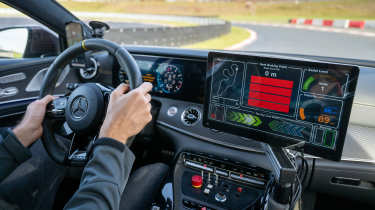
There is a large monitor attached to the centre of the dash, which shows lots of data, including distance to the next brake point and whether you’re on the perfect line, but I’m far too busy to even glance at it.
As I learn the track, the interventions lessen and Pascal reduces the assistance, though it’s always there in the background. By the time we’re up to level 7, I have a good feel for the layout of the circuit and I’m pushing on, and now I’m having trouble distinguishing how much of the braking is me and how much is the system.
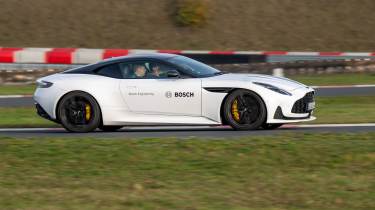
On the fly, Pascal adds a new feature – a voice prompt for braking points that says ‘And… Brake!’ It comes from the Aston’s rear speakers and it’s like having a co-driver. The car is on well-used tyres and at level 8 it’s pushing wide in places, so I feel I’m properly driving it, managing the grip. It feels all down to me, but I know that if I’m close to the limit, the car will tidy the edges.
If this was a trackday, this would be a good time to take a break and review how it’s going, and that’s what we do. Have I got to grips with the track any quicker with TPA than I would have without it? I’m not sure. Have I got on the best lines for the optimum lap time? I’m happy with where I am but know there’s more to be had because you won’t be perfect in a dozen laps. So how do I measure up to the AI-generated optimum?
I’ve seen traces from plenty of data-logging systems. TPA is interesting because it includes optimum distance as well as expected lap time. On the speed trace I’m not race-driver ruthless, not jumping from throttle to brake to make shark-fin spikes in the trace, but I’m hitting the maximum braking on most corners. But still I don’t know how much is me, how much is TPA making me look good.
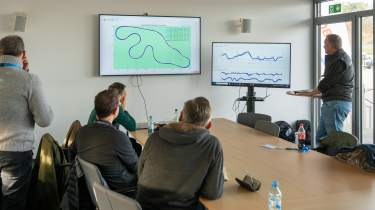
My lines overlaid on a circuit map and compared to the AI optimum are much less satisfactory, which is more interesting. I’m driving the classic ‘wide in, fast out’ style whereas AI is ruthlessly finding the shortest route, braking hard on a tight line into the apex on some corners. Anecdotally, some pro drivers who’ve tried TPA have been shown their ‘imperfect’ line, scoffed, but then tried the AI line and improved their lap times. I’m sure that would work for me here.
Thing is, instead of going back out with the ideal lines in my head and trying to implement them, it would be much better if the system could better guide me onto the ideal line than the current display. But not through steering interventions. Bosch isn’t keen for this either, knowing from its Lane Keep Assist technology that many drivers loath such interference.
So how to guide drivers? Bosch looked into using the head-up display (HUD) fitted to many cars, but it doesn’t work because the perspective is wrong. It’s perhaps problematic that an excellent guide to lines and braking points already exists, in the Gran Turismo video game... For now, that final element in nailing the perfect lap remains tantalisingly out of reach.
Bosch has done most of the heavy lifting; Track Performance Assist offers a safe way to let any driver enjoy a serious performance car risk-free on a circuit. Well, almost risk-free. It plans to map 200 tracks; currently 30 are digitised, including the Nürburgring Nordschleife, which raises the one limitation with TPA: it can’t detect changing conditions, which might be a rain shower on one part of the circuit.
This story was first featured in evo issue 341.