Hydrogen could be the future of supercars, and Bosch has built a Maserati-engined prototype to prove it
Bosch targets Le Mans with hydrogen-fuelled Maserati-engined race car

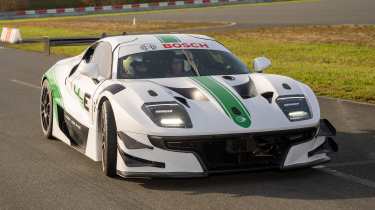
There are a few good reasons why using hydrogen to directly power cars is a good idea and we’ll come onto them a little later, but the best one for enthusiasts like us is apparent the moment this prototype fires up: it sounds glorious, a heavy, rich, loping V6 drawl that’s indistinguishable from the sound of one burning hydrocarbon fuel. Yet there is no aroma, even if you drop on one knee and stick your nose in one of its tailpipes.
Built for Bosch by French sports car constructors Ligier, the JS2 RH2 looks like a cross between a road car and a race car, which is pretty much on the money because the front is LMP3 racer while the bodywork and the rear end housing the Maserati twin-turbo ‘Nettuno’ V6 and eight-speed DSG gearbox, is bespoke. It was demonstrated at this year’s Le Mans and the target is to have a race car ready for the planned hydrogen class in 2028, with road cars to follow.

This car runs on gaseous hydrogen stored in three sausage-shaped tanks, one in each sill and one behind the seats. Liquid hydrogen is 40 per cent more energy-dense but much harder to manage because it is only liquid at -253deg C. Even then, it is much less energy-dense than petrol, so large, insulated tanks are required for the sort of range we are used to.
The main prize with hydrogen is much lower emissions, with 0.8 per cent CO2 (about the same as in the atmosphere) and very low NOx and HN3 (ammonia), which are created because the atmosphere is a blend of gases including nitrogen. Another big prize for powering ICE vehicles with hydrogen would be autonomy; markets such as Europe with legacy ICE industries would be able to continue, saving many jobs.
Mechanically, the Maserati V6 is substantially standard, the only modifications being to the fuel system. It has bespoke injectors with much higher flow-rates, water injection to control combustion temperatures and the combustion process, plus bespoke ignition and ECU. The only clue that it’s not a conventional ICE car is the hiss as the hydrogen fuel system is primed and a lag of 10 seconds after you’ve killed the ignition as the tank valves close and the hydrogen in the system is used up, one bank at a time.
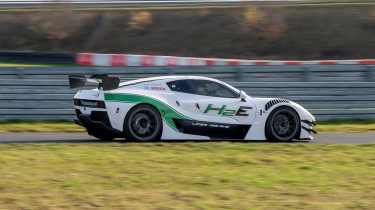
Unsurprisingly, it drives like an ICE car, too. It has a carbon monocoque but, due to the hefty tanks plus a water tank for injection, it comes in at just under 1500kg. Revving out or hauling low revs in a high gear, there’s no difference in the delivery, no sense that it’s anything but a regular ICE car. It makes 600bhp but with more modifications to suit hydrogen could make 20 per cent more, says Bosch.
In a future of humming EVs, a car with the full-throated roar of internal combustion sounds like heaven. In truth, creating hydrogen ICE cars is the easy bit. Synthesising the hydrogen with sustainable energy so that it’s green – currently most is derived from hydrocarbons – and building the infrastructure to deliver it are much greater challenges.