The ultimate supercars of the 1990s – car pictures of the week
Our Eras tests travel to the 1990s, where the genre evolves beyond all recognition compared to two decades earlier

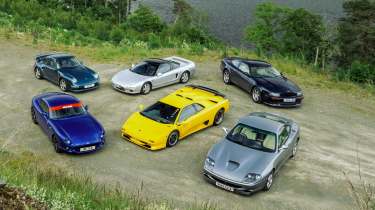
The 1970s was genesis; the 1980s was evolution. The 1990s? That’s when the supercar as a genre started to get out of control, with the arrival of the McLaren F1 cementing the hypercar genre that 1987’s Ferrari F40 seeded. Closer (but not completely down) to Earth, the descendants of the stars we drove in our 1970s and 1980s Eras tests are the most varied yet, for our 1990s supercar Eras test, from which these are our favourite shots.
The Lamborghini Diablo is familiar still – V12, mid-engined, rear-driven, manual, spectacular and scary. Likewise the Aston Martin Vantage V550, being bigger, heavier, more bombastically powerful and imperious than ever. The Porsche 911 Turbo still looks familiar but has rounded edges and is now all-wheel drive and more sophisticated.
Everything else has changed. The Ferrari? Its 12 cylinders are now ahead of the driver, the 550 Maranello reviving the long-legged Ferrari super GT after two decades of Boxers. TVR is on the scene with their wild Cerbera, likewise Honda with its razor-sharp, usable NSX, schooling the rest of the scene on quality and lasting engineering. This is our supercar snapshot of the 1990s, a period that represented unrelenting change but also the evolution of form factors we grew to know and love in the 1970s and 1980s.
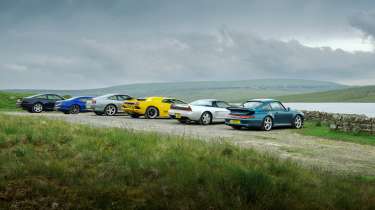
‘As the six cars we’ve chosen to represent the ’90s assemble at our rendezvous point on the Scottish Borders, it’s clear this was a decade of change. Designs may have become more rounded but the supercar had splintered into different directions.
‘New players had joined the game: Honda launched its own take on the formula with the NSX, and TVR graduated from sports car underdog to fully fledged member of the supercar league with the Cerbera. Four-wheel drive had joined the party, employed to great effect in Porsche’s rocketship 993 Turbo. Front-engined cars enjoyed a resurgence, from Dodge Viper to Lister Storm, and the line between grand tourer and supercar became ever blurrier.
‘New technologies abounded: ABS, ECUs, traction control, airbags (triggering perhaps the ugliest decade of all for steering wheels). CD slots joined cassette units; carbs gave way to sophisticated fuel injection, and cats found their way into exhausts; tyre sidewalls became shallower, while damping progressed in leaps and (re)bounds, in some cases via electronic control.
‘At the same time, an upper tier was forming in the supercar world. Following the Ferrari F40 and Porsche 959’s flirtation with the 200mph barrier in the ’80s, the likes of the Jaguar XJ220 and Bugatti EB110 would push the ceiling yet further in the early ’90s, before the McLaren F1 moved the goalposts forever. In hindsight, we could say it was the dawn of the hypercar. But that’s another story. In these Supercar Eras tests we’re concentrating on the ‘core’ supercar below the hypercar stratosphere, as a capsule of the design, technologies and trends that defined each decade.’ – James Taylor, evo Deputy Editor.
Read the full test in issue 349 (September) of evo Magazine, available to order to your door from the evo shop.