Renault Mégane RS (Mk4, 2018-2022) review – the flawed but underrated Civic Type R rival
The difficult fourth-generation Renault Sport Mégane had its moments of genius, even if they weren’t as profound as its unbeatable predecessors
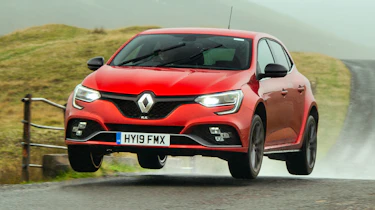
Renault reinvented the Mégane RS in 2018 making comprehensive changes to the beloved French hot hatch. Now available only as a five-door hatch, there was also a new 1.8-litre turbocharged engine, the option of a paddleshift gearbox and rear-wheel steering, this was set to be at once a more grown-up and capable Mégane. Changes that were to affirm the model’s tier-one status in an expanded hot hatch market, one that now included Hyundai’s i30 N and the reinvented FK8 Honda Civic Type R, along with the Mk7.5 Volkswagen Golf GTI and Ford Focus ST. The result was a Mégane RS that was less sure of what it wanted to be, that at times wasn’t involving enough and at others, too hard-edged for its own good lacking the cohesion its predecessors had become known for.
Renault produced plenty of versions of its Mk4 Mégane RS, with Cup and Sport chassis set-ups, 276 and 296bhp power outputs and both manual or dual-clutch transmissions to pick from. There was also a Trophy and a more hardcore Trophy R version. Don’t get too confused by later cars which became RS 300 and RS 300 Trophy in 2021, as these models still have Sport or Cup chassis setups as per before.
Engine, gearbox and performance
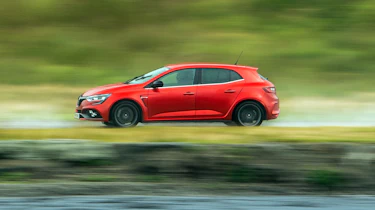
- The 1.8 feels more muscular than its size would suggest
- More characterful and exciting than some of it rivals
- Neither the manual or EDC ‘box are perfect. Try both to see which balances annoyance with enjoyment best
More reviews
In-depth reviews
Reviews
- Renault Sport Mégane R26.R (2008 - 2009) review – Dieppe's finest hour
- Renault Megane E-Tech 2022 review
- Renault Megane RS sport chassis (2017-2020) review – forget the Trophy, basic is best with the Megane RS
- Renault Megane RS Trophy (2019-2020) review – is this Renault Sport’s redemption?
- Renault Megane RS cup chassis (2018-2020) review – sharp, even when you don't want it to be
- K-Tec Racing Mégane review - Renault Sport's impressive hot hatch gets 360bhp
The 1.8-litre turbocharged four-cylinder produces 276bhp at 6000rpm, with a 288lb ft torque plateau delivered between 2400 and 4800rpm providing the RS with a healthy mid-range punch.
The 300-spec engine, arriving on the Mégane Trophy models from 2019 and becoming standard from 2021 when the facelifted model was introduced, produced an additional 20bhp to raise the peak power output to 196bhp. The 300’s extra power was down to alterations made to the cylinder head courtesy of Renault’s Formula 1 powertrain engineers, a faster reacting twin-scroll turbocharger, a Nissan GT-R-style mirror coating on the cylinder bores and a higher capacity, dual-intake induction system.
While the original Megane RS models were available with either the standard six-speed manual gearbox the optional dual-clutch automatic was the only option from the facelift onwards For the 300 Trophy, the EDC box allowed the full 310lb ft of increased torque, which was trimmed to 295lb ft in cars fitted with the manual transmission.
With only around 1400kg to haul around, the fourth-generation Mégane RS was one of the lighter cars in its class. It made for a sprightly at the time 0-62mph time of 5.8sec for the 280 models (identical to a Honda Civic Type R), with a 155mph limiter. 300 models reduced that time to 5.7sec and raised the top speed to 162mph.
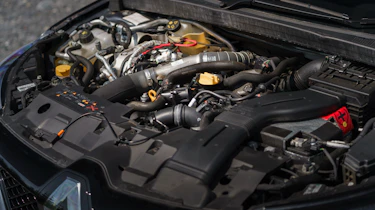
The engine feels far stronger in the Mégane than it does in the Alpine A110 with which it’s shared, even more so than the 1.8-litre figure might lead you to believe. Not only is it powerful, it feels sophisticated too, with more character than a latest-gen EA888 from the VW stable and more enthusiastic than the Hyundai i30 N’s Theta unit.
With an initial pump of torque at low rpm, the Renault’s engine will quickly build steam and just keep on revving to its red line without any distinct reduction in momentum. It might be one of the best hot hatch power plants of its era thanks to its tack-sharp responses, its willingness to spin to the limiter, meaty soundtrack, and, of course, is properly fast.
Race mode adds a mask of thrummy, synthetic noise from the speakers, which not only doesn’t sound very appealing, it’s barely like an engine noise at all. Thankfully you can have Race mode response without the fake noise in Perso mode.
Make no mistake, the Mégane’s EDC gearbox is a vast improvement over the Clio’s similar set-up, but the six-speed unit still lags someway behind the best. It’s smooth and seamless enough when left to its own devices, while it responds fairly crisply to the (slightly small) column-mounted paddles.
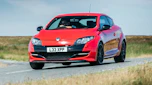
However, it will shift up automatically even when manual changes are selected in Sport mode (you need Race for total control over the electronics), while downshifts can be a little jerky. Select Race and the changes are delivered with a jolt that’s clearly designed to hint at race-bred sportiness, but which actually proves to be irritating.
Conversely, the manual gearshift is quite notchy and its lever an awkward shape, but once you’ve learned it you can whip through changes as quickly as your arm will move, while the pedals are well-spaced for heel-and-toe shifts. T wasn’t a great loss when it was dropped from UK models and only highlighted that regardless of the transmission it was the Megane’s achilles heel.
Ride and handling
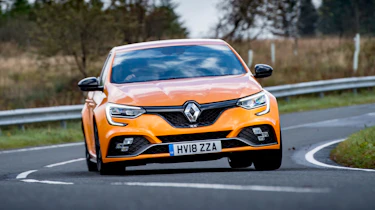
- Cup or Sport? It’s a matter of taste. Ultimate control and regular track use demands the Cup set-up
- Sport offers more on-road compliance and a calmer less frenetic demeanour
- All-wheel steering demands your trust before you can fully enjoy the car
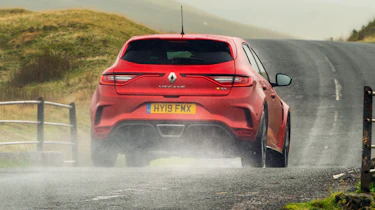
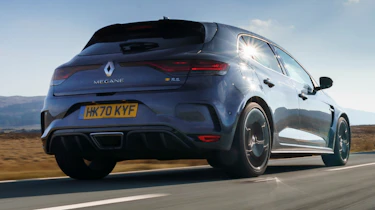
Bulging wheel arches hide front and rear tracks that were widened by 60mm and 4mm respectively, while at the rear is an aggressive diffuser that reduces lift to negate the need for a Civic-style spoiler. 18-inch alloy wheels were fitted as standard and came wrapped in Michelin Pilot Sport 3 tyres, while cars equipped with the optional Cup chassis got 19-inch rims fitted with Bridgestone S001s.
There are many attributes from Renault Sport Méganes that are familiar here, such as strong engine, excellent body control and impressive traction. Where this model behaves very differently from its predecessors is mostly down to the 4Control all-wheel-steering system. It features electronic actuators on the rear wheels that can steer them up to 2.7 degrees in the opposite direction to the fronts for agility, or up to 1 degree in the same direction for stability when changing lanes on the motorway.
Important to remember is when that changeover happens: in all modes other than race it’s at 37mph, with the most extreme drive requiring you to be travelling above 62mph. Only the ultra-hot Trophy R track special omits the all-wheel-steering hardware.
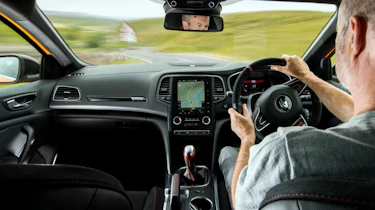
There’s no denying that the sensations you feel in the first few miles are a little unnerving. Through a roundabout, for instance, there’s the curious feeling of the rear of the car swaying from side to side as you twirl the wheel this way and that. Point the nose into a fast corner and you’ll find yourself having to open the steering just a fraction as the Renault turns in quicker and more sharply than you anticipate.
However, get past the initially unsettling reactions and the slightly lifeless yet precise steering and you soon learn to appreciate and exploit the set-up. It makes most sense in Sport or Race settings, where the system reacts faster and, in the case of the latter, continues to turn the rear wheels in the opposite directions as the fronts at much higher speeds to deliver the sort of angle of attack that usually happens when the rear of the car has come unstuck and is gently rotating.
It’s eerie at first, but learn to trust it and the Megane can carry impressive speed through a series of bends. It changes direction with such precision and ease you long for a tight and twisty road for you to lead it down, repeatedly jinking one way, then the other.
Renault Mégane RS – Sport chassis v Cup chassis
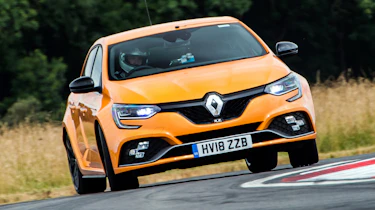
The Cup chassis combines a stiffer set-up of the usual MacPherson strut front suspension and a multi-link rear. The passive dampers, springs and anti-roll bars are stiffer than on the Sport chassis by 25, 30 and 10 per cent respectively.
The more fluid Sport chassis set-up has an impressive compliance and excellent composure over ridges and bumps in the road. Paired with the hydraulic bump-stops, there’s impressive reach into the tarmac, not feeling entirely unlike an Alpine A110, in fact. Even the four-wheel steering feels more natural than in the Cup, perhaps because the extra suspension movement takes the edge off those quick, unsettling movements across the rear axle.
Ultimate body control is lacking by comparison, however, as when you start to really exercise the chassis’ almost otherworldly agility the suspension can struggle to keep up. The Cup’s freneticism and discernible reduction in compliance is made up for by the immense resilience it has to pitch and dive. Compressions and crests are dealt with without any fuss, and if the tyres do leave the tarmac the car returns to earth smoothly. There is some roll, but it’s kept to such a minimum and is so well contained that all it does is help you gauge the levels of grip, which, as it turns out, are huge.
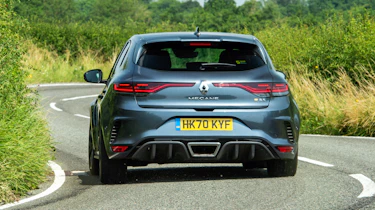
A boon for the Cup is its Torsen type limited-slip differential as opposed to the old car’s GKN mechanical locker. Jump on the throttle early in a bend and the diff gives the front axle incredible bite and helps lock the tyres on the trajectory you’ve set with the steering. The rear axle engages so responsively that it makes the car feel as though you could maintain the same radius no matter what speed you’re travelling at, without the front or rear tyres losing grip.
Just as long as you keep your foot on the throttle. Lift off, and in traditional hot hatch style the back end will want to break wide, but the feeling can vary markedly depending on the amount of grip available and the surface, varying between graceful and controllable to spikey and just a bit scary.
Another option for the Cup was the cast iron and aluminium composite front brake disc set-up, which results in a total saving of 3.6kg in unsprung mass. As with the standard set-up, these discs are 355mm in diameter and are clamped by Brembo calipers. They do a fine job of shedding speed. The pedal action is a little sensitive at the top of the travel, but beyond this the set-up is progressive, powerful and easy to modulate.
What’s the interior like and is the tech any good?
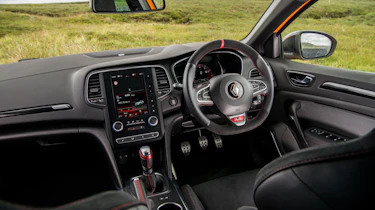
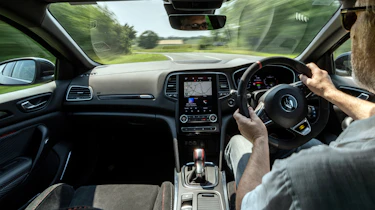
While Renault’s general seating positions got much better over the years, the Mégane still requires some acclimatisation when you hop in, especially given the oddly tall dashboard
There was an attempt by Renault to make the interior feel more high-end than previous versions when this fourth-gen Mégane arrived in 2016. To an extent it succeeded, although the landmark shift in interior car design since the wider adoption of digitisation does make it now feel older than it is.
There’s an array of soft, padded materials across the interior, but the rough edges, sharp cuts and moulding marks of some of the plastics and the occasional wobble of a button undermines the effect.
The seats are great though, whether you’re in the standard chairs or the adjustable Recaro buckets. When we compared the two, we actually found the standard seats are better positioned and more comfortable than the Trophy’s Recaros, and the grippy cloth surface and squared-off bolsters look great, too.
For the facelift, the interior got an updated infotainment screen and proper digital dial display replacing the previously half-digital, half-analogue unit.
Mégane RS MPG and running costs
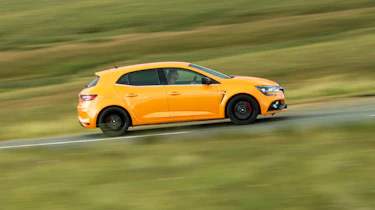
How times change. When the RS was launched back in late 2017, it was officially rated at over 40mpg on a combined cycle, with the dual-clutch transmission certified at 40.9mpg. On the WLTP cycle however, this figure dropped way down to 28-29mpg, which was admittedly far more representative to real-world figures.
This is lower on paper than many rivals, but few concessions have been made in the pursuit of inflating that figure, and with only six ratios in the transmission and no obvious overdrive gear for motorway speeds, that’s what you get.
The regular Mégane RS, with 18-inch wheels, comes with 235/40/18 ContiSportContact 3 tyres. The Trophy model, with the bigger 19-inch wheels, comes on more aggressive 245/35/19 Bridgestone Potenza S001s. We noted a marked improvement in the Mégane’s feel and dynamics with the fitment of Potenza Sports.
Long-term test: 8200 miles in the Renault Mégane RS 300 – John Barker
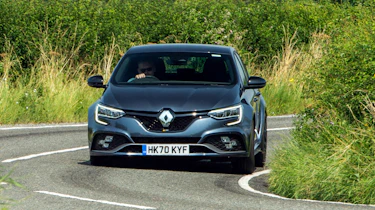
‘Despite being dark grey with dark wheels, the Mégane RS would occasionally cause onlookers to swivel and stare. And why not? It’s a great-looking fast hatch, one of the best, I reckon, with its wider yet perfectly blended front and rear arches and wide snout with neat chequered-flag-style lower lights. Another reason to stare is that it’s so darned rare; in eight months and 8000 miles I saw only one other, and that was the replacement we had while our long-termer went in for service.
‘We reckoned the standard chassis would be easier to live with day to day, though our car did have the Cup upgrade from 18 to 19-inch wheels and thus the same wheel and tyre size as the Trophy. Said wheels and paint were the only options added to what was a very generous standard spec, and took the basic price of £33,585 up to £35,035.
‘Initial impressions were that the 296bhp turbocharged ‘four’ was punchy and sounded keen but was attached to a DCT gearbox (there was no manual option) that was somewhat less enthusiastic and, with just the six gears, seemed a ratio short. Stop-start was well judged coming to rest, the engine cutting before the car was fully stationary and usefully sensitive to brake pedal pressure, but it was a bit clumsy getting going again and I soon adapted my driving to smooth out the restart and pull-away.
‘Dynamically, the effect of the ‘4Control’ rear-steer seemed dramatic the first time I hacked into and out of a roundabout at pace, the back end feeling disconcertingly mobile with each swing of the steering wheel. I quickly got used to this and hardly noticed it after a few thousand miles. Partly this was because I found the dynamics less engaging and encouraging than I’d hoped. The ride was a bit lead-footed on bumpy back roads and the steering lacked the connection and detail feel of the best in this class. A late tyre change would improve this significantly…
‘Behind the wheel of the Mégane was a good place to be in many other respects, though. The handsome, Alcantara-trimmed seats were as comfortable and supportive as they looked, the nav system proved excellent once I’d discovered there were a number of map options, and the sound system was good too. What was truly outstanding, though, were the headlamps, which offered astonishing range and coverage on main beam. I’ve driven smarter systems that can adapt the beam pattern for cars approaching or that you’re following, but for sheer output the Mégane system is probably the best.
‘When the first service became due I arranged to try the Trophy version of the RS, wondering if the firmer set-up would give the Mégane the missing dynamic sparkle. It certainly sharpened up the responses of the chassis, the steering – and the rear steer – being keener. The price was an even tougher ride. There was an honesty about it, but with my usage being more general than cross-country blasts, the standard chassis was the right choice. At the service I asked them to see if they could figure out why the alarm kept going off randomly. There was nothing conclusive, though low battery charge was floated as a possible cause.
‘The dynamics were about to see an uplift, though. A few weeks earlier, on the annual evo tyre test, we’d tried the new Bridgestone Potenza Sport and it had finished an impressive third. The Mégane came on Bridgestone S001s, a very old tyre, but I figured the new Bridgestone would have the same basic DNA and so should be a good fit.
‘I could literally feel the improvement driving away from the tyre depot, the steering clearer and better connected. After a couple of hundred miles in different conditions, including cold, slippery winter surfaces, it was clear that grip was substantially better too.
‘It was a genuine transformation; the car felt more alive, more engaging, more like you’d expect an RS-badged car to drive, and that further improved when you selected Sport mode, which increased the crispness and urgency of the delivery and the tightness of the shifts. The slight downside was a firmer ride quality, but it wasn’t Cup tough and the net result was a consistent and cohesive character somewhere between standard and Cup.
‘Anyone with a Mégane RS, even a Trophy, should fit a set of the latest Bridgestones – or another top-rated tyre such as the Michelin Pilot Sport 4 S or Pirelli P Zero, which would probably bring the same improvement – because they will enhance the feel, grip and enjoyment. They got our handsome Renault much closer to being the car it should have been from the start.’
evo Car of the Year 2018 result – Adam Towler
‘Something has to come last, and in 2018 that something was the Mégane emphatically. Only one judge didn’t place it at the foot of their personal table (and even then they put it in second-to-last place).
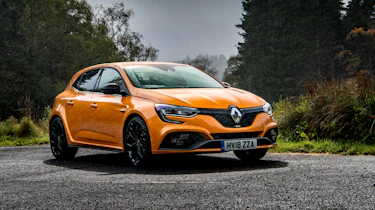
‘That the Mégane made it to eCoty at all should be both a source of consolation for Renault Sport and also proof that we do appreciate its talents. It’s not that the Mégane RS is a bad car, far from it: it’s undeniably fast across the ground and combines debonair styling with sporting aggression in a way most of its rivals can only dream about.
‘But placed under the most ruthless scrutiny and surrounded by genuinely inspirational cars it lacks the authenticity of the old Clio and Mégane Renault Sport models – the feeling that they’d been created for people who love driving by people who love driving. This Mégane feels big, sometimes unnatural and awkward.
‘After the turbocharged Clio RS we naturally worried that Renault Sport had lost the plot – was either unable to, or not being allowed to, create the sort of special cars it was once renowned for. The Mégane was meant to be the car where the blip of the Clio was banished with a convincing riposte to the critics.’
Mégane RS prices and buying checkpoints
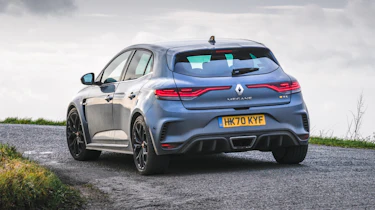
Fitment of a later, more modern tyre is a sign that your chosen used Mégane RS has had the right kind of owner. Likewise, full service history (don't be put off by a specialist appearing in the service book) and clean MOT histories. If your chosen car has the paddleshift EDC box, be sure regular services have been undertaken.
Pay close attention to the 4Control all-wheel-steering system during your test drive and whether it’s working smoothly and changing over as it should. The optional hybrid floating brakes are much more expensive to swap than the standard items, so be aware of this if your chosen car has them fitted. The 1.8-litre engine is known for thermostat issues but is generally robust.
Prices range from £14,000 for earlier, lower-spec, high-mileage cars, to upwards of £45,000 for the ultra-exclusive and exotic Trophy R. Sweet-spot 2021-onward Sport-chassis RS 300s are upwards of £18,000. You can start your search on Carwow.