TVR Cerbera (1996-2004) review – the British bargain supercar
The singular, spectacular Cerbera is a genuine supercar that’s often overlooked – and, arguably, underpriced
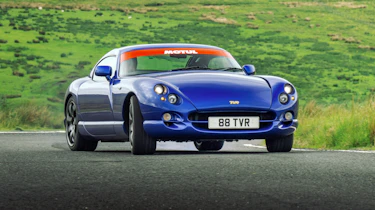
This is one tempting idea. Less than £20,000 could buy you the ultimate TVR coupe, the Cerbera, a monstrously rapid machine powered by that most daring of engineering adventures, an engine designed and built in-house. For a tiny specialist car maker to do such a thing, and get it through all the requisite legislative hoops, was extraordinary, and it’s reason enough in itself to want a Cerbera.
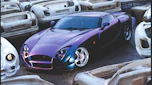
TVR hit its stride in the ’90s in spectacular fashion, led by the much-missed Peter Wheeler. The Blackpool-based marque became Britain’s largest independent car company and rapidly launched a stream of new models, from retro V8 S to beautiful Griffith to (slightly) softer Chimaera. All were fast, innovative and characterful, but the Cerbera – shown as a concept at the 1993 London motor show and in production by 1996 – was the first TVR that could comfortably wear the label ‘supercar’. Powered by that unique V8 engine, top speed was in the region of 180mph (190 for later versions), and it looked like nothing else, inside and out.
TVR Cerbera: Engines and performance
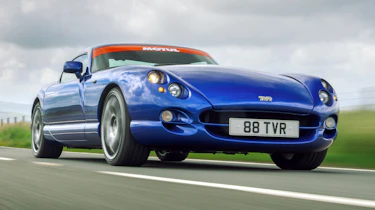
‘TVR didn’t make much money out of the Cerbera – they did it partly to prove that they could,’ says specialist James Agger, who supplied the immaculate blue Mk2 car tested for this story.
More reviews
Group tests
- Ravage Alpine A110: France's perfect sports car made even more perfect
- Alpine A390 v Hyundai Ioniq 5 N – are these EV crossovers fun as well as fast?
- Ariel Atom 4R v Ariel Nomad 2 – is grip more fun than slip?
- Ariel Atom 4R v Caterham Seven ‘evo25’: power-to-weight heroes go head-to-head
- Audi Quattro, RS2 and RS3: five-cylinder icons head-to-head
- Who makes the best GT car? Aston Martin v Bentley v Maserati
- BMW 230i M Sport v Volkswagen Golf GTI Clubsport
- Caterham Super Seven 600 v Super Seven 2000
- Ferrari Enzo v LaFerrari – analogue hypercar meets its digital successor
- Great Ferrari hypercars driven: 288 GTO, F40, F50 and Enzo head-to-head
In-depth reviews
- Abarth 600e review – electric hot hatch with surprising character
- Alfa Romeo Junior review – small Italian crossover to rival Ford's Puma
- Alpine A110 R (2023 - 2026) review – the flawed but fantastic Porsche Cayman GT4 alternative
- Alpine A390 review – France's flawed rival to the Porsche Macan
- Alpine A110 review – the sports car Lotus should be building
Long term tests
- How lowering the roof on the Abarth 695C is a threat to my driving licence
- Alpina B10: Alpina B10: end of term report
- Alpina B10
- Aston Martin's 697bhp DBX707 super SUV is now half price, but I can't see why
- The subtle trick that makes Audi’s old interior better than a touch screen
- My Audi S8 can’t make me hate it, even if its safety systems are often terrible
- Living with this £40k Caterham Seven even makes the KFC drive-thru memorable
- Caterham Seven evo Edition revealed – bespoke 420R joins the Fast Fleet
- It has a VW Golf R engine, but the Cupra Leon is quietly old-school
- Cupra Ateca VZN Fast Fleet test – four months with Cupra's hot crossover
Reviews
- Abarth 695 (2012-2024) review – why we’ll miss Italy’s Mini Cooper S rival
- Abarth 500e 2023 review
- AC Cobra 289 review – British sports car with an American V8 heart built to fight Ferrari
- AC Cobra 378 Superblower MkIV 2021 review – another V8 Cobra, but with a GM heart this time
- Acura Integra Type S 2024 review – a Honda Civic Type R with added restraint
- Alfa Romeo 33 Stradale 2025 review – a rare Italian jewel beyond compare
- Alfa Romeo Tonale 2023 review – 276bhp Speciale version tested
It was glassfibre-bodied, like other TVRs, but the finish was generally excellent and the fit passable. Under it all is a tubular steel chassis, inherently tough but sometimes a key TVR problem area. This, plus temperamental electrics and disintegrating clutches has contributed to a reputation for challenging reliability over the years. Not so the engines; after some initial worries they have proved durable if they are properly maintained.
At the original Cerbera’s heart is TVR’s in-house AJP V8 engine, initially with 4.2 litres and later also offered in higher-revving 4.5 capacity. Another of TVR’s own engine designs, the in-line six-cylinder Speed Six, also joined the Cerbera range in 1999. (And two Speed Six engines were fused to a common crank and placed in quite possibly the wildest supercar of all time, the Cerbera Speed 12; but that’s another story altogether.)
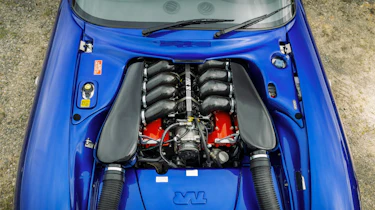
Open the one-piece, front-hinged bonnet of Agger’s 4.5-litre car and you find the engine bay is remarkably uncluttered. The low, light, compact V8 sits well behind the axle line, with unusual inlet ducts made of squidgy rubber. It’s all indicative of TVR’s singular, innovative design approach.
The 4.2-litre AJP8 was 4185cc in capacity, with single overhead cams per bank and two valves per cylinder, a flat-plane crank and the alternator mounted in the 75-degree vee. The 4.2 developed 350bhp at 6500rpm and 320lb ft at 4500rpm, while the 4.5 (4475cc) introduced in 1997 increased that to 400bhp and 380lb ft at higher revs.
Speed Six models are more common – they outsold V8s by around 3:1. The Six is a 3996cc all-alloy engine, also longitudinally mounted and well back in the engine bay. With dual overhead cams and a four-valve-per-cylinder head it generated 350bhp at 6800rpm and 330lb ft at 5000rpm. Official acceleration times were quick: 0-60mph in 4.5 seconds and 0-100 in 10.5.
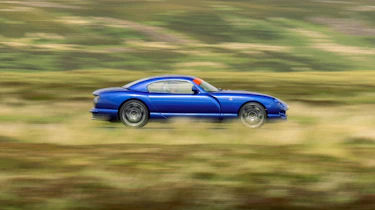
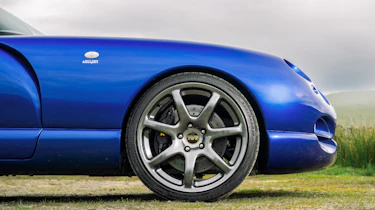
The Cerbera Mk2 was introduced in 1999, with different seats, a larger windscreen and separate spotlights in body-coloured shrouds replacing the Mk1’s more traditional lamps. It was later offered with the Red Rose performance pack, as fitted to Agger’s car, which upped power and torque by 20bhp and 22lb ft for totals of 420bhp and 402lb ft, and fitted bigger, 322mm AP Racing discs cleared by lightweight 18-inch wheels.
As a footnote, the TVR played a small part in the creation of the Mercedes SLR McLaren: Cerberas with gigantic bonnet bulges were used as development mules for its supercharged V8 engine.
TVR Cerbera: Interior
The simple matter of getting into the Cerbera is also typically unique. A button concealed under the mirror instantaneously drops the electric windows a smidge, releases the catch, and the door magically swings open. (The boot, meanwhile, is opened by pressing the ‘b’ part of the ‘Cerbera’ badge.)
The doors are unusually long, to grant access to the rear seats as well as the front. The Cerbera is a 2+2, or ‘3+1’ – the scalloped dashboard shape enables the passenger seat to be slid further forward than the driver’s seat for a bit of extra legroom behind it, though you still have to be pretty flexible to get in the back.
Reportedly, part of the Cerbera’s packaging brief was that it should be able to accommodate Mr and Mrs Wheeler and their dog, plus luggage. Peter Wheeler was 6ft5in, and ensured it was easy for tall drivers to get comfortable up front.
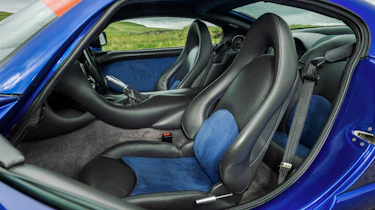
The interior’s design is unique in other ways, too. As well as building its own engines, TVR made much of its own switchgear and, with the fresh thinking (and affordable wages) of design students contributing to its creation, nothing is quite as you’d expect.
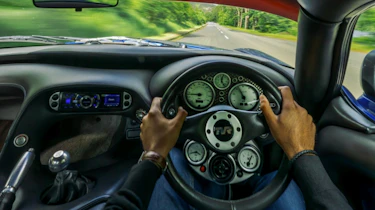
Yet everything works very well. The two-spoke steering wheel incorporates the wiper and headlight switches into its grips, while the clock and fuel gauge are mounted to the steering column surround, together with an air vent to direct cold air straight into your face if you’re feeling hot and bothered. As well you might.
The Red Rose edition also features a 97/95 button, to switch between fuel maps according to which octane level you’ve tanked up with.
Driving the Cerbera Red Rose – James Taylor
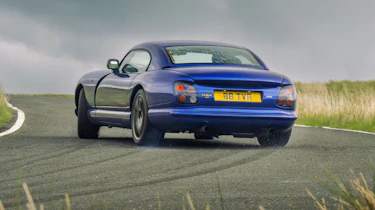
Ignition is keyless, once you’ve disabled that ’90s staple, the immobiliser. When the V8 fires, it sounds like a ground-level sonic boom. You can’t sneak under the radar in a Cerbera. It sounds even better on the move, sound waves ricocheting off County Durham’s dry-stone walls with a barrage of crackles on the overrun. Throttle response is fantastically crisp and sharp, and the power steering similarly responsive – edgy, even – at just two turns lock‐to‐lock. (Speed Six models had a slower 2.4-turns rack.) The turning circle is on the large side, however, and you need to plan ahead for manoeuvres in tight spaces.
The two-spoke design means the wheel flexes slightly, and finding a comfortable position for my hands around the rim-mounted controls is tricky. I finish up holding the wheel a bit higher than I’d ideally choose.That aside, the interior design works fantastically well, with a superb driving position: low hips, legs straight out ahead, left elbow on the high transmission tunnel’s soft leather.
Core to the driving experience is the throttle pedal’s enormously long travel. You could stay below 50 per cent yet still keep a good pace, thanks to the light weight and ample torque. But to experience the Cerbera’s full ferocity (officially, sub-four seconds to 60mph and less than nine to 100 in Red Rose trim), you need to push the pedal to its stop. I do so in fourth gear initially, to lessen the shock and awe.
It’s quite a sensation – a second wind that puts the Cerbera well and truly in the supercar league. Doing it again in third gear is the full Millennium Falcon hyperspace effect: the dry-stone walls go stroboscopic between the sunstrip and the dash.
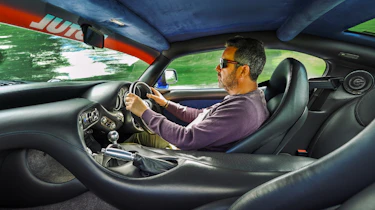
The brakes are fantastically powerful and responsive and the whole car feels remarkably together and cohesive. There’s something race-car-ish in the immediacy of its responses, yet it’s a very usable road car, with well-controlled body movements and well-telegraphed limits. You could even call it refined, to an extent. As angry as the engine can be, it’s docile and drivable in town and traffic.
The gearshift, too, feels great, and it’s easy to downshift smoothly because the V8’s revs flick up so responsively. The Cerbera feels like a car made by a much bigger company with much bigger resources than the plucky Blackpool underdog.
‘It’s radical but functional, practical even,’ says evo editor-at-large Richard Meaden, driving the same car as part of evo’s Supercar Eras: The 1990s feature. ‘It does everything so well. The noise is outrageous and the performance quite shocking, particularly when you realise how much throttle travel there is. I can’t think of another engine that has such immediate response, and the brake pedal’s progressive modulation is great too, like the best sort of race-car setup, though in the wet you need to be wary because there’s no ABS.
‘It’s a slap-in-the-face wake-up call to what we’ve lost with the advances of technology. There’s so much drama and originality and fearlessness in it. It’s not rough around the edges; it’s an exciting, honest, exuberant celebration. In so many ways it’s the essence of what we love about cars.’
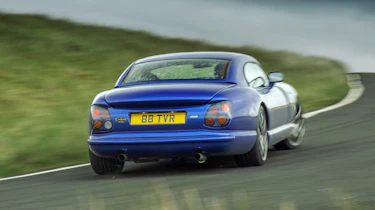
Senior staff writer Yousuf Ashraf agrees: ‘I thought it might feel like a kit car because that’s their reputation – unfairly, because all the fundamentals are there. It has the best brakes here, the gearshift is really nice, the engine tractable. The cabin is insane yet everything’s finished very well and works. It’s such a big character, and a different flavour of supercar.’
Yousuf’s less keen on the steering’s darty quickness, and neither he nor Richard is a fan of the Hydratrak differential, which incorporates a sort of fluid-based traction control, transferring torque to the inside wheel; both find it a little inconsistent in its responses.
Nevertheless, the Cerbera packs the wow factor you’d hope of a supercar, with fresh thinking and a wild but well-resolved driving experience. It’s a truly fantastic car. Three decades on, and from beyond the grave, TVR still punches above its weight.
Prices and buying guide
‘You must go into TVR ownership with your eyes open,’ specialist Paul Glynn told evo in 2009. ‘Buy the best you can for the money, with a history from a reputable dealer or specialist. But don’t be too suspicious if the seller says it has had a factory engine rebuild and there’s no paperwork. The factory didn’t give paperwork, even to the dealers.’
The V8 is a labour-intensive engine, with several hours’ work every 24,000 miles to re-shim the 16 tappets. ‘It tends to get overlooked,’ says Glynn. The six-pot needs its clearances set every 12,000 miles, but it’s a much easier process on this engine. Oil burning is seldom a problem but leaks can be, notably from the V8’s front cover. Setting up the throttles requires a laptop and specialist knowledge.
The Borg-Warner T5 transmission is ‘bulletproof’ apart from occasional wear on second- and fifth-gear synchromesh. The clutch tends to fracture the fingers on the pressure plate’s diaphragm spring, often well before the plates have worn out. A heavy clutch or leaking fluid are grounds for a discount. A clutch typically lasts around 25,000 miles.
Odd clonks can signal worn suspension bushes. Some owners fit polyurethane bushes, which sharpen the already-sharp handling but can make the ride harsher. The power steering is prone to leaks. Various different sizes of wheels, tyres and brakes were used over the years.
The glassfibre body is strong, ripple-free and seldom develops cracks, but water can leak in around the door seals. The chassis can be trouble. Damage to the powder coating quickly causes rust to spread beneath, and badly corroded Cerberas are now failing MOTs. The worst section is likely to be the outrigger at the back of the front wheelarch, where there’s a mud trap, but check all the other tubes behind the sills and across the chassis for pinholes or worse. Repair usually involves partially lifting the body off the chassis. A new chassis is £6700-£7600 before VAT.
Electrics are a perennial TVR problem to the end. Check everything works: lights, dip switches, wipers, the electric door-opening buttons, the immobiliser, the boot lock, the gauges, the windows. All, plus their ECUs, are repairable with parts and expertise from the cottage TVR industry that has grown up since the factory’s demise.
Cerbera values can either be considered tempting or dangerous, depending on the individual. Cars are available for less than £20,000, albeit with 60,000-miles-plus on the odometer. Most Cerberas have been driven, with the lowest-mileage car we could find for sale still having 33,000 miles, for just under £30,000. The lower the miles, the more price is down to the owner’s discretion.
Specs
| Engine | V8, 4475cc |
|---|---|
| Power | 440bhp @ 6750rpm |
| Torque | 402lb ft @ 5500rpm |
| Weight | 1100kg (406bhp/ton) |
| 0-62mph | 3.9sec |
| Top speed | 190mph+ |
| Price new | £46,500 (1999); £91,700 in today’s money |
| Value now | £18,000 to £30,000 |
With thanks to James Agger Autosport