Ariel Atom 4R v Ariel Nomad 2 – is grip more fun than slip?
The Atom and Nomad are two opposing answers to the track car question. We know the Atom's faster, but which is more fun?
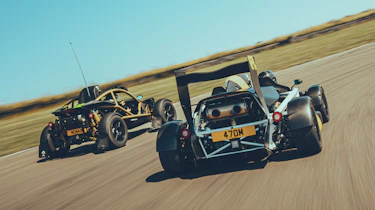
Since we last put a stopwatch on an Ariel around Anglesey circuit, the Crewkerne craftsmen have created both an all-new Atom and an all-new Nomad, so where do the company’s fresh portfolio place on our lap time leaderboard?
The Atom is in the perfect spec for track work. It’s the more powerful Atom 4R, which starts at £77,940 but here has some choice options including front and rear wings, ABS, traction control, sequential paddleshift and three-way adjustable Öhlins dampers, plus a brand-new titanium and carbonfibre exhaust system. Meanwhile, the £68,970 Nomad 2 is here as a just-for-fun exercise, since this particular car is in full off-road spec: raised ground clearance, underbody protection, knobbly tyres, winch, light-sabre aerial, and so on. In the future, we may time it in lighter trim with a lower ride height and grippier rubber, to find out what difference that makes on tarmac.

We start with the Atom. We already know it’s seriously capable after its performance at Cadwell Park in 2024’s evo Track Car of the Year test (issue 322) and so it proves here. Enhanced cooling via the R’s unique sidepods and reconfigured software give the Civic Type R-sourced Honda engine an extra 80bhp and 10lb ft than in the regular Atom 4, for totals of 400bhp and 370lb ft. With ABS and TC to lean on, the intimidation factor of driving a car with a power-to-weight ratio of 611bhp per ton is vastly reduced. There are three engine maps; naturally, for lap times, we put it in the most potent ‘party mode’, in which the turbo boost comes in quite abruptly.
More reviews
Group tests
- Ariel Atom 4R v Caterham Seven ‘evo25’: power-to-weight heroes go head-to-head
- Ariel Atom 4 v Caterham Seven 310R v Lotus Elise Cup 250
Reviews
- Ariel Atom 4RR review – is the most powerful Atom ever worth McLaren 750S money?
- Ariel Atom 4R review – how to make a Porsche 911 GT3 RS look tame
- Ariel Atom 4 2025 review – Britain's exoskeletal track toy just got torquier...
- Ariel Atom 1 (1999 - 2003) review, history and specs of the bare-bones sports car
- Ariel Atom 3.5 (2013 - 2018) review, history and specs
- Ariel Atom 3 (2007 - 2013) review, history and specs
I find this to be the most challenging aspect of getting a lap time from the 4R – even on the exit of very fast corners, it’s a real step when the boost comes in, and you need to be ready for it. We’re recording our times on a very hot day, so I run with a little bit of traction control on, since the hot tarmac is severely limiting rear grip. Less so front grip: with sticky Yokohama A052 tyres, the steering is heavy enough to blister my thumb through my driving gloves. There’s less feel through the unassisted steering than I expected, and it takes a little while to tune in to it. Braking performance is mighty: you can mash the pedal as late as you dare, with absolute faith the car will stop.
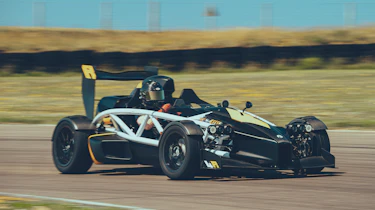
The 4R is a good match for Anglesey, with its blend of mechanical grip and some useful aero: the wings are claimed to generate 110kg of downforce at 70mph. Nonetheless, I do experience a spot of oversteer in the sixth-gear kink after School curve, which is focusing. Still, it’s a controllable car when it slides, and my goodness it’s quick. In a straight line it feels faster than many supercars.
This car’s predecessor, the Atom 3.5R, recorded a 1:12.3 lap in 2018 (evo 255). The 4R smashes that time by more than a second, recording a 1:11.1, which ties it with the McLaren 765LT on our leaderboard, and puts it a tenth ahead of the McLaren P1.
And the Nomad 2? Considering this car is in the worst possible spec for track work, it’s actually very able. And enormously good fun. You must recalibrate your senses after driving other, grippier cars – particularly in terms of braking distances – but once you’ve got over the extra suspension movement (and the shock of the sheer volume of tyre squeal), it gives you enormous confidence.
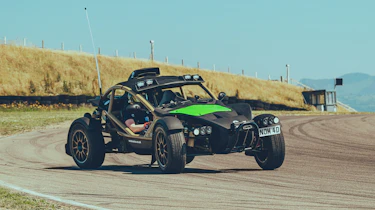
Though this car has the optional hydraulic handbrake, it’s redundant here: there’s so much weight transfer under braking that you can unstick the rear and initiate a slide before you even get to a corner’s conventional turn-in point. Despite that, it’s predictable and a car you quickly build trust in and a rapport with.
Its quickest time (including a not entirely planned visit to opposite lock in one of the braking zones) is 1:22.4. That’s in the lower reaches of our leaderboard, but still quicker than a Mk7.5 Volkswagen Golf GTI TCR and Toyota GT86 TRD. In a different spec, this could be a truly rapid car around Anglesey. As it stands, it’s enormous fun, a brilliant demonstrator of the breadth of Ariel’s range, and a reminder that a ‘slow’ lap time can be inversely proportional to how much fun a driver’s having behind the wheel.