The unlikely 1980s supercars that never were – from Aston Martin to Peugeot
A number of manufacturers flirted with the supercar genre in the 1980s with concepts that never quite made production
Just three months into the ’80s, Aston Martin delivered the decade’s first supercar concept with the Bulldog, a fabulously low-slung wedge with enormous gullwing doors, a drop-down panel to reveal the headlights and a socking great twin-turbo V8 in the middle. It was followed the same year by Bertone’s Lamborghini Athon, based on the V8-powered Silhouette production car. But this pair of flying door-stops with their folded-paper styling were really cars of the ’70s turning up late to the party.
The real ’80s, the years that live on in the cultural memory, took some time to arrive, for music, fashion, movies and concept cars. But when they did, what they delivered was, as Spandau Ballet once said, gold.
Setting an early high-water mark for peak ’80s concept was Peugeot, which fetched up at the 1984 Paris motor show with the Quasar, wide as a train, white as cocaine and packing those ’80s concept essentials of a cockpit-style cabin and unusual doors. Best of all, the Quasar was powered by the steroidal turbocharged four-cylinder engine from the 205 T16 rally car, daringly on show amid the skeletal rear bodywork.
If Peugeot seemed an unlikely company to start bandying around an outlandish supercar concept, it was equally incongruous to find the Honda of the middle ’80s at it too. But that’s just what it did, joining forces with Pininfarina for the radical HP‑X concept, also revealed in 1984. Like the Quasar, this had a low nose, a canopy roof, a motorsport engine in the middle (in this case, a 2-litre V6 from Formula 2) and a white paint job with red trimmings because, yes, we were really in the heart of the ’80s now. The HP-X was of course too radical for the showroom but it definitely set the tone for the NSX that would arrive before the decade was out.
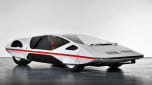
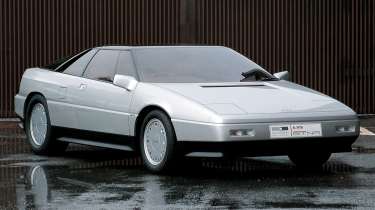
Closer to production intent was the fabulous Giugiaro-styled Lotus Etna, first shown at the British motor show in Birmingham in 1984. The concept may have been a wood and glassfibre mock-up, but contemporary press reports said the real car was on its way featuring an all-new V8, active suspension and other features Lotus couldn’t really afford to develop. The ambitious Etna remained a one-off, though its soft-edged look was mirrored by the heavily facelifted Esprit of 1987.
Lighting up the covers of patriotic British car mags the following year was the MG EX‑E, another mid-engined concept with a roof inspired by jet fighters and a handsome shell designed around the 3-litre V6 and 4WD drivetrain from the Metro 6R4 Group B car. The show car wasn’t a runner but Austin Rover released a cutaway diagram to prove the engineering package would work and dropped coy hints about its production potential, though the dead hand of accountancy would see it progress no further than a rolling one-off.
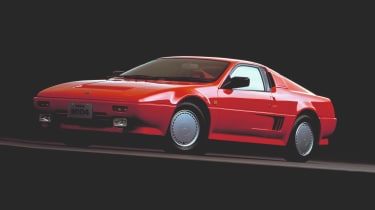
Nissan, on the other hand, seemed like a company with the resources to follow through on the promise of its four-wheel-drive, four-wheel-steer, V6-powered, MID4 concept of 1985. It even had the running prototypes to prove it. What sealed the MID4’s fate as nothing more than a concept was not a shortage of money but, ironically, too much of it.
As Japan’s post-’85 economy went stratospheric, cash sloshed about like water and Nissan decided not to fast-track its new sports car to the showroom but to make the MID4 even better by starting again from scratch and coming up with the twin-turbo MID4 II, then getting really carried away with plans for a V8 or even V12-powered MID4 III… which were promptly nixed when the economic bubble burst.
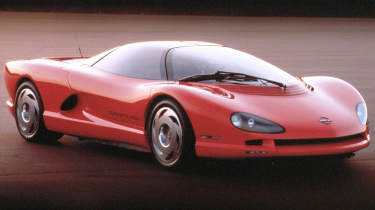
GM was more circumspect when it created the dramatic Corvette Indy concept of 1986, translated from sketch to physical show car at breakneck speed with help from Italian specialists Cecomp in order to wow the Detroit show with mid-distant tech like four-wheel steering, active suspension, drive-by-wire, and a Kevlar and carbonfibre construction. In the middle, a new Chevrolet-branded Ilmor V8 built for IndyCar racing, hence the name.
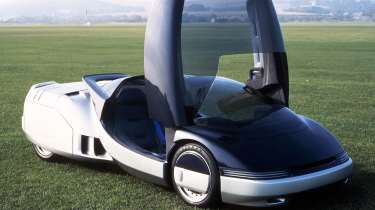
While the Indy show car itself was a non-running 3D poster for incoming tech, GM had quietly commissioned Lotus to carry out some proper R&D on the active systems it purported to run, something the engineers in Hethel did using a Peugeot 205 T16 road car. The CERV III concept of 1990 evolved the same look and showcased several years of graft on the hardware, but remained tantalisingly far from showrooms, which wouldn’t see a mid-engined Corvette for another 30 years.
Even so, the Indy, like many of the cars mentioned here, was anchored in some sort of reality. Perhaps fittingly for a decade known for frivolous excess, we’ll end with a concept that was just pure, joyful craziness. And that concept was called, appropriately enough, the Alien. It wasn’t even from a car company but made by IAD, the Sussex-based design consultancy, to showcase its creative skills and engineering know-how.
The aim was to make something more dramatic than a Lamborghini Countach, and this bubble-roofed, wasp-waisted show-stopper certainly succeeded on that front. The notion that it could undergo powertrain swaps by unplugging the entire rear section only added to its sci-fi vibe. The Alien was never going to be found in a showroom but it was extravagant, self-confident and forward-looking and, as such, a perfect supercar concept for the peak of the 1980s.