The supercar concept cars that were too extreme even for the 1970s
The 1970s were a time of wild styling expression, but these concepts were too much even for the decade that style forgot
With styling having reached its voluptuous peak in the 1960s with cars such as the Jaguar E-type, Ferrari 250 Lusso and Shelby Cobra, it would be easy to conclude that the ’70s obsession with wedge shapes was simply an act of artistic anarchy.
While it’s true that visionary stylists and designers will always push to innovate, the trigger for this spectacular aesthetic shift was less to do with creative urges and more directly linked to engineering advances that led to the rapid abandonment of traditional front-engined platforms in favour of the mid-engined supercar.
Rewind to the mid-to-late ’60s and it’s telling that the earliest mid-engined designs, such as the Ferrari 250 LM and Ford GT40, continued with conventional curvaceous forms. Even the Miura – the first supercar of the modern age – conforms to this ideology. But while mid-engined racing cars such as the Alfa 33, Ferrari 512 and Porsche 917 continued with curves well into the ’70s, leading car designers and styling houses swapped their French curves for set squares, with the resulting raft of sharp, angular designs pushing the boundaries as never before.
One of the earliest wedge-shaped designs actually broke cover in the late ’60s, with Marcello Gandini’s Alfa Romeo Carabo blowing people’s minds at the 1968 Paris motor show. With its pointy lines and scissor doors it was clearly prescient of the Countach he would design for Lamborghini just a few years later.
Not to be outdone, Giorgetto Giugiaro’s Bizzarrini Manta – the first product of his new company, Italdesign – appeared the same year. An unconventional one-box shape with a three-seater, central-driving-position cockpit, the Manta was somewhat overshadowed by the wilder wedges that followed. Still, its influence can be seen in the Maserati Bora, a later Italdesign creation.
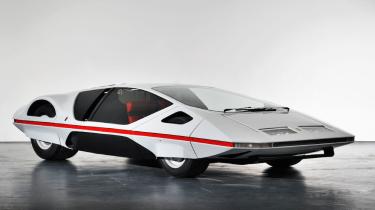
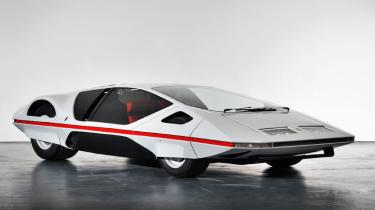
It was in 1970 that the supercar world went wedge-crazy, with both the Ferrari 512S Modulo and Lancia Stratos Zero making their debuts that same year. The former – based on an aborted Ferrari 512 Can-Am race car project and now restored to its former glory by car guy extraordinaire Jim Glickenhaus – is a sensational mash-up of automotive and science fiction, its partially covered wheels and the windscreen and side glass forming a canopy-style roof that slides forward to allow ingress and egress. For many this Pininfarina creation (penned by Paolo Martin) is the ultimate ’70s concept.
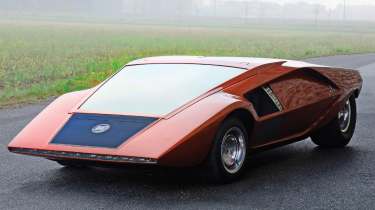
Not to be outdone, Bertone – led by Gandini – created the Lancia Stratos Zero. It too pursued the wedge shape to absolute extremes, this time requiring the whole windscreen to lift up like a bonnet, allowing driver and passenger to step in. Fantastical it might have been, but the Zero directly informed the Stratos HF, which was first shown the following year and went on to dominate world rallying.
As the ’70s progressed, so more wedge-shaped concepts were shown. The brilliantly named Maserati Boomerang, which was shown in 1971 without an engine and in 1972 with a 4.7-litre V8, further resolved Italdesign’s ideas. Indeed, Giugiaro credited it as the genesis of his subsequent Lotus Esprit and BMW M1 production cars, which evolved the wedge into his so-called ‘origami’ phase.
Another influence over the M1 was BMW’s own E25 Turbo Concept. Also shown in 1972, the mid-engined car was the work of BMW’s chief designer, Paul Bracq. Built to celebrate the Munich Olympics, it also marked the creation of BMW M. Powered by a turbocharged four-cylinder engine, the gull-winged supercar featured design highlights such as the shark nose and a driver-focused interior that would inform future generations of production BMWs.
Meanwhile in Stuttgart, Mercedes-Benz was developing ideas of its own with the intriguing series of experimental mid-engined C111 prototypes. Initially built to explore Wankel rotary engine technology before switching to petrol and diesel powertrains in subsequent iterations, these increasingly extreme machines set a host of speed records. The last of them – the ultra-streamlined C111‑IV – set a new Nardo record with a verified speed of 250.96mph in 1979.
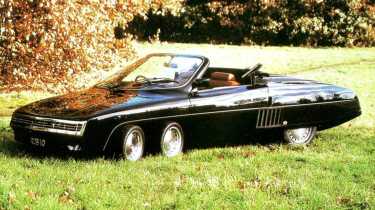
And then there’s the Panther 6. This undisputed star of the 1977 Earl’s Court motor show was the brainchild of textile industry mogul turned car maker Robert Jankel. His company – Panther Westwinds – was known for the retro-inspired Jaguar-based J72 and DeVille. By contrast, the 6 was shockingly futuristic. Inspired by the six-wheeled Tyrrell P34 F1 car, it was pitched as a machine to surpass Ferrari’s 512 BB and Lamborghini’s Countach for speed, drama and luxury.
Styled by Vauxhall design aces Wayne Cherry and Geoff Lawson (the former responsible for the sensational Vauxhall SRV shown in 1970), it looked suitably otherworldly. Powered by a souped-up, twin-turbocharged, rear-mounted 8.2-litre Cadillac V8 for a claimed (but never verified) 600bhp and 254mph(!) top speed, the two-seat convertible was huge – almost 5.2 metres long – and its asking price was equally colossal: £39,950 versus £26,000 for a Ferrari BB.
Sadly, and perhaps inevitably, Jankel’s claims of 15 orders failed to materialise and the project stalled. When a second energy crisis hit in 1979, the market for 4mpg supercars was further marginalised and Panther Westwinds went into receivership. It was a sad end, but nothing summed up the ’70s quite like the Panther 6.