Ford GT40 (1967) review – the car built to spite Ferrari
In creating the GT40 to defeat Ferrari at Le Mans, Ford inadvertently laid a bit more groundwork for the supercar species as we’ve come to know it
It’s impossible to ignore the influence of racing on the supercar as a species. And one racing car has had more influence than most. You already know the backstory of the Ford GT40: Henry and Enzo; Lola source material; Anglo-American development; difficult early years followed by Le Mans dominance. While it was foiling Ferrari and Porsche in competition and capturing fans’ hearts, its chiselled nose, kick-up tail, impossibly low form and overall concept were inspiring designers and engineers in the road car world too.
And away from the racetrack, people were finding that the GT40 made a genuinely adept road car. Tractable V8 torque delivery gave it docile driveability at road speeds, and the sturdy, stiff monocoque structure meant it rode well, too. Race team mechanics shaking GT40s down on the road – and in some cases driving to and from the Le Mans circuit pre- and post-race – could happily testify to that.
Ford in fact had planned to build road versions from the outset (if it hadn’t launched the GT40 as a pure racing car first, it could have made a pretty strong claim to the ‘first ever supercar’ title) and the MkI GT40 could be ordered in race or road-legal spec from Ford Advanced Vehicles’ HQ in Slough. The road versions featured extra instruments, mirrors, lights, interior trim and exhaust silencers but were still pretty hardcore: seriously loud, seriously hot for the occupants, and devoid of space to carry anything.
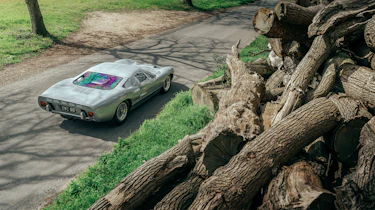
In 1967, however, Ford launched the MkIII: a true, dedicated road-going variant of the GT40, though it’s fair to say it was not a runaway sales success. Of the 105 or so original GT40s made in total, only seven were MkIIIs, three of them right-hand drive. This car, chassis number 1107, was the final one to be built, in 1969.
It has been owned by Ford of Britain from new and for some time was the company car of Walter Hayes, Ford PR supremo and a key figure behind many of the Blue Oval’s motorsport programmes, including the GT40. When he transferred from Ford of Europe to Detroit in 1980, he insisted the GT40 went with him. Quite a commuter car.
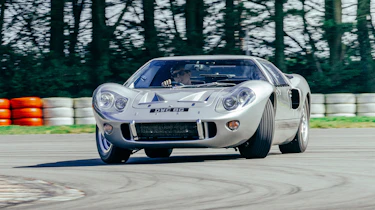
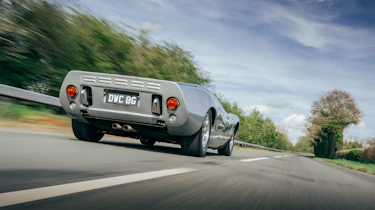
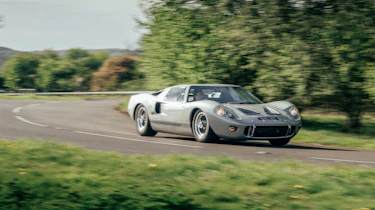
Rolling out of its trailer, sunlight glinting on its Silver Fox paintwork, it looks utterly purposeful yet prettily compact. Few letters and numbers go together more perfectly than ‘GT40’ but, like most great stage names, it’s not the one it was born with. Its true name is simply ‘Ford GT’, and famously the 40 suffix began as a nickname, referencing the roof being only 40 inches from the ground. In a name it’s an abstract figure; in reality it’s hard to describe just how low the GT is. Barely hip-height, it makes the two-to-three inches taller Lamborghini Miura look like a big car.
Key elements of the MkIII’s more road-friendly spec include the round-beamed two-aside headlights – rather than the distinctive square lenses in the race cars – in taller front wings, to adhere to US safety requirements. There are additional lights below, and somewhat quaint-looking chrome overrider bumpers front and rear. The tail is much longer, to make space for a boot. Or, more precisely, a box: the luggage compartment is an oblong case with six cubic feet of storage. It’s also positioned over the rerouted exhaust, so be careful what you put in it.
By the late ’60s, the race cars were running on magnesium wheels but the MkIII reverted to the original Borrani wire wheels, today wearing continuation historic tyres by Avon (priced at around £800 a corner). Back when it was delivered, it would have sat on Goodyears. Some consider the MkIII’s altered overhangs and spectacled headlights make it an ugly ducking compared with the racing versions, but here, today, it looks pretty stunning to my eyes.
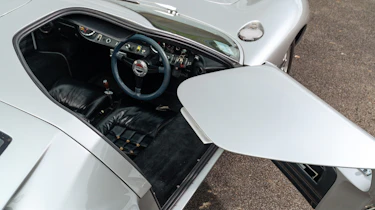
Another change was the repositioning of the gearchange from the right-hand sill in the racers to a conventional central location. This means the lever’s less likely to go up your trouser leg as you climb in, but getting aboard is still a challenge. Much of the roof arcs away together with the lightweight door to leave that distinctive cutout to step into.
Driving the Ford GT40
You can either thread your left leg through the small gap between the large-ish steering wheel and seat base, then support yourself with your arms as you post what feels like most of your torso through the same gap, or, sacrilegious as it feels, stand on the seat before lowering yourself in. The seats are dramatically reclined for a real lay-back driving position. They’re leather-trimmed and plumper than those of the race cars, though still with the little circular vents so familiar from pictures.
I’ve pored over so many photos in the past that the whole cockpit feels like I’ve sat here before: the red/blue-bordered ‘Ford G.T.’ script on the steering wheel and the horizontal rack of dials with the speedo at the far left angled towards the driver’s seat. It reads to 180mph. Unlike in my daydreams, I’m discovering that I don’t quite fit. Or my legs don’t, anyway. My knees touch both the bottom of the dash and the wheel at the same time, and I realise I’ll need to splay them slightly to let my hands get past when manoeuvring with a lot of lock at parking speeds.
Tall drivers need to duck to avoid a free haircut when closing the door, but there’s enough headroom for me. I’m glad I’ve worn my narrowest trainers, though, as the pedals are ultra-close even by racing standards. I wonder how Walter Hayes coped with them in ’60s-era office attire. The curved, pendant-shaped throttle pedal is perfectly positioned for heel-and-toeing and it’s a goosepimpling thrill to know it’s identical to the cast pedal assembly upon which Gurney, McLaren, Miles et al would have deployed their best footwork.
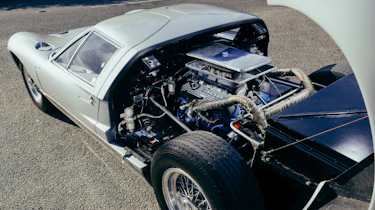
It starts with a simple key. The V8 needs a little encouragement from cold but tickover is smooth as silk once it’s warmed up. The 302 cu in (5-litre) engine is detuned compared with the racing versions, turning out around 306bhp here. Since this is a sub-1000kg car, that’s still a power-to-weight ratio comfortably ahead of a Cayman GT4’s, for example. The ZF ’box’s gearchange is reportedly dreamy in racing GT40s but has a reputation for being recalcitrant in the MkIII due to the more convoluted linkage rerouting it to the middle, and I’m warned that first gear has a habit of jumping into neutral.
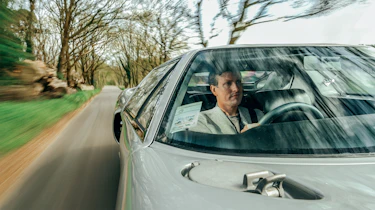
Nonetheless, there’s synchromesh on every gear, and first (left and back, in a dog-leg pattern) engages willingly. The conventional handbrake works nicely, the clutch is weighty but user-friendly, and with so much low-down, smooth torque on tap, it’s easy as pie to pull away and get into second gear early. That reputation for tractability immediately rings true – and I’m underway, on the public road, in a GT40. If I were taxiing in a Spitfire or plugging in an ex-Hendrix Stratocaster I’d be no less awed. Nor trepidatious. But it’s quickly clear the GT’s road manners are – genuinely – excellent.
The steering is heavy during low-speed manoeuvres but lightens on the move, and there’s lots of feel from the 215-section front tyres. The 245mm rears would have been broad back then but are narrower than the fronts of many supercars today. Although catseyes thwack sharply through the structure, overall ride quality on those tall tyres and 15-inch wire wheels is smooth. Better, in fact, than the majority of modern performance cars.
The brakes – solid discs all round – need a good firm press but are thoroughly effective. The throttle pedal has a v-e-r-y long travel, all the better for savouring the V8’s ultra-smooth delivery. The red line is at 6800rpm but there’s a strip of no-go-zone tape at 5000. I’m anxious to treat the car with respect and never let the needle stray past the marker, but it’s enough to sense the V8 really getting into its stride before each upshift.
Even if for a few fleeting moments, I can say that I’ve experienced full throttle in a real GT40 in second and third gear (and I can tell you that the hairs on my arms stood up as I typed that sentence). Down below the red line it doesn’t feel startlingly quick by modern standards but it’s more than fast enough.
In period, this car’s official performance figures list 0-100mph in 11.8 seconds, quick enough to out-accelerate a Miura (Autocar magazine recorded 8.8sec in a race-spec GT40 in 1969). With Le Mans gearing, some race cars with the older four-speed gearbox could reach 90mph in first. In this shorter-ratioed five-speed car, the engine is flexible enough to pull fifth gear at almost any speed without trouble.
And it sounds so, so good. As burbly and snarly and raucous yet smooth as a V8 should. It is loud – the top of the airbox is right next to the interior glass, a couple of inches behind your head – but not ear-splittingly so. The MkIII was fitted with extra sound-deadening material versus the MkIs. I’d go as far as to call it a relatively chilled driving experience on the road, albeit one that demands plenty of concentration.
The indicators are activated by a little plastic tab on the right-hand side of the dash that you nudge right or left as required (up and down flashes the headlights). To indicate right, you need to hold the tab in place to ensure the lamps are definitely flashing, and their lumen count is closer to glowworms than modern LEDs. Since this car doesn’t currently have wing mirrors fitted, and the interior mirror shows you more of the top of the engine than the road behind, I’m pretty cautious about changing lanes. But traffic all around gives the GT40 a wide berth, other drivers somehow aware that it’s something special. It may be small but it carries the giant aura of a supercar.
What about corners? Running through a series of arcing, second- and third-gear curves on a near-deserted Norfolk B-road, the GT40 settles quickly after turn-in and clearly has deep reserves of lateral grip. Although the MkIII’s suspension was softened compared with the MkI, it still feels nimble in the way you’d expect of a mid‑engined car without being nervous or flighty. It feels like a soft but stable, friendly sports car.
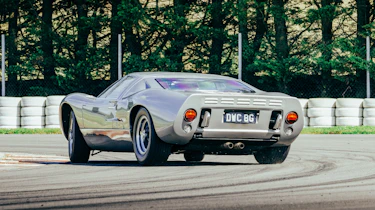
To exceed its limits on the road you’d have to be trying pretty hard. But you sense that it doesn’t particularly enjoy being driven slowly and would rather be let off its leash and run at its own pace than trundle in traffic. It feels like I’m only scratching the surface of its potential on this road, yet at the same time I feel totally involved. I’m getting a sense of how much fun Mr Hayes must have had on his commutes.
That reputedly awful gearchange doesn’t feel all that bad to me. That said, the throttle response is a little hesitant right at the top of the pedal’s travel, so you sometimes need a sort of double-blip to flick the revs up for a smooth downshift, while reverse gear (lift the little metal spar below the tiny gearknob, then left and forwards) invariably crunches no matter how carefully I try to engage it.
Although there’s more ventilation than in the race versions, the MkIII’s cockpit soon becomes a very warm place. Ford Zephyr-sourced globe-shaped air vents at each side of the dash can be spun around to direct cool air towards you, and there are opening quarterlight windows rather than the racing cars’ Plexiglass with tiny swing-out vents, but it’s not long before the interior gets toasty.
In an odd way, although they’re decades apart, the car the GT40 keeps bringing to my mind is the Aston Martin Valkyrie (also prone to overheating its occupants). In terms of purity of purpose, totally immersive driving experience and surprisingly smooth ride quality, somehow there are strands of the same creative cloth connecting the two in ethos. Except the GT40 sounds much nicer.
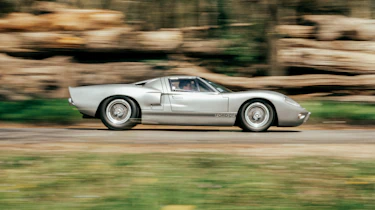
Like the Valkyrie, the GT40 was a brilliant but flawed road car perhaps not fully appreciated in its time. Part of the reason only seven MkIIIs were built is that Ford struggled to sell them. At $18,500 in the States, it was the most expensive car Ford had ever sold. At £7500 in the UK, it was the equivalent price of a very nice house. (For context, an E-type Jag was a little over £2k.) The perils of launching a supercar before a market for such cars really existed.
In today’s money, that works out at around £122,000, which sounds like a bargain to me. Car & Driver tested the MkIII in the States, or rather, detested it: its review slated most aspects bar the way it went, stopped and cornered, in particular finding the gearshift and build quality ‘unacceptable’.
In Britain, Car magazine ran a story in 1968 titled ‘The short, sad saga of the GT40’ in which Nick Brittan tested a MkI road car. He broadly agreed with C&D, concluding (albeit tongue-in-cheek) that he’d rather spend that car’s £6000 asking price on six Cortina 1600Es. Reputedly, some years after production had come to an end and Ford sought to get rid of redundant GT40s lying around and cluttering the place, a message went round the company offering them at knock-down prices not far off that of a 3-litre Capri. Today, this particular car’s value is estimated at £8-10m.
The car has undergone multiple restorations and, as part of Ford’s Heritage Collection, lives under continuous expert care, so its quality may well be higher than that of the example C&D unenjoyed so thoroughly. Still, I wonder if I’m simply too star-struck to see the MkIII’s flaws clearly.
The next day, when we assemble all the cars in the safety of Lotus’s Hethel test track for the pages preceding this story, there’s one more photo on the list for the GT40: a cornering shot, on one of the circuit’s wide, empty open hairpins. Dickie Meaden has competed in another original GT40 in historic racing, and describes how it feels relatively soft for a race car, and more progressive, less snappy than modern supercars. That’s exactly how the MkIII feels.
Even without ever straying over the 5000rpm tape or taking any risks, it comes alive. Carry a gentle dollop of speed into the corner, lift the throttle, and the nose tucks inwards like a modern mid-engined car, and then you can slowly feed in that long throttle pedal and allow the V8’s lovely wave of torque to carry you out of the corner. Everything happens in slow motion, the narrow but grippy tyres sending you all the information you need, the chassis on your side. It’s safe, it’s progressive. It’s beautiful to drive. It’s the real deal.
The MkIII has a reputation as a GT40 with blunted claws and too many compromises; not enough civility to be a real road car, not as fit for purpose as the racers. But for four or five runs past the camera on that corner, its race-winning source code feels fully alive and intact.
If you’ll forgive me a moment of personal sentimentality, my late father’s dream car was the GT40. Like most people, he never sat in one, nor touched one, let alone drove one. With every gearchange and every turn of the wheel – that wheel, with that Ford G.T. script – I feel I’m driving the car for him as much as for me. Best of all, it turns out to be a hero it’s safe to meet. Is it a supercar? It feels pretty super to me.
| Engine | V8, 4949cc |
|---|---|
| Power | 306bhp @ 6000rpm |
| Torque | 329lb ft @ 4200rpm |
| Weight | 998kg (312bhp/ton) |
| 0-60mph | <5.5sec |
| Top speed | 165mph |
| Price new | £7549 (1969) (£122k today) |
| Value now | £8-10m |