Range Rover Sport Electric review – a Porsche Cayenne’s worst nightmare
Like its full-sized big brother, the Range Rover Sport is now available with an all-electric powertrain, and it’s good enough to tempt you out of a V8

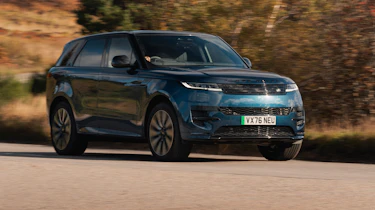
You wait for one all-electric British premium-luxury car to come along, and then four arrive in the space of five weeks. After Bentley’s Torcal, Jaguar’s Type 01 and the Range Rover Electric we now find ourselves behind the wheel of the Range Rover Sport Electric. It’s a £110,000 battery-electric version of the very popular Sport, which slots around the existing mild and plug-in hybrid diesel and petrol models, which are available in various flavours of six and eight cylinders.
As with its big brother Range Rover, the Sport Electric sits on the company’s MLA-Flex platform and was developed from its inception to be offered with an all-electric powertrain. It’s just taken JLR a few years (four in fact) to get around to launching it. The result is a 118.5kWh battery unit with double-stacked cells installed between the front and rear axles with a 349bhp electric drive unit driving each axle. In total there’s 542bhp and up to 627lb ft of torque at your disposal. Which is useful, because it weighs 2770kg. And if that power figure sounds a little low for a battery electric vehicle in 2026, Porsche’s Cayenne S produces 657bhp for £99,900 and the Turbo 1140bhp for £130,900.
More reviews
Long term tests
Reviews
- Range Rover Sport SV review – A Defender OCTA in a suit
- Range Rover Sport Overfinch Supersport review - for when a Range Rover Sport SVR just is too subtle
- Range Rover Sport SVR (2014-2022) review – Land Rover's big bold hot rod SUV
- New 2018 Range Rover Sport revealed with plug-in hybrid and 567bhp SVR
> Range Rover Electric review – why we’d have the EV550 over a V8
Not that this mass dents the car’s acceleration because it will still reach 60mph in 4.5sec (3.8 and 2.9 seconds for aforementioned Porsches). Launch the Range Rover Sport with all the systems wound up in Dynamic mode - when you are provided with the full fat 550bhp - and the sensation, while not as violent as those from Stuttgart, is still a little unnerving when perched so high and managing so much car.
Regardless of the drive mode you’re in, the Sport Electric presents the substantial updates that have taken place to the chassis to enhance the Sport’s dynamics. As Vehicle Engineering Director, Matt Becker explained: ‘The Range Rover and Range Rover Sport were quite close in terms of dynamics, with the latter lacking some of the dynamic character you would expect.
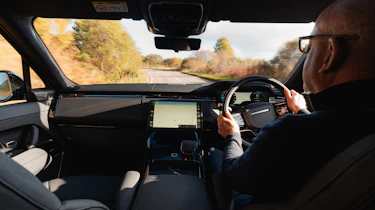
‘So with the Electric models we’ve introduced some upgrades to the Sport that help move the two models apart and allow them to showcase their unique characters better.’ Those changes include a different steering ratio and changes to the damper software and drive modes. If you’ve experienced the current Sport you’ll spot the changes pretty quickly.
First is the steering, where there’s more weight that feels more natural allowing for better on road positioning. It’s not Ferrari lightning quick, thankfully, but it does make the Sport easier to manoeuvre regardless of your speed, and makes for a calmer car when you run at a decent pace along flowing roads as you’re making fewer adjustments. On tighter, more technical routes it’s more direct, its rear-wheel steering more noticeable and the car more agile and comfortable as a result.
Where the Range Rover focusses on extreme comfort, JLR has given the Sport a more connected ride quality, with improved body control and a ride that’s more together. With the 118kWh battery increasing rigidity through the way it's integrated in the platform, there has been more scope to adjust the spring and damper rates to improve refinement and agility. Set to Comfort it’s more alert, the body movements more linear and steady, and the sense of connection stronger. There’s less body roll and if you’ve spent time in a combustion-powered Sport you’ll feel the EV’s Comfort mode is somewhere between a V8 petrol’s Comfort and Sport setting. In Sport the Electric adds more detailed layers to what’s taking place at the surface. It’s not Defender Octa sharp but you find yourself covering the tarmac at a pace that would impress in a quick estate car, never mind an SUV of this size.
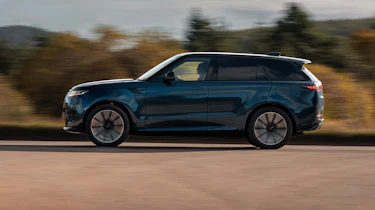
Then there is the powertrain, which like its Range Rover brother brings into question the need for a V8 engined Sport. Not only is its performance effortless but the throttle application and mapping is smoother, more refined and better suited to a car of this size. No, there is no growling V8 soundtrack, but that’s been missing in this generation of Sport since legislation banished the soundtrack to a digital file to be played through the speakers. And you never drove a V8 engined Sport on its limiter, thumping through gears and chasing the redline, you rolled along on its torque wave and watched the fuel gauge race to its stop. That this electric model has a range above 330 miles that’s a match for a fully fuelled V8 Sport only emphasises the suitability of a battery powertrain in such a car. Efficiency is a claimed 2.8 mi/kWh.
Obviously there remain question marks over the charging process in the UK, but find a quick charger and you’ll get from 10 to 80 percent battery charge in 22 minutes. And as with the Range Rover Electric, the company’s charging app is designed to take the jeopardy out of charging in the UK.
The switch to electric doesn’t hinder the Sport’s off-road capabilities one bit. If anything, they aid them. There’s no need for a low range gearbox, so when climbing an obstacle everything is much smoother and measured, with no flare of engine revs to distract you. With additional changes to the firm’s Terrain Response that maximise the benefit of an electric powertrain when negotiating whatever the landscape can throw at it the Sport’s off-road credentials are improved rather than compromised. Wading depth remains 900m (the charging flap, like the fuel flap is positioned at 1-metre on the rear three-quarter panel if you ever find yourself in the position of wondering how deep the water is that you are currently in. Assuming you haven’t switched on the on-board wading app, that is).
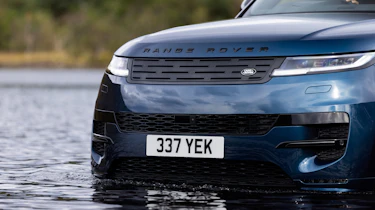
Range Rover has been criticised for being late to market with its electric offerings, especially so as sister brand Jaguar launched the I-Pace in 2016, but in taking its time it feels the brand has been able to develop the right car at the right time. There’s certainly more powerful electric SUVs, and there are cheaper ones from disruptor brands, but the Range Rover Sport has landed in a sweet spot of offering just the right amount of everything. There remains a question mark over reliability, an area Managing Director Martin Limpert acknowledges is an area they need to work on and are, and many will still question the suitability of an electric powertrain in meeting their needs. Certainly if you rely on the ‘utility’ of your SUV more than the ‘sport’ then diesel will still most likely be the preferred fuel choice for you. But if you currently run a petrol plug-in hybrid or a V8 petrol, the EV550 could be the model to convince you to at least try the electric alternative.
Price and rivals
Range Rover’s new Sport Electric starts at £111,570 on the road in Dynamic SE trim and climbs to £126,289 for the First Edition. Porsche’s 657bhp Cayenne S starts from £99,900 the Turbo with 1140bhp starts from £130,900. BMW’s new iX5 M60e xDrive with 612bhp starts from £101,775, Mercedes new AMG GT SUV in GT53 trim producing 544bhp starts for £113,774.