Why this 300,000-mile Ford Mondeo felt more revolutionary than a Lamborghini
With one of the development parameters being the ‘perfection feeling’, the Mondeo was always going to be something special
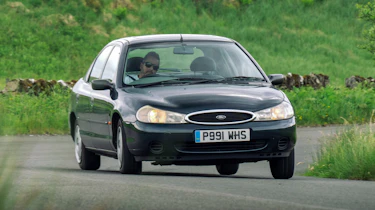
Much as the ’90s supercar scene experienced a transformative shift from models rooted in the ’70s to fresh designs with more driver-friendly dynamics, so bread-and-butter saloons enjoyed their own revolution.
Creating the Mondeo was an all-out $6billion effort from the Blue Oval. Initial discussions began just three years after the Sierra was introduced, the new project carrying the internal codename CDW27. By 1988, Ford was deep into the benchmarking process, identifying the Honda Accord and, later, the Nissan Primera as its ‘100 per cent’ target cars, with others, such as the Toyota Camry and Peugeot 405, also in the crosshairs.
To set a new benchmark for the sector meant setting new engineering and development standards. No fewer than 13 parameters were established: everything from ride and handling to ‘shiftability’ (the feel of the gearshift) and something called ‘perfection feeling’, the aim here being to imbue the Mondeo with a premium ‘hewn-from-solid’ feel.
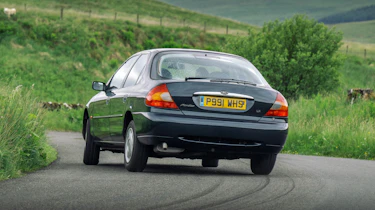
The Mondeo introduced many advancements, either as standard equipment or options. A driver’s-side airbag was fitted to all models; a world first that contributed to the Mondeo being named European Car of the Year in 1994. Seatbelt pre-tensioners, anti-submarine seats and side-intrusion bars were other standard safety features. ABS was a cost option, as was traction control on higher spec Si and Ghia models, though not the humble 1.8 LX driven here. Electronic adaptive damping was another option but rarely selected, largely due to cost and the vast majority of Mondeos being bought as company fleet cars.
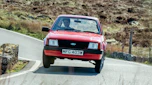
The Mk1 Mondeo was a huge success. Almost 450,000 sold in the UK alone between its launch in 1993 and the Mk2’s introduction in late 2000. It even entered the British political vernacular, then-Labour leader Tony Blair identifying the need to win over ‘Mondeo Man’ in the run-up to his party’s landslide 1997 general election win.
We’ve grown accustomed to built-in obsolescence in most things, but the Mondeo is from a different age, Ford’s immense investment showing in every aspect of this car. Still going strong after 303,000 miles, its second owner – Carl Smith – bought it 23 years ago for £950 with a modest 60,000 miles on the clock. He then proceeded to drive it almost a quarter of a million miles – to the moon! – mostly on motorways and clearly with real mechanical sympathy.
Fastidious maintenance and generous Waxoyl protection also paid dividends: P991 WHS has never failed an MOT and remains on its original engine, gearbox and clutch! Smith sold it to The Great British Car Journey museum earlier this year for £1500. Supercar speculators eat your hearts out.
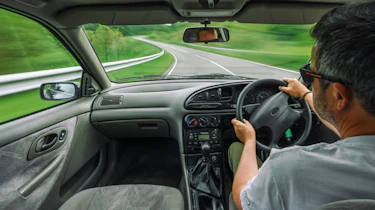
It’s remarkably fresh to drive. Ford developed the 16v Zetec engine for the Mondeo, and this 1.8-litre, 113bhp, 117lb ft derivative still pulls with the same lusty low- and mid-range I remember from driving Mondeos back in the day. The smooth, free-spinning top end gives the car a genuinely refined and sophisticated feel. One that, combined with the fine handling, made for a pioneering elevation of the everyday driving experience.
Chassis dynamics are still stand-out good. There’s a tautness to the body control that suggests ride comfort will be on the firm side, yet there’s a sweetly judged suppleness that soothes away sharp edges and isolates you from the busyness of coarse surfaces. Find some fun corners and the Mondeo really shines. There’s precision to the steering and a deftness to the handling that makes it a pleasure to hustle. It remains poised up to and beyond the limit, turning in crisply and reacting faithfully to throttle and steering inputs.
It’s fair to say that prior to Mondeo, mass-market cars – at least European mass-market cars – weren’t delivered with the same commitment to excellence. In going the extra mile, Ford ensured the Mondeo was a truly world-class car, one that served as a watershed moment as Ford rid its reputation for building mediocre, cost-cut family cars and instead became known as a leader in handling dynamics and safety features.
Of course, it’s still bizarre to step from a Diablo SV into a Mondeo. The gulf in spectacle and performance remains hard to wrap your head around, yet for the first time in our Supercar Eras series, not only does an everyday family saloon possess some genuine sparkle but it has the point-to-point chops to live with a Lambo, at least on tricky roads or in dicey conditions. The rise of the repmobile had begun.