Petrol v electric: Alpine's A290 faces the Mazda MX-5
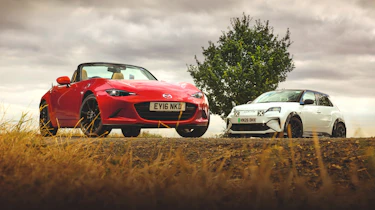
Alpine’s A290 is under consideration by evo contributor Peter Tomalin as a replacement for his MX-5. A comparison is in order…
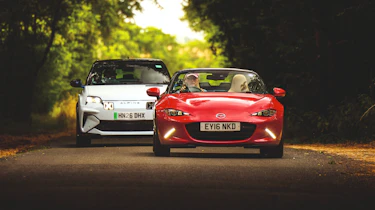
It’s the end of a day’s driving and photography, and we’re on fast, cross-country roads that thread through a drought-bleached landscape. As always when a twin-test is drawing to a close, you’re mulling each car’s strengths and weaknesses, edging towards deciding which car wins. In this case, though, there’s rather more riding on it than usual, because one of the protagonists is my own current car and the other – if it wins – could well be my next.
Yep, like many of you I suspect, I’m toying with the idea of going over to the dark side. Partly because Mrs T and I are having solar and batteries installed at home, which opens up the possibility of substantially cheaper motoring (at least until the government works out how to tax electric miles). But also because there are now real options.
Whatever your view of EVs, there’s no question that engineers are finding ways to make them genuinely fun to drive. My own Damascene conversion came on last summer’s 2020s Eras test, where I had my first drive in Hyundai’s really quite astonishing Ioniq 5 N rocketship – 600bhp+, simulated gearshifts, crackles, pops and all. It truly opened my eyes to what was possible with pure battery power, though its £65,000 list price put it somewhat out of reach.
Alpine's A290 is on the (very) short list of EVs that attract the full £3750 Electric Car Grant in the UK. Prices start at £30,245 for the 178bhp GT, though arguably the one to have is the mid-range GT Performance at £32,745, which sees power rise to 217bhp and cuts the 0-62mph time from a briskish 7.4sec to a genuinely lively 6.4sec. And if you want all the bells and whistles, the top-spec GTS (like the car here) has the same 217bhp but a more upmarket cabin and premium audio system and is priced at £34,245.
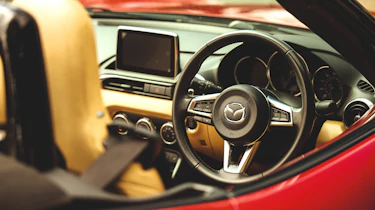
Which puts it toe-to-toe with a brand new MX-5 2.0, with an almost identical list price and 0-62mph: £34,515 and 6.5sec. So if this were a straightforward twin-test between new MX‑5 and A290, it’d already be a genuinely intriguing match-up, with nothing to choose in terms of price or performance. But for me there’s so much more riding on it. Is the A290 the car to replace my much-loved 5?
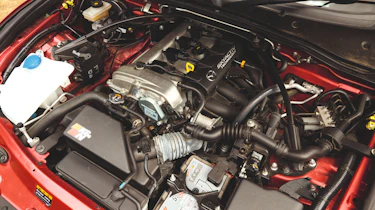
Mine’s an early ‘ND’, which means it started life with slightly less power than the latest model, but a Stage 1 remap by specialist BBR has taken it to within a whisker of the current car’s 181bhp, so the 0-62 should be near enough identical, while peak torque is actually slightly up on the latest 2.0, with 160lb ft at 4750.
Of course, the A290 has its measure there, with a meaty 221lb ft and almost instant access, as is the EV way. And then there are those fuelling costs. With an EV-friendly tariff and a 7.4kW home charger, you can take it from practically zero to fully charged overnight for about four quid. Which in theory should give you a range of about 220 miles. And if you spent your driving life pottering around at 40mph, it might even get close to that. After some spirited driving in our hands, the maximum indicated range dropped to 180 miles, which, allowing for a safety margin, equates to around 150-160 real-life miles.
For many, that will be absolutely fine. It will cover most commutes, and save you a chunky sum in the process. In the MX‑5, averaging 40mpg and with superunleaded at around 170p per litre, that same 160 miles would cost you roughly 30 quid. At those rates, if you drove 5000 miles a year, it would amount to £937 for the Mazda, a mere £133 for the Alpine. So the EV’s off to a good start.
The tech’s friendly too. My son Freddie, who’s helping with the driving duties today, has a Renault 5 E‑Tech and an Ohme Home Pro charger – a popular choice for smart-tariff integration – and has found it an absolute doddle to use. He’s with Eon Next Drive for cheap overnight charging, and it all works seamlessly via the Ohme app, which allows you to program exactly when and how much charge you want, and then monitor progress remotely. Or you can spend three minutes filling the MX‑5’s tank and give yourself an instant, reliable range of 350 miles…
I start in the Mazda. Freddie drove the A290 back to his place last night to give the battery a boost, so we’re meeting there. He texted me late last evening: ‘Took a very roundabout way home. Enjoyable drive! Very quick.’ He’s not wrong. I’ve had the Alpine a couple of days, and twice I’ve taken it for a quick spin that turned into something rather longer. It does feel properly rapid, but also a genuine hoot to throw around, and so drum-tight and refined.
The MX‑5 feels a touch tinny by comparison. Tiny, too. And with the hood up, a tad rattly over sharp bumps. But most of all, almost shockingly mechanical. Suddenly I’m acutely aware of the gearshift’s action (slightly stiff when cold) and the need to blend throttle, clutch and brakes.
We’re off to some favourite roads. Hood down now, the MX‑5 feels noticeably energised, the exposure to the elements – and the deliciously rorty exhaust note – encouraging you to rev the engine right out through the lower gears and gun it through flick-flack direction changes, where its lack of mass (c1000kg to the A290’s near-1500kg) is a constant joy. With your hips so low and close to the rear axle, you have an intimate connection with the tarmac and a detailed sense of the grip ebbing and flowing.
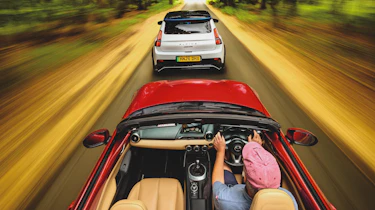
We switch between the cars as the morning progresses. Following it from behind, the A290 looked terrific; compact and reasonably hunkered down to the road for a tallish hatch, but climbing aboard after the Mazda feels like you’ve reached the front seat of the top deck of a bus. And there’s so much going on with the multitude of graphics on the wraparound screens after the simple analogue dials of the MX‑5.
To be fair, it’s a very appealing cockpit, particularly with the GTS’s expensive-looking – and smelling – leather. A simple double-stab of one physical switch disables the dreaded ADAS, and there are physical buttons too for most of the everyday functions. The sculpted, flat-bottomed steering wheel feels terrific and has cool-looking switchgear for driving mode selection, braking regen levels and the ‘Overtake’ function.

The last of those gets mixed notices. ‘A bit gimmicky,’ is Freddie’s view, ‘because you get just the same thing from depressing the accelerator all the way down.’ Whereas grandson Roen absolutely loves it – especially with the accompanying screen graphics that confirm you’ve entered warp drive. But the A290’s not just about the stereotypical EV wallop up the road; that 221lb ft can be deployed with pleasing progression when desired.
Sport mode gives a sharper throttle response, a little more steering weight (it’s still a touch too light), and a slightly louder ‘engine note’ when accelerating. This could be just another gimmick, but in fact it’s subtly done and brings an added layer of enjoyment. ‘Despite what I was expecting, I actually do like the engine noise,’ says Freddie. ‘It’s not excessive but it does sound good.’ The way it grows and hardens only when you’re really into the throttle is very nicely judged.
As is the seamless blend of conventional and regen braking; keeping the latter in its mildest setting gives a pleasingly naturalistic flow to the drive. Meanwhile the suspension – multi-link at the rear, with a 6cm wider track than the R5 and bespoke springing and damping – combines real composure with a playful edge. The occasional tug of torque-steer and a little shimmy through the steering as it lightens over crests adds to the fun, and a lift and a brush of the brakes on turn-in gets the nose nicely tucked in as the rear shifts around. Chunky (225/40) Pilot Sport 5 Ss give just enough bite while taking the sharp edges off the worst ridges and craters.
The Alpine is making a very convincing case as both a practical everyday car and one you’d drive just for kicks. In other words, the time-honoured recipe for a hot hatch, but with an EV twist. I can quite easily imagine living with one of these and having a lot of fun in the process. Back in the MX-5, life’s pretty bloody good, though. Where the EV’s delivery is all about the torque, the thrill in the 5 comes from ripping up to the red line, the way it sings at the top end as the final rush comes. Under a motorway bridge, the exhaust note bounces off the concrete and you just know that no piped-in artificial engine noise will ever match its rawness and authenticity.
There’s delicacy here too, the steering wheel – smaller and thinner of rim – eliciting a precision and immediacy that’s just out of reach for the Alpine. And where the A290 needs to be taken by the scruff to get the best from it, you don’t need to be driving like your trousers are on fire to enjoy the MX-5. There’s pleasure to be had executing a perfect heel-and-toe downshift, or slicing through turns at 50mph, which of course always feels much faster in a tarmac-skimming sports car. ‘The Mazda’s just great, isn’t it?’ says a beaming Freddie.
We swap seats one last time and head for home via some favourite B-roads. Leading in the Alpine, I’m impressed all over again by its cabin, by its ride, refinement and effortless shove. But I know where I’d rather be – and in that moment I have my answer.
Specs
| Mazda MX-5 | Alpine A290 | |
|---|---|---|
| Engine/motor | In-line 4-cyl, 1998cc | 1 x 162kW |
| Power | c180bhp @ 6750rpm (BBR remap) | 217bhp |
| Torque | 160lb ft @ 4750rpm | 221lb ft |
| Weight | 1053kg (c175bhp/ton) | 1479kg (149bhp/ton) |
| 0-62mph | 6.5sec | 6.4sec |
| Top speed | 135mph | 106mph |
| Basic price | £34,515 | £34,245 |