My Range Rover Sport survived something that would wipe out an ordinary car
Need a machine built to withstand Britain’s current pothole hell? Look no further…

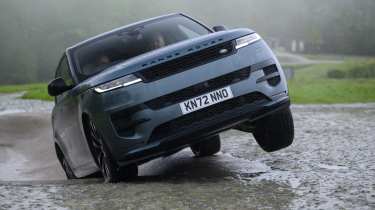
It was dark, naturally it had been raining, and the road – a typical British B-road barely wide enough for two cars but with a central white line that was still visible – would pass for a shallow stream, the puddles forming a small reservoir with a sideline in destroying tyres, wheels and suspension components. I’d managed to avoid it, until the fatal night when I didn’t.
The windscreen filled with water. The wipers sprung into action. The noise was terrifying. The shock through the steering wheel and up to my shoulders was violent. The tyre pressure warning alarm was surely only moments away from being activated. I was already planning the recovery with a call to Land Rover Assistance.
> Range Rover Sport SV review – A Defender OCTA in a suit
The tyre pressure warning alarm never went off. KN72 NNO still tracked straight and reacted to inputs as it should. My shoulder ached. We continued on our way home, where I could investigate properly. The bulge in the sidewall would be epic, the crack in the wheel sizable, I told myself. I was tempted to wait until the morning. The cold light of a new day might soften the blow. It might have stopped raining by then, too.
More reviews
Reviews
- Range Rover Sport SV review – A Defender OCTA in a suit
- Range Rover Sport Overfinch Supersport review - for when a Range Rover Sport SVR just is too subtle
- Range Rover Sport SVR (2014-2022) review – Land Rover's big bold hot rod SUV
- New 2018 Range Rover Sport revealed with plug-in hybrid and 567bhp SVR
- Range Rover Sport review - more entertaining than you might expect
I didn’t wait until the morning. I bit the bullet: grabbed a coat, found a torch and went to take a look. And nothing. The Pirelli Scorpion Zero all-season had the same amount of air at the bottom as it did at the top. The wheel’s eight spokes were all still the same shape. The nearside front suspension was still holding the corner up. I went to bed. It would all be different in the morning.
It wasn’t. Nothing had changed. An inflated tyre, a round wheel and functioning suspension. Closer inspection found nothing untoward in the wheelarch either. My shoulder still ached.
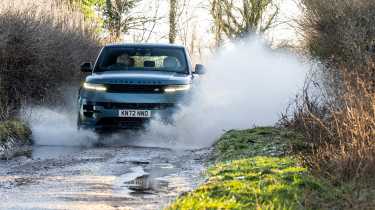
I knew Land Rover’s kerb-strike test was ‘substantial’, so taking on a pothole should be within tolerance. But returning to the scene of the ‘impact’ this wasn’t what you would call an ordinary pothole (actually, you might in 2026). Parking the Sport’s 23-inch front alloy in it, at least 25 per cent of the wheel disappeared from view. There was no ‘entry’ or ‘exit’ ramp of broken bitumen to soften the blow, just a hard face of compacted tarmac, concrete and, I suspect, bits of alloy wheel and rubber. I must have hit it at 45-50mph and yet the Range Rover didn’t flinch. Had I been in its Fast Fleet predecessor, the DBX707, I would have spent the evening picking up pieces of a 23-inch wheel and tyre from the nearby field. A supersaloon’s front corner would have been obliterated.
Of course, there’s a sizable chunk of irony that our roads are in the condition they are in because cars are getting too heavy, and a 2300kg Range Rover Sport is guilty as charged. But combine this with roads that are patched up rather than repaired and it’s little wonder the roadside tyre replacement companies are enjoying strong business. As I can attest to, for later that week the family A-class demonstrated that it didn’t have the same resilience to taking on potholes. My shoulder still hurt, but that pain faded into the background when I got the bill to rebuild the nearside front corner of an A-class.
This story was first featured in evo issue 322.