New BMW X5 will face Audi’s Q7 with hybrid, diesel and electric power
The Neue Klasse BMW X5 is here to face the new Mercedes GLE and Audi Q7

BMW might not have invented the premium SUV market; Range Rover beat it by several decades. And it wasn’t the first German brand to explore the segment either, with the Mercedes M-Class arriving in 1997.
But 1999’s BMW X5 was the first to offer a genuinely car-like driving experience, and as an all-rounder it’s been hard to beat across four generations so far – and BMW is confident the all-new fifth-generation X5 will remain a class benchmark.
New BMW X5 powertrains and handling – electric, PHEV and diesel power
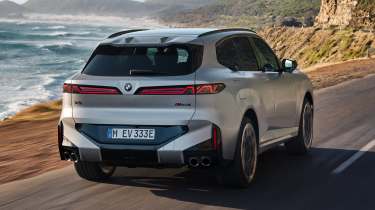
There’s a bit of a five theme with the latest X5 in fact, with the fifth-generation car also offering (globally) five different drive systems, including an all-electric iX5 capable of, you guessed it, more than 500 miles on a charge (and offering more than 500bhp, too).
UK buyers can expect four of the five options BMW is ultimately offering, and that quartet includes a diesel, two plug-in hybrids, and a fully electric iX5. BMW’s not given up on diesel yet, and while CO2 emissions will ultimately rule it out for most company buyers, private customers may be more tempted. The X5 40d xDrive uses a 309bhp, 494lb ft 3-litre turbocharged inline six with 48-volt mild hybrid assistance, and while CO2 numbers haven’t yet been confirmed, both combined economy and performance have: 40.4mpg, 0-62mph in 6.1 seconds, and 143mph.
Then there are the two plug-in hybrids, the 50e xDrive and range-topping M60e xDrive. Both use a 3-litre turbocharged inline six petrol engine and 26.5kWh battery, but there’s a distinct step up in output between them. With 482bhp and 516lb ft the 50e is already quite brisk, at five-flat to 62mph and a 155mph limiter, but the M60e elevates things to 604bhp, 590lb ft, and cuts half a second from the 0-62mph time. They’ll do 63 and 61 miles on a charge respectively, or 40-50mpg in plain old hybrid mode once you run out of battery juice.
The electric iX5 will be the company-driver favourite thanks to its zero-CO2 figure but certainly isn’t left behind in performance terms. Its twin motors (one at the front, one at the rear) put down a combined 570bhp and 594lb ft, trailing the M60e by just a tenth to 62mph and topping out at 130mph.
Buyers of the iX5 will probably be most interested in the 525-mile WLTP range figure. That’s set to be the longest of any EV on sale in the UK (impending i3 aside), and it’s not for want of fast charging either. Up to 460kW should also put it among the quicker top-ups of any car on sale, if you can find a charging station to supply that.
Handling has always been an X5 strong point and there’s little reason to expect any different this time. Ignore for a moment that the iX5 uses something called the Heart of Joy to control its various functions, and instead concentrate on standard adaptive suspension, roll stabilisation and 3.2 degrees of rear-wheel steering on M Performance models, and manual or automatic adjustment of ride height. BMW also promises its usual 50:50 weight distribution, and from our experience of the iX3 and the slightly older iX, BMW’s SUVs remain capable, if not always engaging.
Silly name aside, Heart of Joy should give the iX5 similarly adept road manners too. It promises processing power ten times faster than BMW’s usual electronic control units and is able to optimise driving and braking forces among all four wheels. It can also improve energy recuperation under deceleration, allow the car to blend semi-autonomous functions (such as hands-free motorway driving up to 81mph) with the driver’s own inputs and use braking regen to make smooth limo-style stops.
Built at BMW’s facility in Spartanburg in the United States, the company hasn’t yet confirmed pricing and full specification for the new X5 but does say it’ll hit UK roads in March 2027. A 466-mile hydrogen variant, and a more performance-orientated electric model, will arrive later down the line.
New BMW X5 – design and interior
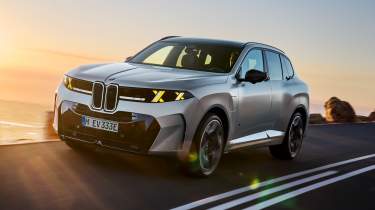
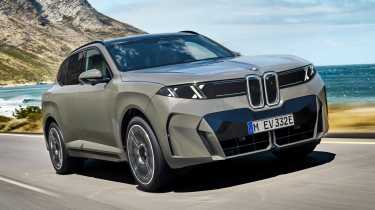
Where the X5 is recognisably a member of BMW’s Neue Klasse family, alongside the recently-launched iX3 and upcoming saloon-shaped i3. SUVs in this new lineup get a narrow grille design reminiscent of the original Neue Klasse cars of the 1960s (the i3 has a wider interpretation), and vastly smaller than that found on BMWs of the last five or six years.

For once though the standout visual feature isn’t BMW’s latest interpretation of its classic kidney grille, but the “double-X” daytime running lights, which either look like the protective tape on old racing cars (cool) or a cartoon character who’s been knocked out cold (less cool) depending on how hard you squint. Expect them to become the next aftermarket trend among knackered old 3-series everywhere.
The profile is more squared-off than recent BMWs, with similarly geometric arch detailing; the Hoffmeister kink is present and correct, while at the rear the styling also echoes the other Neue Klasse models, with slim tail lights that almost meet in the middle of the tailgate, stopped in their tracks by an inset BMW roundel. The door handles are semi-hidden, taking the form of little upturned flicks at the bottom of the B and C pillars.
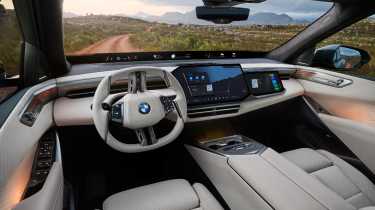
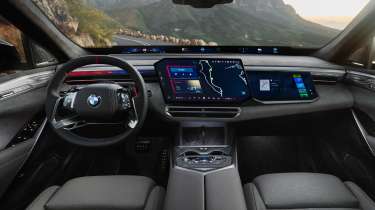
The cabin design is also broadly shared with the iX3 and i3. Your eye will clock the most notable features in roughly this order: an ovoid steering wheel with architectural spokes at twelve and six (the ones at nine and three don’t actually meet the wheel rim), a large rhombus-shaped central touchscreen tilted towards the driver, a thin Panoramic Vision display at the base of the windscreen, and an optional display on the passenger side.
M Sport Pro models and up get a marginally more conventional steering wheel design (only marginally, mind) and a darker theme than the light and airy car you see in these images, but otherwise all X5s are equipped to the degree you’d expect from one of BMW’s core models. A panoramic sunroof, ventilated and massaging Sports seats, and a 3D head-up display are standard, while rear heated and ventilated seats and 18-speaker Bowers & Wilkins audio are on the options list.
M Sport, M Sport Pro, and M Performance models get the usual suite of Shadowline trim, sportier exterior styling, M Adaptive suspension, and unique alloy wheel designs – 21 inches on the M Sport, 22in on the Pro, and there’s the option to delve further into the M Performance catalogue for spoilers, diffusers, and even more wheels. The M60e plug-in hybrid gets a yellow version of the double-X lights (much like existing M cars get yellow-tinted DRLs), a rear spoiler, a unique grille design, quad exhaust outlets, and 22-inch alloys with performance tyres.