Jaecoo 7 review – impressive in ways, not great in others
Is what is now one of Britain’s best-selling cars actually any good? We got one in to find out

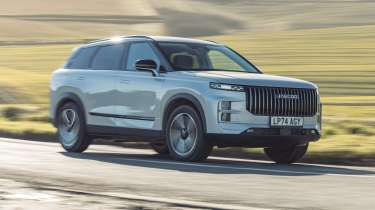
It is currently the bane of any road tester’s life. Tell anyone that you drive cars for a living and it’s only minutes before someone asks ‘what about that Jaecoo 7, then?’. It’s the talk of the country, now being a regular fixture in the UK top 10 most-registered new cars, peaking in March 2026 at the top spot. And superficially, it’s easy to see why. People love the way it looks (it’s not known colloquially as the ‘Temu Range Rover’ for nothing) and it’s competitively priced (though not as 'bargain basement' as you'd expect) too.
You'd be right in also wondering if this isn't a little out of our usual sphere of interest but to that I'd counter, it’s important for us to stay in the loop of what the vast majority of consumers are investing their money in. Plus, some of our favourite performance cars have their roots in more humble products – Volkswagen’s Golf GTI, Ford’s Fiesta ST for example. Then there’s the fact that morbid curiosity also prevails as we all find ourselves asking, what’s the catch? If it looks good, is that much cheaper than rivals and comes from a new, unknown name, where’s the trade-off? Only one way to find out.
Powertrain, performance and efficiency
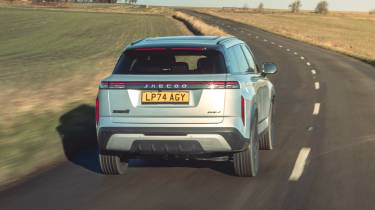
- Hybrid powertrain genuinely impressive and efficient
- Management of energy works well
- Electric element makes it feel brisk and responsive
The Jaecoo 7’s powertrain lineup includes a straightforward petrol with a 1.6-litre turbocharged engine and 146bhp, a closed-loop self-charging hybrid, known as Super Hybrid System (SHS-H) with 221bhp and a plug-in hybrid with a 1.5-litre engine and 201bhp. It’s the last of those three - the most popular - that we’ve tested.
We’re off to a good start, as this is a genuinely impressive powertrain, offering passable performance, commendable efficiency and clever self-management. Peak power of 201bhp and 229lb ft aren’t show-stopping – 0-62mph takes 8.3sec on the way to a 112mph top speed – but the electrical element and sturdy 18.4kWh battery mean it’s responsive, with a useful EV-style surge available from low speeds. This is a powertrain you have confidence in around town as well as at higher speeds.
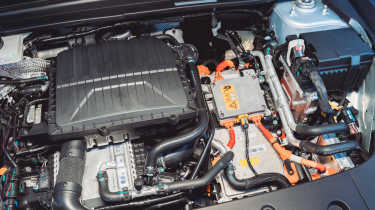
Many plug-in hybrids default to chewing their way through their battery reserves irrespective of the type of driving, even at motorway speeds. The plug-in Jaecoo swaps to its combustion engine (often smoothly but not always) at higher speeds, meaning your battery power is kept in reserve for when it can be most efficiently used, in urban and rural lower-speed driving, not to mention in traffic.

It’s also swift to self charge when you give it a target to reach and the electric range itself is decent. All told, with some heavy-footed driving and plenty of self-charging we managed to average almost 50mpg overall. With diligent home charging and more considered driving, this would be a very frugal prospect indeed.
Notes? The gearbox can sometimes feel a little unresponsive, though the torque of the electric motor works well to disguise its deficits. Throttle and regenerative braking on initial pedal application could do with some tweaking, as it’s a bit ‘on-off’, leading you to become more of a nodding dog with only millimetric throttle movements than you’d like in stop-start traffic. That said, the regenerative friction braking handshake is surprisingly well resolved.
Ride and handling
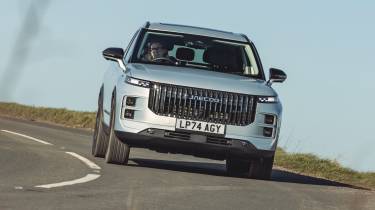
- Body control to rival an old body-on-frame Land Rover
- Lifeless detached steering
- Needlessly choppy ride
You’d be forgiven for expecting impressive things when it comes to ride and handling too. It has a stiff structure, independent multi-link rear suspension and dynamics proudly honed at a German development centre. This, because ‘Jaecoo understands that customers in the UK and Europe are some of the most demanding worldwide when it comes to vehicle dynamics. and that UK roads bring with them a unique set of needs for a vehicle set-up’.
On the contrary, in our experience at least, the driving dynamics bring things crashing right back down to Earth. Never mind a Porsche Macan, if you’re used to Citroen’s C5 Aircross, the Jaecoo will feel like an old Land Rover Discovery with its body tethered to its ladder chassis via an intricate web of bungie chords.
The latency between you passing through a disturbance in the road and the body actually reacting is palpable. Then it often doesn’t settle after that first undulation, meaning you start to feel like you’re caught in a runaway wave machine when on a continuously undulating road, to the point of making yourself feel slightly carsick. It really could be a masterclass in mass control feedback loops.
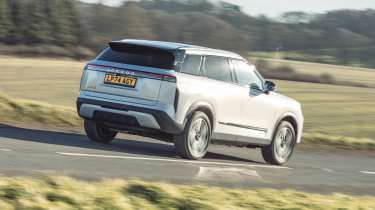
In spite of a glaring dearth of control, it also doesn’t ride very well. Slow things down and you go from feeling a bit ill, to flinching every time you pass over an errant bit of gravel, given the unceremonious manner in which it handles high-frequency bumps. The steering’s not great either – light and easy at low speeds, granted, but concerningly vague, unresponsive and inconsistent once you’re free of the urban sprawl, especially off-centre. It is at least easily manageable on the motorway.
The dynamics are by far and away the most glaring way the Jaecoo tells on itself. You do recall while driving it just how far Land Rover have come in terms of their suspension tuning. This is where some of the extra money a Volkswagen Tiguan or Audi Q3 costs goes.
The amount of work that’s claimed to have been put into it makes this confusing, with ‘everything from spring and damper rates, steering ratios, anti-roll bar stiffness, bush rates, tyre types and pressures, plus brake pad materials, developed to deliver the ride, handling and agility expected by European motorists’. I would be very curious to see what even the most disinterested of drivers thought of a Range Rover Evoque or Velar's driving experience by comparison.
Interior and tech
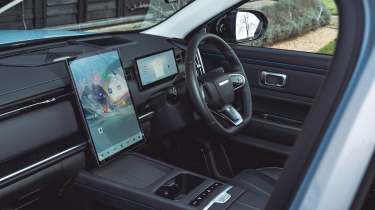
- Quality is fine, UI is responsive if menu-heavy
- A few tech glitches to be found and dodgy ADAS
- Well-equipped and spacious
The driving experience is further marred by the ADAS tech, which is still not up to standard even after updates. The lane assist tugs at the wheel if you dare not track absolutely centrally in your lane and the driver attention warning is hyperactive. It got so irritating that at one point I vowed to make this entire review ‘You have become distracted!’ written a thousand times like Bart Simpson repeating lines on a chalkboard.
Happily, it’s relatively easy to switch off with a swipe and a few taps on the screen to disable it. It should come as no surprise that almost everything the Jaecoo does is handled in the touchscreen. The SHS-P powertrain is only available in Luxury spec, which upgrades the vertical screen from 13.2 inches to 14.8. Happily, it’s relatively responsive and smooth, even if the Apple-esque, menu-heavy UI takes some navigating. It's intuitive in that iPhone-alike way but then using it while driving reminds you why phone use is banned behind the wheel.
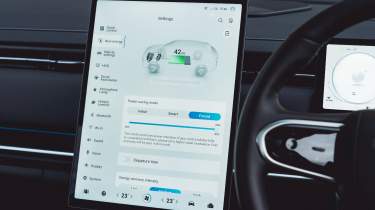
If you don't hook your phone up with either Apple CarPlay or Android Auto then the climate controls and car settings are easily accessed via a bar along the bottom of the screen. Connect your phone however and this disappears. I also found Google Maps glitched aggressively with Android Auto hooked up, the system constantly thinking I was in the Norfolk town of Attleborough. You could say that's a Google thing, but it didn't happen in any other test cars I hooked my phone up to that week.
Luxury spec also adds a heated steering wheel, an upgraded Sony sound system and cooled seats in the front. Those came in handy during our test when Britain was being ravaged by the third of the seven heatwaves we’ve suffered so far this summer. The rear seats are only heated, not cooled. Lesser models have their drive selector in the middle but the SHS-P car we had used a (somewhat unresponsive) column stalk.
Quality in the interior is a mixed bag. Everything looks nice enough, the synthetic leather seats featuring chunky piping and a soft waxy feel. But it’s skin deep, with tinny plastics and flimsy materials a short hunt away. There’s a good amount of wind noise and tyre roar at speed too, the Jaecoo appearing flimsier and less substantial than some rivals when it comes to NVH. It’s happily easy to see out, nicely spacious in the cabin with clever storage solutions and a decent-sized (if not class-leading) boot.
Price and rivals
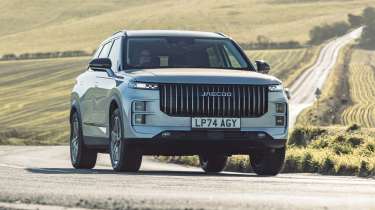
The Jaecoo 7 range starts from £29,195 for the SHS-H in base Pure trim with Deluxe, Luxury and Black Luxury the subsequent trim levels. Petrol engined models starts from £30,115 (for both front- and all-wheel-drive versions), albeit these are only available in Deluxe trim and upwards. As above, the SHS-P is only available in Luxury trim, from £35,165.
Obvious rivals include the Nissan Qashqai and Kia Sportage. We’d also consider the Citroën C5 Aircross, which while less impressive in terms of its hybrid powertrain, is a much more comfortable, cossetting experience on the road.