Lotus Elise (S3, 2010-2021) review – lithe, lightweight and extinct
There was nothing like the Elise before it arrived in 1996 and surely, there will be nothing like it ever again
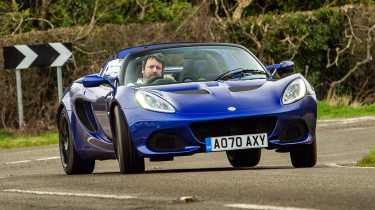
The Lotus Elise has not been surpassed for its beautiful simplicity, pleasing compactness and bristling energy and feedback since its discontinuation in 2021. Cynics will argue that it didn’t change or develop enough, retaining the same basic extruded and bonded aluminium chassis design across nearly three decades. In reality, the Elise highlights just how overweight, over-the-top and cumbersome sports cars – and all cars – have become. Short of an Ariel Atom, a Caterham or some other obscure kit car, sports cars just don’t get lighter, sharper or more satisfying than an Elise and likely never will again. It should be on any driving enthusiast’s bucket list to own one, or at least get behind the wheel.
The question of which Elise is a more difficult one to answer, given there are so many of them. The third-generation Elise range exploded with an enormous variety. Basic, Sport and 220 models were joined by the 250 and 260 Cups that stopped little short of what was once understood to be the Exige. For the 2010s, the Exige evolved into a howling V6-engined Cayman GT4-bothering monster. Lotus revived the Sprint name in 2017 for the lightest, most basic Elise variants, which weighed as little as 798kg, marking the first time the Elise went sub-800kg since its 1996 introduction. The 240 Sport was one of the final iterations of the Elise, sending the non-Cup car off with a higher-powered flourish.
Engines, gearbox and performance
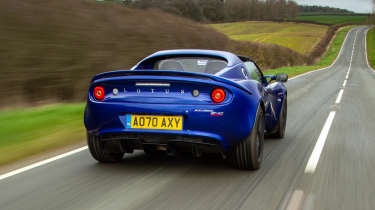
- 1.6-litre (134bhp) and 1.8-litre (217-250bhp) supercharged engines
- Both engines come from Toyota
- All Elises use a six-speed manual transmission
More reviews
Whether you want your Elise to be the consummate B-road sports car or a focussed track car there’s a model for you. The S3 range spanned from the road-biased Sport model to the lightweight Sprint and hardcore Cup. The Sport and Sprint models could be bought with either a naturally aspirated Toyota 1.6-litre four-cylinder or a supercharged Toyota 1.8, the bigger-engined models getting the 220 suffix. The Cup 250 and Cup 260 use the same 1.8-litre engine but with more power, and include motorsport-developed upgrades and serious aerodynamic additions.

The basic 1.6-litre four-cylinder engine puts out a fairly apologetic 134bhp at 6800rpm and 118lb ft of torque at 4400rpm but it’s characterful all the same. It’s relatively quiet below 4000rpm, but as it approaches its 6800rpm limiter it starts to feel much keener and sounds more vocal too. The noise is not dissimilar to the sound emitted from the first Elise’s K-series – there’s the same hollow rortiness. You do really need to rev the engine to feel the full performance of the smaller engine, but it remains incredibly smooth even when you do.
The rest of the range (the 220s, 250s and 260s) are powered by a 1.8-litre supercharged four-cylinder. The extra capacity plus forced induction gives the Sport 220 and Sprint 220 an extra 83bhp with max power of 217bhp at 6800rpm and max torque of 184lb ft at 4600rpm.
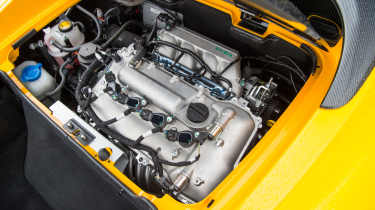
The same 1.8 is used in the Cup 250 and Cup 260. Confusingly, it’s the engine in the Cup 260 and not the one in the 250 that puts out 250bhp, with a peak torque figure of 195lb ft at 5500rpm. The Cup 250’s motor produces 243bhp at 7200rpm and 184lb ft between 3500 and 5500rpm.
All Elises use the same six-speed manual gearbox, with a beautiful exposed linkage in later Sprint and Cup models. It’s a huge improvement over older Elises – where the shift was rattly and loosely defined before, it’s much more positive in the Series 3.
The acceleration times in the Elise range are affected as much by each model’s weight as they are its power. The slowest accelerating car is the basic Sport, it hits 60mph from a standstill in 6sec. The Sprint, with its 830kg kerb weight – 26kg less than the Sport – reaches 60mph in 5.9sec.
The Cup 250 is the heaviest Elise in the line-up with a kerb weight of 917kg. However its extra 26bhp over the 220 models means it’s the quickest Elise, hitting 60mph in 3.9sec. The Cup 260 weighs in at 895kg, 22kg less than the 250, and has 7bhp more power, it reaches 60mph in 3.8sec.

The Elise has never been about ultimate power and performance. Its close sprint-style gearing has never allowed it to hit hugely impressive top speeds. The Sprint and Sport models top out at 127mph and the 220 versions at 145mph. The Cup 250 has a higher top speed compared to the 260, 154mph and 151mph, respectively. The 260’s 3mph lower limit can probably be explained by all the extra drag its downforce-generating wings produce.
The Sport 220 is the sweet spot of the Elise range, providing just the right combination of grip and power. The regular Sport’s engine is a little too weak, while the Cup and Race models have more power than you need.
Lotus Elise Sprint 220 – John Barker
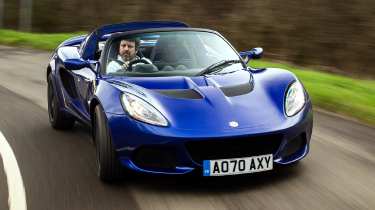
‘Thumb the starter button and the engine assumes an unexpectedly sonorous idle. Lotus says that it has spent a lot of time on the sound and boldly states that it has created ‘the best sounding four-cylinder car in production’. It’s certainly one of the most characterful fours, with a lovely, rounded bass quality that gives it an almost retro feel, as if it’s breathing through carbs. It’s a very willing engine too, its strong pick-up helped by the lower mass and well-chosen gearing that means there’s always a solid response.’
Lotus Elise Cup 250 – Antony Ingram
‘Last time we tried an Elise Cup 250 the engine’s characterless sound was one of its few demerits, but exhaust noise is now a dominant feature, growling angrily at idle and sounding like a single-seater under hard acceleration. That’s not where the racing car sensations stop either, with crisp throttle response and a fabulously tactile gearshift, each movement clacking through the open gate with little effort but real mechanical precision. Unlike the larger Evora, it’s equally satisfying on the way down the ’box, with firm and powerful brakes serving as the perfect platform for instantaneous blips of the throttle.’
Ride and handling
- The best Elises are those that move around a bit – the 220 is the sweet spot
- Cup models are more capable, with more serious suspension and tyres
- Any Elise experience is about the interaction and involvement. Just choose your level of capability
Even in retirement the Elise is a fantastic sports car and one of the best driving experiences available, at any cost. One defining aspect that makes it so enjoyable is its tiny dimensions; you have the space to choose your line while remaining on the correct side of the road.

The Elise’s sub-ton kerb weight, no matter what derivative it is, means the chassis can be determinedly controlled as well as communicate everything the car’s doing in intimate detail while still providing a decent, compliant ride. It’s a trick that Lotus consistently pulled off for years, that Alpine then emulated in its A110.
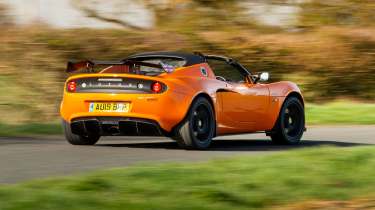
Both the 250 and 260 have improved stiffness with a T45 steel roll bar and better aerodynamics – the 260 produces 180kg of downforce at 151mph thanks to its large rear wing and vented front arches. They feel tough and agile, but with huge agility and can carry exceptional speed. No matter how demanding the road, the car’s balance is rarely upset and there’s so much grip from the Yokohama tyres that understeer or oversteer are never something you need to worry about on the road.
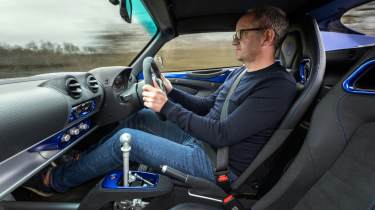
The Cup 260 also gets two-piece brake discs, two-way adjustable Nitron dampers with 24 settings and Yokohama Advan AD08R rubber. It was basically a roundabout successor to the S2 Exige.
With the adjustable dampers it can be wound down for improved road manners. So configured it can devour a country lane with a dynamism verging on nonchalance, were it not for the boisterous dialogue that filters back through the steering wheel at all times. It almost floats along, seemingly skimming over the lumps and bumps in the road, unfazed by just about anything.
Driver’s note
‘Unexpectedly for a car that sells on being lightweight, the steering is rather heavy, particularly at parking speeds. In the dry the chunky, Lotus- tuned Yokohama Neovas (175/55 R16 front, 225/45 R17 rear) give immense grip, especially when they’re warm, and the Sprint feels balanced and slingshots into and out of corners like a race car. The quality of the road surface hardly seems to matter because, as ever, the ride is very impressive. Not only is it remarkably supple but there is no bump-thump noise either, which helps give the dynamics a very satisfying sense of quality. There’s really no surface it can’t neutralise, although the front tyres can be distracted by cambers on heavily crowned B-roads.’ – John Barker, evo Editor-at-Large
evo Car of the Year 2017 verdict – Colin Goodwin
‘It’s not just the Sport 220’s realistic performance that appeals, there’s also its modest dimensions. It’s so easy to place on the road and position for corners. The sight of a van or large car coming the other way on a country lane doesn’t bring with it the clenching of the wheel and worried focusing of the eyes that you experience in over-wide sports cars like a Jaguar F-type. Time spent in this car has been a tonic. A glorious relief from a life that these days is spent writing endlessly about SUVs and listening to nonsense spoken about self-driving cars . The Lotus Elise Sport 220 shows not only how it used to be done, but how it should still be done.’
Interior and tech
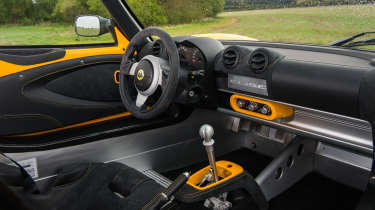
- Elise interiors have always been sparse and thinly-equipped…
- … but the S3’s presentation is better, especially in models and with trinketry like exposed gear linkages
- Elises are more cramped than most sports cars but also oddly accommodating
The Elise’s sparse interior smacks of focus and simplicity. Most of the sills, floor, central tunnel and dash are left as exposed aluminium. There’s also lots of painted plastic to match the exterior. Whatever is left (not much) is covered in rubber, leather or, optionally, Alcantara.
Carbonfibre could also be specified for many of the interior components, with carbon sill plates lowering the door opening by 10mm thanks to the greater manufacturing accuracy that allowed them to be fitted closer to the extruded aluminium beneath, making it easier to get in and out. The woven carbon adds an even racier vibe than standard. The standard exposed aluminum gearshift mechanism delivers plenty on that front.
The slim seats are pleasantly accommodating in all the models and, even though they aren’t deep with very prominent side bolsters, they are very supportive. Sprint models upwards were fitted with the lighter carbon fibre-shelled examples. The cheapest lightweight Elise Sport didn’t get many luxuries for the money; full carpets, floor mats, air-conditioning, a Bluetooth-enabled stereo, cruise control and even sound insulation are all optional extras.
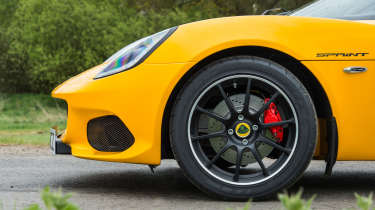
The pricier Sprint featured exotic materials to make the Elise 26kg lighter. The engine cover, roll-hoop cover and vented bonnet panel are made entirely from carbonfibre, the rear screen is polycarbonate, the wheels are made from a forged alloy rather than cast and the Sprint is fitted with a lithium-ion battery.
MPG, running costs and buying guide
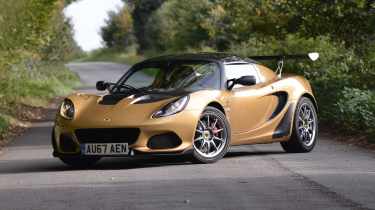
The Elise is one of, if not the, cheapest sports car to run. The little 1.6-litre returns an impressive 44.8mpg on a combined cycle, and the 1.8-litre’s figure – even in the more powerful Cup models – of 37.7mpg is remarkable in light of the performance on offer. Of course, being liberal with the throttle will see the figures drop into the lower 30s and prolonged track sessions could slash the trip-computer readings into the 20s.
The Elise range used a staggered setup of sticky Yokohama Advan Neova tyres, 16-inch upfront and 17-inch at the rear. Their modest size, compared to most modern sports cars, means a new set of boots won’t dent your bank account too significantly. Likewise other consumables like brake discs and pads, aren’t unreasonable in size and therefore aren’t unreasonable in cost.
Being Toyota engines, they’re solidly reliable too. Just be sure diligent servicing has taken place, including the supercharger for 1.8-litre models. Also beware of accident damage. Capricious cars in wet conditions, Elises, so prangs aren’t uncommon.
Prices, specs and rivals
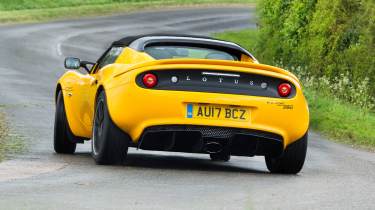
Third-generation Elise prices have held well over the years, with 1.6s starting from around £20,000 and supercharged 1.8 220 models starting from around £30,000. Sprints, Cups, limited run models and enhanced spec cars run from the mid-30s all the way up to £50,000, which is getting towards early used 981 Porsche Cayman GT4s.
Over the years everything from Porsche’s Boxster to the Caterham 7 has been compared with the Lotus Elise. Often, the Lotus is found to be the best compromise in terms of having just the right amount of refinement and solidity, with as much interaction, tactility and light weight feel retained as possible. You could also consider less focussed, hardcore roadsters as an alternative – everything from Abarth’s 124 Spider to the Mazda MX-5 and even the Mk3 Toyota MR2.