Ferrari Amalfi Spider review – the perfect foil for Aston Martin's Vantage S Roadster
Ferrari has listened to its customers, refining the Amalfi as a daily compared to the Roma, while rationalising its cabin. But it does have a muted voice

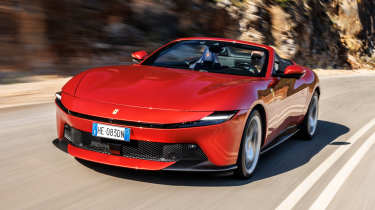
You could quite easily drive an Amalfi Spider, utilise no more than 20 per cent of its ability and you’d be no less enthralled. Even at that paltry amount Ferrari’s entry-level sports car – can a 631bhp, £227,200 be classed as entry-level? – will thrill, excite and entertain the majority who slip behind its steering wheel. But you’d also be missing out on quite a lot, too, because like its coupe sibling, the Amalfi Spider is one of the most compelling starting points in the Ferrari family since the 355.
Feedback from Roma owners was that in ‘wet’ and ‘comfort’ drive modes the front-engined, rear-drive super-GT was a little spiky for their liking. Therefore, these two modes have borne the brunt of the engineering team’s attention. The result builds on the Roma’s appeal in creating a roadster that doesn’t solely rely on exposing the occupants to the elements to entertain them.
The retractable roof remains fabric and one of the few elements carried over from the Roma Spider, with a design finessed to suit the Amalfi’s silhouette. It retains five fabric layers with three insulating rubber layers sandwiched between and is stretched over an aluminium and steel frame. A neat touch is the same material used for the roof running from the ‘parcel shelf’ behind the two rear jump seats out under the roof and onto the rear boot lid, helping to break up what is now quite a heavy rear body, with a more pronounced rear diffuser and heavier set bumper.
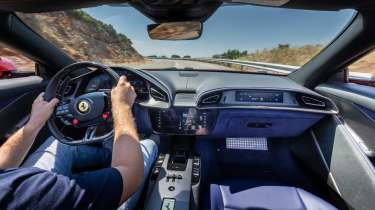
An instrument binnacle for both driver and passenger and the higher, more pronounced central tunnel is as per the coupe. So too the new steering wheel that brings back actual buttons in place of the haptic controls. There’s also a physical thumb-sized anodized red starter button to press.
More reviews
When you do, once the flare of revs subsides, so too does the soundtrack, thanks to EU noise and emission regs. These have not been kind to any manufacturer, but it feels a harder punch to the gut that the emotion has been ripped from the Ferrari V8’s heartbeat.

The muted tone continues with the roof open and those changes to the Comfort configuration are also immediately noticeable. The Amalfi Spider is calm and relaxed, the throttle a little lazy (for a Ferrari), the steering less hyperactive, the ride supple, the body controlled like a polished GT. It has fine ergonomics once you find both sets of controls for the seat adjustment (fore and aft, tilt and height on the side of the seat, lumber, thigh, lower back etc via the HMI touch screen). It’s also whisper quiet with the roof closed and free from buffeting with it open, the windows up and the wind deflector in place.
When you do push on in Comfort the chassis remains reigned in with the rear tyres rotational speed micromanaged thanks to the flattened torque spikes. It doesn’t make for a flat Ferrari, but it certainly provides a direct response to those customers requesting something a little milder for most of the time.
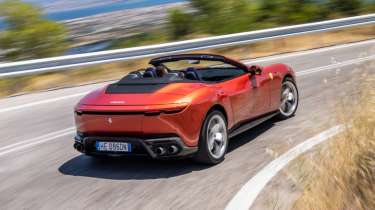
When pushed there’s life the higher you climb into the revs and the harder you lean on the chassis. Build your rhythm and the Spider responds with a fluidity and flow that reminds you of its Maranello roots. It will still nibble away at its dynamic edge with some roll-oversteer into long, looping curves but never unmanageably so.
You soon crave more because you sense there is more to give. The changes in Comfort mean that when you switch to Sport (we'll get to Race later) the step-up is more marked. The throttle response goes from stepping out of a pair of comfortable leather trainers and into your fancy New Balances. Instantly everything about it feels sharper, more instinctive, lighting quick in everything it does.

The steering ratio doesn’t change but it’s keener, more alert – although it doesn’t feel as quick or as light as other modern Ferraris – and its linearity means you guide it deep into the apex with no fear of arriving offline. That’s not strictly true. On the roads of the Greek test route, if you didn’t fully commit at turn-in the Amalfi would occasionally indicate it didn’t wish to partake in getting you round the corner.
It felt like its new Goodyear F1 tyres (they replace the Michelin tyre previously used on the Roma and are joined by a Bridgestone and Pirelli) were running 40psi at the front, 20 on the rear. It made for a hard to read car in terms of your lock inputs for those first few kilometres on an unfamiliar road.
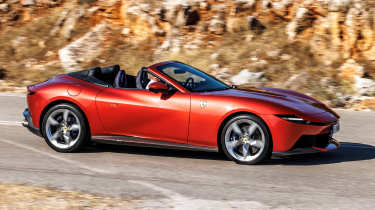
Work some heat into the tyres and add some commitment from your wrists and the Amalfi comes to you. It’s quick to find your required line and those F1s that were previously gliding across the surface are now keyed in, kneading their tread blocks into the Tarmac. In second and slower third gear corners it encourages you to be a little rougher with the Spider.
So you throw it in early, jump on the power promptly and ride out of the exit on a wail of revs, as the V8’s turbos spin to 171,000rpm. the F154 V8 will kicksyou along the straights with as much of its 631bhp and 561lb ft as you’re prepared to manage. You’ll reach 62mph in 3.3 seconds and top 199mph if you so desire.

Those red lights atop of the steering wheel soon come at you in a blink, your senses now being battered by the intake and exhaust battling it out for your attention while the wind rushes over you. Yet the tyres rarely give out a squeal unless provoked. In long-long-long fourth gear turns they grip, the body leans, the e-diff balances the torque, the Spider refusing to deviate unless a compression too deep for a 12-inch ruler presents itself mid-corner. Even then there’s composure from beneath and not a single shimmy or shudder through the car or up through the steering column.
There’s more adjustment via the steering and throttle available to you in Sport, too. Slower exits allow more angle dialled in via your right foot, the car remaining calm so long as you keep your steering inputs equally measured. There’s also a sweet spot where you can set the Amalfi Spider into a turn and it will arc round with what feels like hardly any steering input. All four tyres move in the same direction as one, gliding across the surface on the edge of the stability and traction system reigning you in.
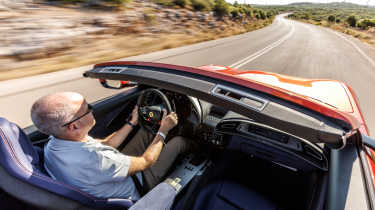
Race is as feral in the Spider as it is in the coupe. Gearshifts, already far quicker in Sport than in Comfort, now become quick enough for you to worry about the abuse the clutches and gearbox are taking. The V8 never seems to drop below 5000rpm, the speed never seemingly stopping climbing. Experiencing the step change from Comfort to Race is one of the largest chasms in automotive drive modes I can think of. They feel like two different Amalfis. Then you remember it only has 20bhp less than a V12-engined Enzo…
Race, and CT off do start to pull at the Amalfi’s dynamic thread though. No more does it feel like a super-GT or super-sports car. It requires your full focus. Those Goodyears can start to overheat and over-rotate and you’re now the one leading the mission. Now you wish there was a little more feedback across the board; steering that bites a little harder, damping that ties the body down to eradicate some float that you don’t uncover at lower speed and a throttle that is less binary.
This, like the coupe, is a by-wire car – steering, throttle and now brakes. While the calibration frazzles the mind, those from more physically connected era will be impressed by the control weights and feedback, albeit while asking if it could be more immersive experience, with a more physical connection between car and driver.
With everything wound up to the max, the Amalfi Spider can’t escape its less focussed remit, but that’s not to say the car couldn’t handle a more extreme set-up. It’s just that for this iteration its limits are dictated by the market it sits in.
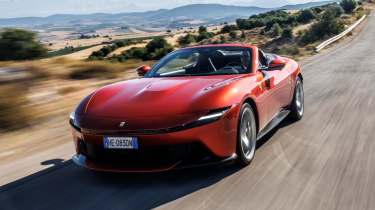
Is this a bad thing? I’d say not. The Amalfi is first and foremost a GT car that just so happens to have been developed by Ferrari, a supercar maker. It stands to reason that everything it produces is going to be created with an eye on performance. Sport mode is a sweet spot that rewards and entertains without being terrifying. Race is for those who enjoy the challenge, knowing there are better cars out there, while enjoying what’s on offer here.
For Ferrari it’s how the car performs in its default setting that matters most. And to that end it has met its brief with unqualified success. It’s a calmer car to drive quickly, a more refined cruiser and one that always retains a sense of occasion.
Price and rivals
Aston Martin’s £185,745 Vantage S Roadster is like driving an Amalfi Spider in Sport mode everywhere. Conversely, the Ferrari in Comfort makes a £233,700 Bentley Continental GT S Convertible feel like you're in full dynamic mode everywhere. Getting the three together, along with Porsche’s £209,500 911 Turbo S Cabriolet, will be a fascinating conquest, regardless of the roof that’s over your head and how you choose to spend your circa £200,000 budget.