Best roadsters 2026 – the best drop-top driver’s cars
The best roadsters offer big thrills with minimal compromises – these are evo’s favourites from the present and past
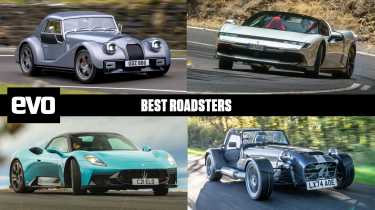
Summer is in full swing, and that means there’s no better time to enjoy top-down motoring. And if you’re an enthusiast, the most focused category within the convertible genre is the roadster. These are cars that are less about cruising down Highway One and more about getting closer to the elements as you attack the Raticosa pass. Often more singular than your average convertible and based on pure sports cars, roadsters offer the ultimate in driving thrills.
It’s a broad church, spanning from the humble Mazda MX-5 to the multi-million-pound Pagani Utopia Roadster. While a few all-time greats have fallen from configurators of late, namely Porsche’s 718 Boxster, there are still great roadsters on the market for those optimistic sun-seeking drivers. We list our favourites below.
Best roadsters 2026
- Ariel Atom 4
- Aston Martin Vantage Roadster
- Ferrari 12 Cilindri Spider
- Maserati MCPura Cielo
- Ferrari 296 Speciale Aperta
- McLaren 750S Spider
- Ferrari 849 Testarossa Spider
- McLaren Artura Spider
- Mazda MX-5 RF
- Chevrolet Corvette
- Caterham Seven 420
- Morgan Supersport 400
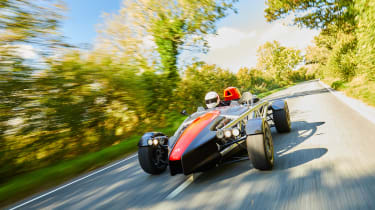
Ariel Atom 4
- Pros – Performance, complete sensory overload, wonderful detailing
- Cons – Lack of weather protection, lacking the old car's frenetic supercharged soundtrack
- evo rating: 5 stars
Visually similar to previous Atoms, the presence of a new number hinted that this really was a new car. The biggest change was the engine, still a Honda unit, but now the turbocharged engine from the Civic Type R, replacing the old naturally aspirated unit (not that it stayed naturally aspirated in Ariel’s hands).
With a turbo came the option for different levels of boost, letting you break yourself in gently – on the tamest setting it starts out at around 200bhp, topping out at 320bhp with the knob twisted all the way up. Performance on full boost is ferocious, but once again the Atom got better to drive in its latest iteration, a longer wheelbase and slightly slower steering making it feel less nervous but in no way detracting from its pure, intense thrills.
‘Floor the throttle and the Atom quivers for a millisecond, as if you’ve connected the metal frame to the mains, before slamming forward with a ferocity that makes it difficult to focus on the vanishing point. And then KER-CHUMPF, as my foot comes off the accelerator pedal and boost pressure is expelled. Even wearing a full-face lid that release of pressure is astonishingly loud: the Atom soundtrack is no longer defined by roar or whine, but by that noise.’ – Adam Towler
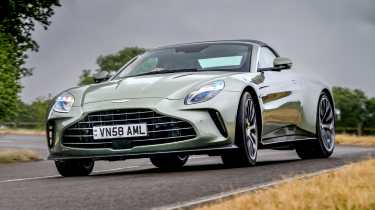
Aston Martin Vantage Roadster
- Pros – Retains all the good bits of the coupe
- Cons – Ride is on the stiff side for a roadster
- evo rating: 5 stars
The latest Aston Martin Vantage is the poster child of Aston Martin’s rejuvenation, being such a complete turnaround compared to its predecessor in spite of quite obviously sharing its bones. The bump up in power of over 150bhp is only the start, with the Vantage being a more exciting, yet more exploitable supercar-bothering sports car, that’s traditionally prettier with much better tech, fit and finish inside. The Roadster carries on the coupe’s fine form, compromising very little dynamically and improving the UI with easier-to-read graphics.
‘The Vantage offers a more characterful alternative to the McLaren Artura Spider or a used Maserati MC20 Cielo. The former might have the Aston’s number in ultimate dynamics and pace and the latter for supercar looks, but the Vantage Roadster should be considered as a serious alternative to both.’ – Stuart Gallagher, evo editor-in-chief
> Aston Martin Vantage Roadster review
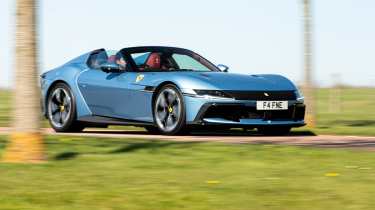
Ferrari 12 Cilindri Spider
- Pros – Loses none of the berlinetta’s performance
- Cons – Still lacks the vocal range you expect of a V12 Ferrari
- evo rating: 5 stars
We loved the 12 Cilindri berlinetta with its 6.5-litre naturally-aspirated 819bhp V12 but as with all roadsters, we had concerns whether lopping the roof off would have a detrimental effect on the Spider. We needn’t have worried as Ferrari has gone to great lengths to ensure the drop-top is as structurally sound as the coupe, and it drives every bit as well as the hardtop.
The 12 Cilindri Spider feels more GT than hypercar and it’s all the better for it with a supple ride that belies its poise and agility when you push a little harder. Grip levels are high and it’s as refined as the coupe which is a big plus, too. Despite being hugely capable the one disappointment is that the glorious V12 isn’t a little bit more vocal – even with the roof furled and the windows down, the engine is a little muted, which is not what you want or expect from a 6.5-litre Ferrari V12.
‘The Spider is a remarkably capable front-engined supercar and a very good GT too, with an easy-going drivability and supple ride. Roof up, I’d guess it’s pretty much as refined as the berlinetta, and structurally it was solid over some dreadful surfaces.’ – John Barker, evo editor-at-large
> Ferrari 12 Cilindri Spider review
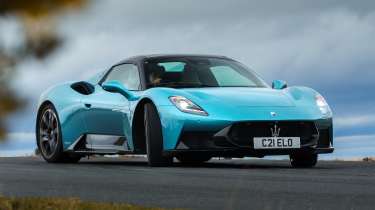
Maserati MCPura Cielo
- Pros – All of the excellence of the coupe, with the sky overhead
- Cons – Expensive; not particularly lightweight
- evo rating: 4.5 stars
We were big fans of the Maserati MC20 and so in not changing all that much, the MCPura is a lovely thing too, in coupe and open-top Cielo forms. We admit, there is a temptation to create synergies between the MCPura and Ferrari’s 296 GTS above. Yet the two, in fact, couldn’t be any more different aside from their mid-engined layout and cylinder count.
That’s because the two take completely different approaches to their powertrain, chassis and construction. Like the MC20, the MCPura is underpinned by a carbonfibre tub built by Dallara. Its V6 engine is a 90-degree unit and twin-turbocharged, but does without any hybrid assistance and a huge headline power figure. This has its advantages, such as a purity to the driving experience and an impressive compliance from the suspension. Its engine is also a delight, with immense performance and a character that feels more like a skunkworks race engine than modern supercar. Even better, the folding hard-top roof – this one finished in glass – displays no obvious compromise over the experience you’ll get with the exceptional coupe.
‘It’s an easy car to fall for. Both the Ferrari 296 and McLaren Artura are more complete supercars, but the MCPura is one with a unique character that can happily lean into a GT-style role, and deliver an intense thrill when the moment comes to unleash it. It hasn’t quite stolen our hearts like it once did, but we’re glad it still exists as an unapologetically pure alternative to the hybrid norm.’ – Yousuf Ashraf, evo senior staff writer.
Ferrari 296 Speciale Aperta
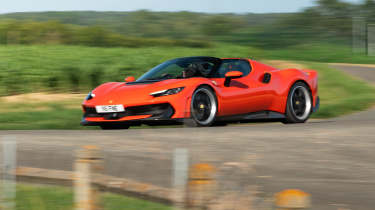
- Pros – Outstanding engine character; razor-sharp shifts; exploitable chassis
- Cons – It’s almost half a million pounds…
- evo rating: 5 stars
The Ferrari 296 is already one of our favourite modern supercars, capturing the noise, athleticism and sheer speed of the best mid-engined Berlinettas. The Speciale version is even better, bringing even more vivid performance, sound and handling sharpness to the package. The Speciale Aperta, meanwhile, combines those attributes with open air thrills with almost no compromises, resulting in one of the most rewarding and enjoyable roadsters on sale.
With the same 868bhp as the Speciale coupe, the Aperta feels just as intensely rapid – perhaps even more so given that it exposes you to the elements. But it’s the car’s natural balance that shines brightest, thanks to its impressively rigid structure and the fact that it weighs 50kg less than the 296 GTS, at 1490kg. In everything from its eerily precise steering to its gearbox, brake feel and seamless integration of electronic chassis systems, it’s as intuitive and exciting as drop-top Ferraris get.
‘The ride is taut, but it’s not as hard-edged as the bare-carbon doorcards and Speciale badge might have you believe, even without bumpy road mode on the Multimatic dampers. Body control is excellent, so unlike some supercars like the Maserati MCPura, you can happily tackle a not-so-smooth, undulating B-road at a good pace without grimacing at the sound of carbon on concrete contact.’ – Sam Jenkins, evo Senior Staff Writer
> Ferrari 296 Speciale Aperta review
McLaren 750S Spider
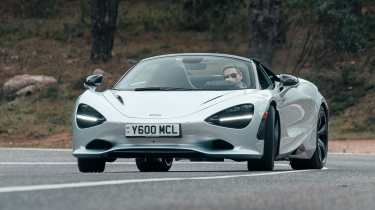
- Pros – All of the intensity, feedback and agility of the coupe
- Cons – Interior not as special as the 720S it replaced
- evo rating: 5 stars
Despite a new name and a £269,160 price tag, the McLaren 750S is very much an evolution of the 720S rather than a completely new car. For us, that can only be a good thing, because the 720S remains one of the world's greatest supercars.
For the 750S, McLaren has teased more power from its twin-turbocharged 4-litre V8 for peaks of 740bhp and 590lb ft, while also stripping out 30kg (the Spider weighs 1438kg and feels almost identical to the coupe thanks to its carbon construction). The suspension has also been revised to generate more 765LT-style sharpness and aggression, and the combined effect is one of the most thrilling and addictive open-top supercars you can buy.
‘Perhaps the most compelling argument for this car remains as it was in the 720S: it does everything. The 750S looks exotic and outrageous, it feels so special thanks to the driving environment and due to its sophisticated chassis and carbon fibre construction, it copes on road and track with equal aplomb.’ – Jethro Bovingdon
Ferrari 849 Testarossa Spider
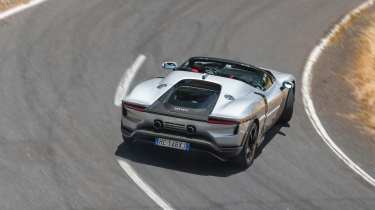
- Pros – Stunning performance; more approachable than a Revuelto; no compromise as a Spider
- Cons – A V12 would complete the package
- evo rating – 4.5 stars
The Ferrari 849 Testarossa rights all the wrongs of the SF90, which was a fantastically capable supercar but not as cohesive or engaging as a flagship Ferrari should be in its early forms. By comparison the 849 is deeply exciting and engaging, and one of the most technically impressive supercars on sale, blending torque vectoring electric motors with V8 power in a seamless and enjoyable way. It may lack the outright drama of a Lamborghini Revuelto but in terms of its performance and dynamics, it's up there with the very best.
Taking the roof off makes it even better, and amplifies the sense of speed and intensity of this 1035bhp junior hypercar. The 849 Spider gains 90kg over the coupe due to strengthening measures in its aluminium chassis, and its folding metal roof. In practice the compromise is minimal and the Spider still feels amazingly agile and approachable for a car of this type. So deft is the calibration of the electronics and torque vectoring that, once you’re confident enough, you can drive it like a 296, exploiting the adjustability of the chassis to the full.
The 849 doesn’t come cheap, starting at £407k for the coupe and £442k, and its only downfall is that the V8 engine lacks a distinctive character, which any supercar should have at this price. But there’s no denying its abilities, and the Spider adds a welcome hit of drama to the package.
‘Despite having lost its roof, there’s almost no fuzziness in the Spider’s responses. On really poor surfaces you notice some vibration through the structure but it’s very mild. Open-top McLarens still have an advantage in this respect with their carbon chassis, but the gap is much smaller than it once was.’ – Yousuf Ashraf, evo Senior Staff Writer
> Ferrari 849 Testarossa Spider review
McLaren Artura Spider
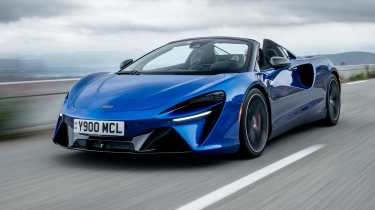
- Pros – Mesmerising performance, brilliant chassis upgrades, roof down thrills
- Cons – V6’s soundtrack doesn’t match its performance
- evo rating: 5 stars
We immediately fell for the McLaren Artura when we first drove it, so much so that it made the podium at evo's 2022 Car of the Year test, sharing third place with Ferrari's 296 GTB. That a Spider version arrived later was no surprise, but we didn't anticipate the extensive upgrades that McLaren would apply to its baby supercar at the same time. The changes have made a stunningly fast car even quicker thanks to a power boost to 690bhp, with comprehensively reworked chassis systems designed to deliver more precision than before. The result is a car that managed a very close second at evo Car of the Year 2024.
The revised Artura is a significant step on from what was already a brilliant car, with newfound levels of finesse and sharpness to the driving experience. The best part is that thanks to a stiff carbonfibre chassis, the Spider weighs just 62kg more than the coupe and offers the same level of excitement – if not more so with unfiltered access to the tunes from its V6.
‘More than just an open-top derivative of the original Artura coupe, which finished equal third on eCoty 2022, this Spider version has been refined in many ways and its V6 hybrid electric powertrain now delivers 691bhp. It’s a handsome, exceptionally capable car with terrific feel and great refinement.’ – John Barker, evo editor-at-large
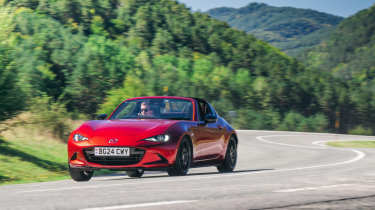
Mazda MX-5 RF 2.0
- Pros – Balanced; lightweight; superb manual gearbox
- Cons – Characterless engine; heightened price
- evo rating: 5 stars
By some margin the cheapest car in this list, the MX-5 RF is still a pocketful of fun. Its diminutive proportions almost make it look three-quarter scale, and it delivers a lightweight simplicity that’s a rarity these days.
A round of updates in 2024 made it better than ever, with lightly tweaked styling and new interior tech, but most importantly a new asymmetric limited-slip diff and retuned steering. The changes make its modest performance even more easy and satisfying to access, so much so that it was a real contender for 2024 evo Car of the Year title, missing out on the top step of the podium by a whisker.
The 2-litre model generates 181bhp, but speed isn’t really the MX-5 RF’s thing – it’s all about carrying momentum and working with the biddable, roll-happy chassis. It remains as simple a recipe as ever, and there are few better ways of experiencing the charms of a rear-drive sports car at law-abiding speeds.
‘The modest 205/45 tyres are nothing special, the engine has just 181bhp and is a charisma-free zone, and yet the MX‑5 was consistently one of the most rewarding and entertaining cars on the test. I found it utterly absorbing. And it felt exactly the same in the wet, which is the hallmark of a great chassis.’ – John Barker, evo editor-at-large
Chevrolet Corvette Convertible
- Pros – Naturally-aspirated V8, quality dynamics
- Cons – Weird looks, hamstrung performance for Europe
- evo rating: 4.5 stars
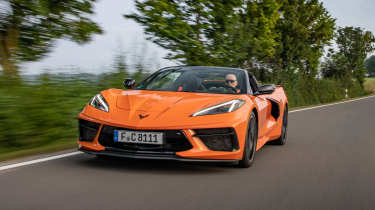
Always left of field but no longer only in left-hand-drive, is the Chevrolet Corvette C8. It’s the first mid-engined Corvette, but some things don’t change – it still has a 6.2-litre pushrod V8 at its core, albeit with a dry sump. Unfortunately, the C8’s V8 has been pegged back to 475bhp in the EU for emissions reasons, meaning it’s not as potent as its 495bhp US-based counterpart.
The C8 features contemporary tech everywhere else too, with power sent to the rear wheels via an eight-speed dual-clutch transmission familiar to the Maserati MC20, while its aluminium chassis is suspended by double unequal-length wishbones at all four corners.
Even the coupe offers open-air motoring via a removable targa roof panel. For the full drop-top experience, though, you'll need to go for the Corvette Convertible with its retractable folding hard top, which also improves the looks of the slightly fussy American sports car. The Z06 and E-Ray meanwhile, offer wider bodies with either a flat-plane crank 8600rpm V8, or a hybridised version of the pushrod 6.2. They’re all really rather good too – gone are the days of American sports cars trading purely on power, with laughable dynamics. If only the steering had a bit more life to it.
‘Certainly it’s a lot more delicate in its dynamic approach than any previous Corvette, with a precision to the controls and a deftness to its responses that traditional front-engined Corvette drivers would struggle to recognise. From its steering to its brake feel (which can be adjusted via six different drive modes) to its ride – controlled on our test car by £1940 of Magnetic Ride adaptive dampers – it just works.’ – Steve Sutcliffe, former evo contributor.
> Chevrolet Corvette Convertible review
Caterham 7
- Pros – the joy of driving in its elemental form
- Cons – rough and ready all the time
- evo rating: 5 stars
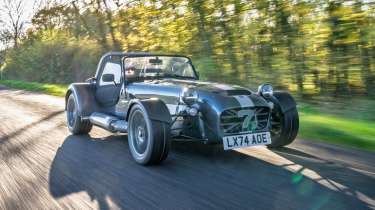
The 420S along with the 360S are core models in the Caterham range, and perhaps the best examples of the inherent rightness of any Seven. Both came about with a simplification of Caterham’s range in 2015, both powered by a 2-litre Duratec four-cylinder, whose 180bhp and 210bhp outputs lend each model its name through power-to-weight ratio – though since neither is 500kg on the dot, there’s a bit of artistic licence there.
Both have easily enough grunt to unhook the rear wheels at will and indulge in the Seven’s driver-friendly (and easily held) balance when the rear breaks free, though there’s also enough torque that you can motor along very quickly only using half the available revs. S spec keeps them road-friendly, though like almost all Caterhams, they’ll indulge track use more willingly than almost any other car.
Best of all, and this counts for any Caterham not just the 420 or 360, the Seven is the car perhaps above all others that fully integrates you into the job of driving. As a vehicle with which to interact, to enjoy the operation of a machine and get as close to the elements as possible, there are few substitutes.
‘Between the compliant platform, exploitable, responsive performance, pedals that are perfectly judged in terms of positioning, weighting and action and the joy of the short-throw five-speed manual shift, this is a car that you can revel in on the road without tempting litigious fate. The ratio of thrills per miles per hour is perfectly judged.’ – Ethan Jupp, evo web editor.
Morgan Supersport 400
- Pros – Supersport finds its voice, and a dizzying turn of pace
- Cons – Costs an extra £30k, needs concentration at the limit
- evo rating: 5 stars
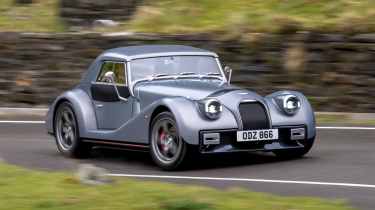
The perfect roadster driving experience sits somewhere along a spectrum. A Caterham offers the ultimate thrills and connection but isn’t a car in which you enjoy those transitory miles between great roads. A conventional roadster, whether an MX-5 or a McLaren Spider, does that bit better, but then you lose some of the viscerality. That’s where Morgan comes in with the Supersport. It is at once sumptuously trimmed, with surprising creature comforts like heated seats, cruise control and wireless phone charging, but also closer to the Caterham than a McLaren in terms of how close it gets you to the elements. In ways, it’s the perfect compromise; as fun at 50mph as a McLaren is at 100, but feels like a Maybach compared to a Caterham when covering mundane miles. And now it’s even better, with the Morgan Supersport 400.
‘The Supersport 400 stands as testament that Morgan can turn out a car that deserves to be in the conversation with the finest of today’s sports cars. If you love the base model but always felt there was headroom in its package for something a little bit hairier and more focused, without losing the charm and usability at its core – this is it.’ – James Taylor, evo deputy editor.
Five used roadsters
- Porsche 718 Spyder RS
- BMW Z4 Handschalter
- Lotus Elise Cup 250
- Ferrari 812 GTS
- Lamborghini Huracán Evo Spyder
Porsche 718 Spyder RS
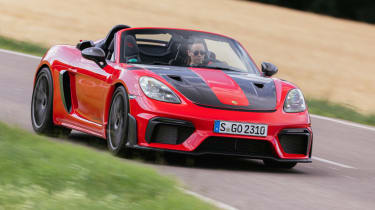
Porsche’s entry-level roadster has morphed into an altogether more serious, hugely competent machine since the first Boxster arrived in 1996, and the 718 Spyder RS is the pinnacle of the breed. A drop-top Cayman GT4 RS in all but name, the Spyder RS gets the same 493bhp 4-litre flat-six, which revs to 9000rpm and sounds utterly sublime while doing so.
> Porsche 718 Spyder RS review
Straight-line performance is very similar to that of its hard-top stablemate, but the driving experience is a little less hardcore with more road-biased suspension and steering tuning. This is a good thing; on the road, the Spyder RS feels pure, intense and all-consuming, but without some of the harsher edges of the GT4 RS. Few – if any – modern sports cars are quite as intoxicating. As the last combustion-engined Boxster, it's a fitting send-off.
BMW Z4 Handschalter
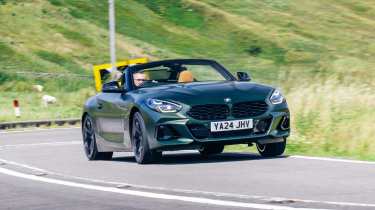
BMW’s Z4 has always struggled to be the driver’s car that so many wanted it to be, and the main reason for that comes in a Boxster shaped fly in the ointment. Put simply, the Z4 has never been its equal when it comes to out-and-out driver satisfaction. The latest generation – especially in M40i form – is a decent steer, but lacked the ultimate in involvement.
The Z4 ‘Handschalter’, which literally means ‘hand-shifter’ in German, changed that. Yes, six years into its life the most powerful Z4 was made available with a six-speed manual gearbox. Then just 18 months later, BMW killed the Z4. It was only available in green with a brown interior, but that third pedal provided another layer of interaction that made the Z4 a much better car.
The turbocharged straight-six is still an absolute joy to sit behind and the manual ‘box really lets you get the best from it. Additional revisions for the Handschalter include different chassis settings with mixed-size wheels, updated steering, new rear dampers and changes to the adaptive M differential. The steering’s still not perfect, but it’s comfortable, hooks up well out of corners and is a lot of fun. Still no Boxster beater though.
Lotus Elise Cup 250
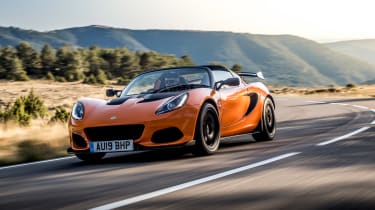
The Elise has always been a great road car, and pretty good on track too, but towards the end of the car’s run, Lotus explored a couple of more focused variants, the Cup 250 and Cup 260. These were, in many ways, similar to the earlier Exige models before that line grew and adopted V6 engines, and with first 245bhp (Cup 250) and then 249bhp (Cup 260 – we’ll allow them the exaggerated name for only a few more horses), both were in the same ballpark as an Exige from a decade or so earlier.
Sticky Yokohama tyres were the order of the day (the Cup 260’s boots were 10mm wider, too), while the 260 in particular featured more serious aero, and adjustable Nitron dampers. While track driving was well within each car’s remit, they were – like any Elise – equally brilliant on the road.
Ferrari 812 GTS
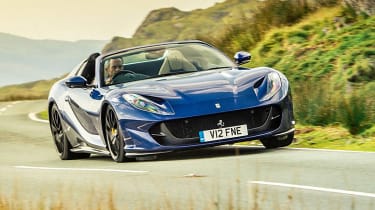
There are few greater joys than unfiltered access to a fabulous engine, and the Ferrari 812 GTS provided exactly that, opening the roof on Ferrari’s front-engined V12 supercar on a non-limited basis for the first time. We certainly weren’t crying out for more noise when we drove the bombastic 812 Superfast, but the GTS’s folding hard-top made us reassess this the first time we uncorked its 789bhp naturally aspirated V12.
Yes, the GTS is 120kg heavier than the coupe, but it’s still surprisingly wieldy and athletic for a big GT, and there’s something undeniably majestic about a front-engined, open-top Ferrari with 12 cylinders. Being on sale for half the time the 812 Superfast was, it’s a lot rarer than its coupe counterpart. And while prices still well above £200,000 aren’t cheap, they look like bargains next to a £330,000-plus new 12 Cilindri Spider…
Lamborghini Huracán Evo Spyder
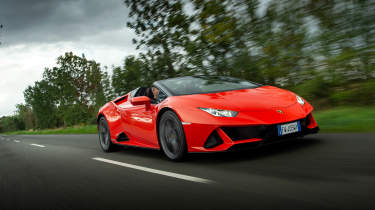
The Huracán Evo Spyder was everything a Lamborghini should be: brash, loud and unforgettable. The Evo marked the Huracán’s first steps towards greatness, which culminated in the spellbinding STO and Tecnica versions. But you can’t get either of those in convertible-form, so the Evo Spyder it is.
With a 1542kg dry weight it’s a fairly hefty supercar, but on the road the Evo Spyder melds together rather nicely. The dynamic steering is faithful and accurate, the balance is safe rather than spikey and the V10’s power delivery is wonderfully linear. Most of all, the Evo Spyder is memorable, and it doesn’t trade on drama to cover glaring holes in its repertoire. Downsides? Lopping off the roof means the Huracán’s driving position and cabin space is somewhat compromised. Then again, what price to put only fresh air between your eyes and the howl of that V10?
> Lamborghini Huracán Evo review