Chevrolet Corvette E‑Ray review – does hybrid and all-wheel drive dilute the C8’s appeal?
The Corvette E-Ray combines a 655bhp hybrid V8 powertrain with four-wheel drive for a punchy £160k asking price. Is it a worthy alternative to an AMG GT or Aston Martin Vantage?
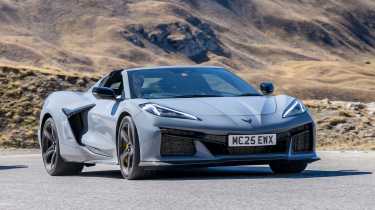
It’s hard not to admire Chevrolet and the team behind the Corvette. In 2019, it made the controversial switch to a mid-engine platform for the eighth-generation Stingray in search of greater performance and dynamic polish – a big gamble for a car that sells in vast numbers to a mostly conservative, traditionalist crowd. Next they set about tackling the Porsche 911 GT3 with the hardcore Z06 version by channelling the Ferrari 458 Speciale. Just like the Porsche, the Z06 benefits from a bespoke, motorsport-derived engine. However, this one is a 5.5-litre flat-plane-crank V8 modelled on the staggering Speciale engine and developing 670bhp at 8400rpm. Incredible.
Then there’s the ZR1, which adds twin turbos to the mix for over 1000bhp, and the fearsome ZR1X, which uses a hybrid system to boost performance to hypercar levels. We’re talking 1250bhp, 0-60mph in well under 2sec and a Bugatti Tourbillon-beating sub-9sec quarter mile time. We sadly don’t get the ZR1 models in the UK, but the C8 has become a car that covers all bases, from rivalling standard 911 Carreras to being among the fastest accelerating cars on the planet.
Somewhere in the middle sits the E-Ray, which launched as the first hybrid C8 in 2023. Sitting above the Stingray but below the Z06, it offers well over 600bhp from a Porsche 918 Spyder-style hybrid system and four-wheel drive, plus chassis elements derived from the Z06. Think of it as Chevrolet’s Porsche 911 Turbo – a do-it-all performance machine with a wide reaching brief and all-weather ability.
More reviews
Group tests
- Corvette Stingray v Porsche Cayman GTS v Audi R8 RWD
- Corvette Z06 v Exige Cup v GT3 RS v Noble M400 – battle of the road-racers
In-depth reviews
Reviews
With that said, in the UK the E-Ray isn’t the bargain offering it is in America, where it starts at $122k – substantially less than a 911 Carrera. Here it costs a rather punchy £159,230, putting it between a 911 GTS and Turbo, and in the firing line of very capable rivals such as the Mercedes-AMG GT 63 and Aston Martin’s Vantage. The E-Ray does have the numbers to compete in that crowd, but is the package as a whole up to the task? Read on to find out.
Engine, gearbox and technical highlights
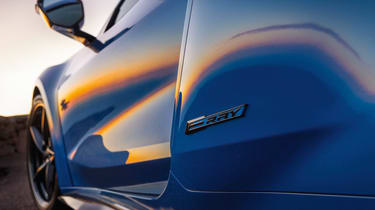
- Stingray-derived V8 combines with front electric motor for 635bhp
- Double wishbones and adaptive dampers, plus optional carbonfibre wheels
- 1.9kWh battery pack enables short periods of electric running
The E-Ray takes elements of the relatively plush Stingray and the track-focused Z06 and combines them with a Porsche 918 Spyder-style hybrid system to deliver huge performance. 0-62mph is ticked off in 2.9sec, making it the fastest-accelerating Corvette on sale in Europe. Top speed is 184mph.
The E‑Ray features the same 475bhp 6.2-litre V8 and eight-speed dual-clutch gearbox as the Stingray and in combination with a single electric motor driving the front wheels, total outputs are 635bhp and 574lb ft of torque. Although it should be noted that the quoted kerb weight is a rather hefty 1907kg.
The E-Ray has the wide body from the Z06 and hence huge 275- and 345-section tyres, there are standard-fit carbon-ceramic brakes and the hybrid system with its tiny 1.9kWh battery (mounted within the central tunnel) is designed to add performance, not efficiency. There’s no plug-in capability, although a Stealth mode does allow for silent progress for a short period at speeds of up to 45mph. The EV-ness almost seems like an afterthought. Perhaps the good folk at Chevy forgot they already had a Z06 and just reached the same end goal but in a different way. Or maybe they just can’t help themselves.
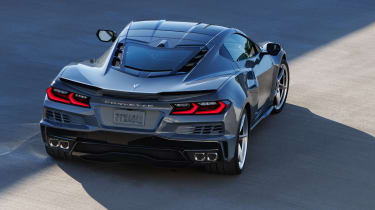
Despite the widebody aggression, this is a car that appears to supercharge the Stingray formula rather than being a hybrid-boosted Z06, retaining the useability and refinement that makes the standard car so appealing on a daily basis, but elevating the performance to new heights. Adding all-weather capability, too. Widening its appeal further is the C8’s stow-away targa roof, plus the option of a convertible to offer open-air thrills.
Suspension is by double wishbones all-round with Magnetic Ride Control dampers switchable through three settings, with an electronic limited-slip differential at the rear. There’s a Performance Traction Management (PTM) system to manage drive to the wheels, which can be specified as lightweight carbonfibre items to save 19kg in total. Michelin Pilot Sport 4S tyres are standard, so too are Brembo carbon ceramic brakes with six-piston calipers.
Driver’s note
‘The many driving modes are selected via a rotary dial and customisable via a ‘Z’ mode switch on the steering wheel. As well as presets, you can drag touchscreen sliders for various parameters including steering weight, damper stiffness and brake pedal response, and there are also varying presets for the stability and traction control. It’s a little overwhelming, and the sense of strangeness is amplified by the square steering wheel, which naturally places your hands at a sort of high ten-to-two position rather than quarter-to-three.’ – James Taylor, evo Deputy Editor
Performance, ride and handling
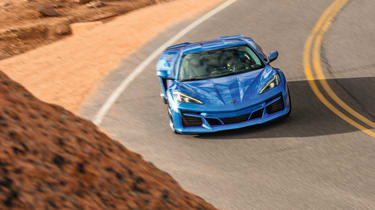
- Huge performance and flexibility, underlined by old-school V8 character
- Nuanced and adjustable four-wheel drive handling
- Steering lacks feel, can hunt cambers and tramline on bumpy roads
Even before you start the E‑Ray, it’s providing mode choices. This car has many modes – and plenty of configurability within them. In addition, the Performance Traction Management system offers various stability and traction control options to pair with the drive modes (which have their own default traction and stability settings). It’s all a bit intimidating and needlessly complex.
Pressing the brake pedal awakens the dash and allows you to toggle to Stealth mode for a few miles of EV-only, front-drive Corvette action. Great for those early-morning starts that might otherwise wake the neighbours, but you’ll soon want to enjoy the deep, comforting V8 beat of the 6.2-litre LT2 engine. In the mildest Tour mode the E‑Ray lopes along smoothly, with a much more supple ride than the Z06. It’s easy to appreciate the benefits of a stiff chassis built around a strong central tunnel, double-wishbone suspension at each corner and a very long wheelbase.
At low and medium speeds the E‑Ray scores decisively over the Z06 due to its easily accessible torque. The 6.2-litre combustion engine already beats the peak output of the Z06’s 5.5-litre screamer by 20lb ft, but the additional 125lb ft provided by the permanent magnetic drive front motor dramatically increases the advantage. Whereas the Z06 can feel genuinely gutless when you request a little more speed while cruising in one of its higher gears, the E‑Ray responds with real intent. On most roads and for most people, I expect Corvette’s hybrid would beat its hardcore would-be racer.
Use the centre console-mounted control wheel to toggle up into Sport and Track modes and the E‑Ray feels pretty well tied-down, too. There isn’t the incredible alertness of the Z06 but the car really controls its mass superbly. Z-mode, accessed on the square steering wheel, is effectively an Individual mode and allows the driver to play with damper settings, steering weight, powertrain settings and even brake feel. Plus, once you double-click the traction control button you can tweak the PTM between Wet, Dry, Sport I, Sport II and Race.
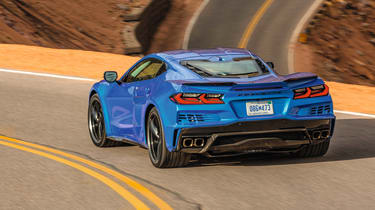
This all sounds deeply confusing. Honestly, it is, and you mostly find yourself using the preset modes and either leaving the traction control alone or switching it off completely. Fortunately, where the sheer configurability is intimidating, the E-Ray is pleasingly simple to drive. It just feels like a really hooked-up car, with masses of performance and a chassis that provides plenty of options.
The spec suggests that the hybrid part of the E‑Ray is almost hidden away. There are no charge cables, the range is pathetic and the Corvette messaging is all about performance. However, in reality the E‑Ray embraces the electric boost. Unlike some hybrids you’re aware that there are two distinct power sources – partly because the thumping V8 soundtrack is overlaid with a synthesised plasma-gun warble, but also because at times (when cruising in higher gears, for instance) the hybrid system responds first when you initially get on the throttle, before the mighty engine hits its stride. With the front axle motor being a separate entity to the engine, it doesn’t always feel cohesive in how it delivers power. But when fully lit, the combined performance and responsiveness is something to behold.
On the road, it’s not often you test the ultimate grip of 345-section rear tyres, but there are definitely subtle new sensations and capabilities that you feel and enjoy as you start to load the E‑Ray up. Treading the line between the front axle feeling ‘active’ in the driving experience and a car descending into an odd, inconsistent experience that’s constantly shifting the goalposts is tricky, but the E‑Ray manages it really well. Compared to a solely ICE-powered four-wheel-drive car, it’s somewhere between the almost pure rear-drive feel of an early R8 and the extreme capability of a Nissan GT‑R, which pulls itself straight with greater force and is more aggressive with its front axle.
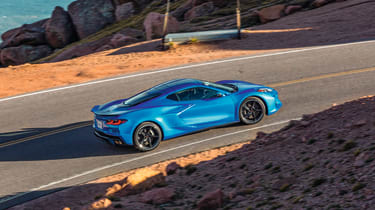
You can feel that the E‑Ray is driven at both ends, but it doesn’t demand you adopt a particular driving style, and even lets you enjoy neat, intuitive slides while still building massive forward momentum, like the best four-wheel drive cars do. Downsides? The E-Ray’s balance and poise is readily enjoyed on smooth roads, but it can get busy over bumpy and heavily cambered surfaces, hunting and twitching in your hands and making it tricky to position its abundant width. The steering isn’t the most natural, either, feeling quite heavy and sticky while not feeding your hands with very much information.
The character of the engine never gets old, however, even if we’d prefer to hear pure tones from the V8 rather than the overlaid EV sound. The eight-speed dual-clutch ’box is fast and smooth too. Even the annoyingly long gap between third and fourth – a quirk of all C8s – is slightly less of an issue due to the torque on offer. Overall, the smooth, slightly heavyweight feel of the car is very much Stingray Plus rather than the edgier, more agile and attacking style of the Z06, but the added AWD capability does lift it above the base car in more than simply straight-line performance.
On track
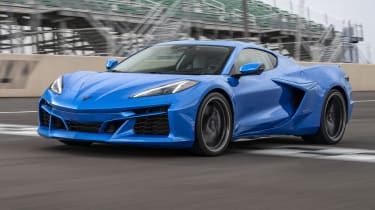
It seems slightly cruel to venture out on track in the E‑Ray. It is deliberately very different to the track-focused Z06, it weighs not far off two tons and the amount of performance on offer is sure to punish the tyres and brakes. In reality, however, the E‑Ray is a riot: and very, very quick.
You do need to work to its strengths, however, and carrying speed into corners and then teetering the car on the edge on exit isn’t the way to fast lap times. Instead, get the E‑Ray slowed down early, quickly get the turning done by sacrificing a bit of apex speed and then pin the throttle to provide maximum thrust from the front wheels. Traction is mighty and on shortish tracks with several slow corners the E‑Ray will match or even beat a Z06. The brakes are superb, the steering may lack feel but on track you simply want consistency and accuracy, which it provides in abundance, and the sheer performance and grip on offer is quite something.
What’s particularly impressive is that the E‑Ray requires less patience than the lighter (although narrower) Stingray. There’s more front-end bite and the weight of the engine is better controlled, so you can hustle it a bit more without washing into understeer or provoking roll oversteer. The PTM system works well in Race here, too. You can sense it gently caressing your inputs to knock the edges away but still the car feels free to move beneath you. Remove the stability and traction aids altogether and the E‑Ray remains really composed and is a joy to slide. Now that middle ground I mentioned between R8 and GT‑R swings a little further towards the Nissan, so you have to be sensitive to what the drivetrain is doing and work very calmly on the steering wheel. Opposite lock will be required from time to time, but you can often balance the car in a lovely four-wheel drift.
If there is a problem here it’s that the small battery means you’ll only get a lap or two at qualifying speed in Track mode before it’s depleted. More consistent lapping is possible by selecting Charge Plus, which will keep the battery in a sweet spot but provide a little less power. Chevy claims this allows for 30-minute sessions without a drop-off in performance. Incidentally, the front wheels can’t be driven over 150mph and the E‑Ray’s top speed of 184mph is pure ICE-enabled.
Driver’s note
‘In steady driving, the Corvette is clean and very fast in its responses, but clicking up through the modes to Sport or Race adds so much additional weight to the power steering that it feels like the front tyres have lost about 20 psi. The best feel is achieved in the lightest Tour setting.’ – James Taylor, evo Deputy Editor
MPG and running costs
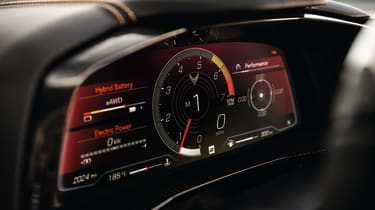
In theory the E-Ray is the economical Corvette, but that term is relative of course. Officially it’ll achieve 22mpg, which is a little behind the quoted figures for a 911 Turbo S, but better than the 20mpg claimed figure for Mercedes-AMG’s non-hybrid GT 63.
Consumables certainly won’t be cheap, considering the Brembo carbon ceramic brake package and extremely wide tyres. Go for the carbonfibre wheels and you’ll need to have a sharp eye for curbs and potholes – they’re a c£10k option.
Interior and tech
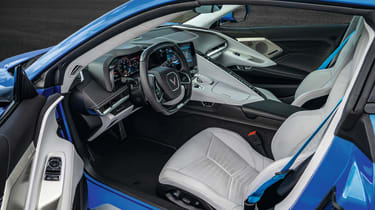
Depress the rubber button tucked behind the leading edge of the side intake and the door feels lightweight and swings out for miles to grant easy access to the E‑Ray. You have to drop quite a way into the cabin, supercar-style, but the seats feel plush and the environment is the polar opposite to a minimalist McLaren’s, for example. Let’s call it ‘busy’. The almost completely square steering wheel is an odd touch, too. The whole interior has a plumpness about it. Mid-engined it may be, but the E‑Ray’s ambience is positively luxurious.
Quality is good too, with pleasing metal detailing and a solid feel to the trims and major controls. Busy it may be, the Corvette does feel special inside, with a great sense of occasion and a much more cocooned feel than something like a 911. The digital dash has relatively clear instrumentation and while the central touchscreen isn’t as clean and intuitive as what you’ll find in a 911, it’s easier to navigate with practice.
evo Car of the Year 2025 – result
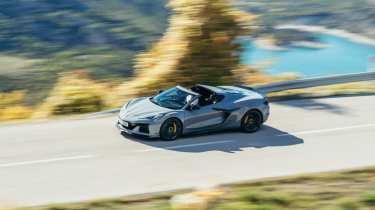
There were times when the Corvette looked like it might trouble the top end of the scorecard at our 2025 Car of the Year test, but depending on which of our six judges you spoke to, it could also be a wooden spoon contender.
James Taylor struggled a little to get on with it, but thought there was a great car in there somewhere; it just required a lot of time to uncover. Dickie Meaden, like many other judges, simply couldn’t understand why it looked the way it did and consequently found it undesirable despite loving driving it and being full of admiration for the quality of the engineering.
‘The acceleration when you extend the throttle the whole way is eye-popping,’ said Henry Catchpole. ‘There’s also an ease and a smoothness to the car that’s beguiling, and you can push with confidence.’ Yousuf Ashraf preferred the regular Stingray: ‘Its narrower body and tyres make it feel more fluid and up on its toes, but there’s a lot to like about the E-Ray; it has a unique personality and is a more intriguing car.’
In the end, the E-Ray placed eighth out of 12 cars, pipping the Aston Martin Vanquish to eighth by 0.2 points but losing out to the seventh-placed Maserati GT2 Stradale by 0.1.
Price and rivals
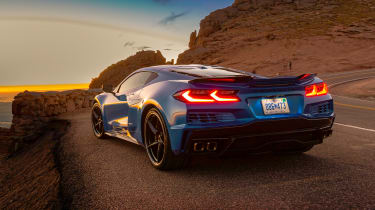
The Corvette E-Ray has a broad spread of talents and massive performance, but it does come at a hefty price. At £159,230 it’s far from the bargain option you might expect a Corvette to be, but then the C8 has moved the game on significantly compared to its predecessors, not least in being the first hybrid-capable model.
At that level the E-Ray sits between two hybrid Porsche 911s – the £137,900 Carrera GTS, and the £199,100 Turbo S. The GTS is around 100bhp less powerful but offers a masterful blend of old-school mechanical character and electric response, with a much more cohesive power delivery than the ‘Vette from its hybrid flat-six. It feels lighter and more feelsome too, more like a sports car. The Turbo? It’s heaps more expensive but a genuine 200mph car – not much on the road can touch it from point-to-point.
Aston Martin’s Vantage is more expensive than the E-Ray at £165,00, but offers the prestige of the Aston badge, a far more compelling design and a more sumptuous interior – plus the honest fun of a bombastic V8-engined, rear-drive coupe. The Mercedes-AMG GT is more straight-laced but ruthlessly efficient, with a four-wheel drive system and clever hydraulically cross-linked suspension, but not as warm and characterful as either the E-Ray or Vantage.
For something more GT oriented with space for four, there’s also Maserati’s GranTurismo to consider. It’s nowhere near as explosive and quick across the ground as the Corvette, but there’s much to be said for its more relaxed tourer vibe for day-to-day use.
Chevrolet Corvette E‑Ray specs
| Engine | V8, 6162cc, plus e-motor |
| Power | 635bhp |
| Torque | 595lb ft |
| Weight | 1765kg |
| Power-to-weight | 377bhp/ton |
| 0-60mph | 2.9sec |
| Top speed | 183mph |
| Basic price | £159,230 |