New Lotus Emira 420 Sport review – taking aim at the Porsche Cayman GT4
Lotus’s sports car gets added focus and is all the better for it. As it needs to be with such a lofty target...

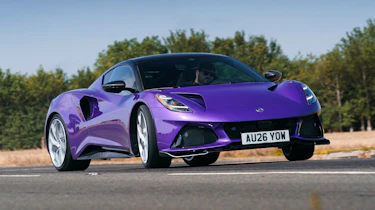
The Lotus Emira 420 Sport is nothing short of the UK’s answer to the Porsche Cayman GT4 and yes, Gavan Kershaw, Lotus’s Director of Attributes and Product Integrity is happy to namecheck Stuttgart’s two-time eCoty winner directly. He says that the ‘Tour’ and ‘Sport’ suspension packages available on the Emira Turbo, Emira Turbo SE and V6 correspond directly with standard Cayman and Cayman S.
What about the Cayman GTS? That’ll be the new 420 on its standard fixed-rate suspension set-up. The Cayman GT4 rival is the Emira 420 Sport with the Handling Pack, which among a number of lightweight features, includes the fitment of manually adjustable Multimatic dampers. Apart from the obvious German competition, manually adjustable suspension on a niche British sports car, for somewhere in the region of £120k, sounds a lot like the new Morgan Supersport 400 too. It’ll also need to beat Alpine’s outgoing A110 R and offer an experience over and above that of some lower-tier Porsche 911s, against which the 420 Sport is closely priced.
> Lotus axes Emira EV for new 536bhp petrol engine
The Emira hasn’t had an easy first few years. It took too long to be fully finished, let alone properly go into production. When we did eventually get hold of a proper production car – a supercharged V6 manual on ‘Tour’ suspension – it fell mid-pack in a test of its sports car rivals, behind Alpine’s A110 and Porsche’s Boxster GTS. We tested the i4 and the Turbo SE and found they improved things further, with greater poise and polish. But in both instances, we were left wanting more – a heightened variant to release the full potential of a promising sports car.
Lotus Emira 420 Sport – what’s new?
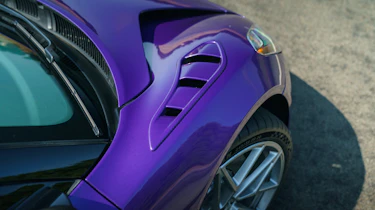
It’s not such an emotionally rousing start for the 420, as even from a medium distance the changes from the standard car aren’t immediately obvious but move closer, circle it a few times, and they start stacking up. A McLaren-esque inlet trim (more obvious when in carbon) on the side is most visible from farthest away and no, the parallels with Woking don’t stop here.

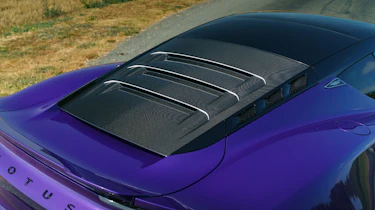
Closer-up the extra splitter, opened-up front vents, more aggressive skirts, arch vents, clear rear lights, boot lip spoiler, carbon slatted deck lid (with herringbone symmetrical weave), titanium exhausts and new wheels, on which the 420 Sport sits 5mm lower, complete a comprehensive package. Unless you have the carbon exterior pack, without a big wing it’s a bit ‘if you know, you know,’ but the Emira’s inherent presence is enhanced and none of it without purpose.
Unlike the GT4, there’s no more aggressive seat option. Kershaw and design boss Russell Carr say this is because the 420 is first and foremost a road car – that, and the harsh economic realities of homologation and the volumes needed to justify that kind of investment.
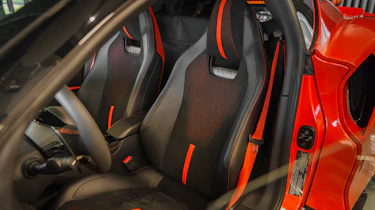
It’s a regrettable omission, as you feel like you sit a bit too high on the standard 12-way adjustable items and I think the 420 Sport’s elevated billing warrants the extra theatricality, support and improved driving position. You can at least clothe the existing seats in perforated back-coloured Alcantara, a personalisation touch first pioneered on the Evija hypercar.
Downforce is up by a moderate 25kg (without adding drag) and the rate of airflow through the car has increased. Its honeycomb-grilled maw can intake 15 per cent more air to the side radiators and 14 per cent more through the middle, while the titanium exhaust has a 30 per cent improvement in exhaust valve gas flow, aiding the rise in power to 416bhp from the Mercedes-AMG M139 four-cylinder engine without messing up the power band.
The splitter aids that downforce figure but also speeds up airflow into re-profiled brake ducts, increasing cooling and therefore, braking endurance, even though the hardware itself is unchanged. The exhaust is part of the Handling Pack and also saving 9kg from the tail of the car. Likewise the lithium-ion battery (10kg) and the carbon deck lid (5kg). The forged wheels also save 5kg in all-important unsprung weight and are wrapped in the same ‘LTS’ Michelin Cup 2 as on the most sporting configuration of the ‘standard’ Emira.
The standard fixed-rate dampers are, according to Kershaw, a step up in focus from the Sport chassis on the standard Emira. But where the folding money has gone, and what could well justify the handling pack on their own, are the Multimatic spool valve dampers, 11-way adjustable by hand at each corner for bump and rebound, with the handbook offering recommended settings for either road or track. Yes you’re asking, so here they are. Road: front bump 3, front rebound 4, rear bump 6 rear rebound 4. Track: Front bump 9, front rebound 8, rear bump 10, rear rebound 7. The geometry’s been subtly tweaked to suit, too.
DSSV dampers are a bit brain-scrambling, which is why they tighten the trousers of big-brained engineers. The need to know is they’re almost infinitely configurable when setting them up, have hugely predictable damping characteristics and are enormously resistant to extreme temperatures and cavitation – the buildup of bubbles in a damper’s fluid that can cause inconsistent feel. With the four-cylinder they’ve the best chance at success too, given its rear subframe is next-generation compared to the V6’s – lighter and stiffer, basically GT4 racer spec.
Lotus Emira 420 Sport – performance, ride and handling
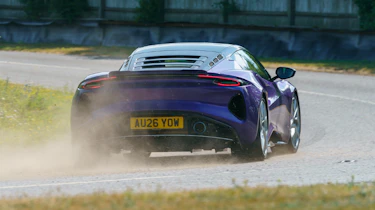
In part what is an excellent almost McLaren-esque view out, both to your sides and ahead, actually reinforces the impression you’re sat too high. Those aforementioned ‘Becker points’, where the car’s body falls away from view, make positioning the front of the car instinctive. Our car has the Alcantara steering wheel and carbon interior pack, though the new larger DCT paddles – with their re-engineered action and controlling a more responsive transmission – are standard in carbonfibre. Look up and two manual latches remind you that the Emira can now be had with a pop-out roof panel.

The Lamborghini-esque flip-up shield for the starter feels more appropriate in this less reserved Emira variant, but the motor doesn’t fire with much exoticism. The 416bhp, 369lb ft AMG four-pot is an effective if not expensively tuneful thing, even with the optional titanium pipes through which to respire.
My car is left hand drive, so there’s the added joy of the turbo being right over my left shoulder. Listening to it take great lung fulls of air, building up from 2000rpm, then the almighty flutter as I lift off is a pure juvenile joy, putting me in mind of a baby McLaren P1. The engine’s vocals are McLaren-like in general which is to say, not overburdened with texture or musicality, rather a more full-bodied and industrial roar.
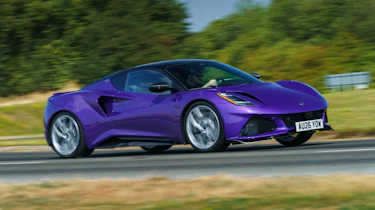
It does at least pull sooner than the old 3.8 V8s, which needed over 4000rpm to really come on song. The surge through the revs has shades of Woking then, as you pull a paddle to bring home the next gear from near-redline, the crack from the exhaust has real 675LT ignition cut vibes. Totally lacking multi-cylinder exoticism it may be, but this powertrain is far from drab and dreary and it’s plenty potent enough, with the 0-62mph sprint time dropping to 3.9sec. Top speed is 186mph.
I’m not so pleasantly surprised by the gear shift experience. I wish the paddles clicked with a bit more race car-style resistance, while the ‘box isn’t PDK-obedient, nor the shifts themselves PDK-quick. And being the AMG engine, there’s no manual option.
Knowing about the added focus, the drop in roll, my initial fear was whether this was going to be too frenetic a road car, dynamically, like going from A110 to A110 S. Happily, it’s more like an A110 R, the dampers in their prescribed road setting treading an exceptional balance of transmitting all the surface details you need while soaking up the worst impacts, the body feeling much more tied down without cutting you off.
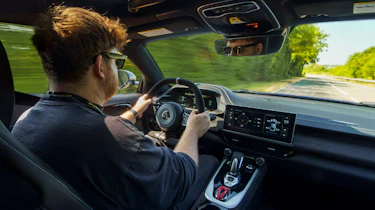
The result is that I can scuttle across the acne-addled, awkwardly tumbling Norfolk roads this car was developed on at increasing pace, without the looming sense of risk that an errant bump will send me into orbit. This is what we craved from the Emira, the right kind of sharpness, without the sacrifice. There’s more than one shade of McLaren LT in miniature here.
The hydraulic steering is silky and well-weighted in Track mode (my favourite over Sport and Tour) and while it does gently spasm as the tyres deflect across cambers and ruts, it gives a feeling of connection, rarely straying into distracting or disconcerting territory. What isn’t quite perfectly resolved here is that initial sense of aloofness. A current 911 GT3 clearly articulates whether your direction change request was ham-fisted or well-judged, allowing the car to load both its front and rear sidewalls with a neutral stance.

The Emira however can still deliver mixed results from corner to corner, the output not guaranteed by the same steering input from one corner to the next. Force a bit more heat into the Cup 2s and it nips in nicely, especially on a gently trailing brake, but a simple to-and-fro seven-tenths flow on a country road can be a mixed bag. I think smoother, more consistent and flowing roads might work in its favour. There’s no mechanical limited-slip diff in four-cylinder Emiras, but the E-diff works well, though it defaults more to big angles than subtler, daintier flourishes, so you need to be prepared to catch it.
Driving the Emira 420 Sport on track
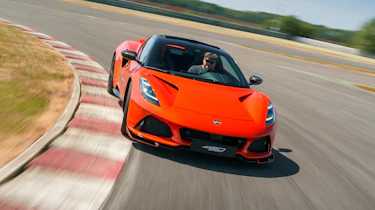
We also tested an Emira 420 Sport on the Hethel circuit with the Multimatic dampers in their track settings. This track is the opposite of flattering, for car and driver and more the better, to iron the kinks out of both.
I struggle most with the Complex, never quite nailing that first phase that sets you up for the coming 20-second to-and-fro. But the Emira forgives my hamfistedness, allowing me to back off and, with heat in the Cup 2s, tack it back on line. It feels enormously settled in high-speed direction changes, the brake and flick at speed from Chapman through Windsor dealt with in a cool, calm, minimal back-and-forth lean.
Along the long back straight, the brake pedal is resisting my downward press nicely and consistently. Even with the surface evolving beneath us, both in adhesive quality and appearance, from slightly rough to smooth inky black tar. It’s stable and squat, the new arch vents atop the ‘Becker points’ subtly and unhurriedly dipping as three figures tumble into two on the digital speedo.
A lack of lapping time precludes proper testing of brake endurance, but questions over the nose’s aloofness and the gearbox’s responses and obedience remain. Sometimes they’re just not quite with you. The seats too, aren’t track-fit to the point I’m holding myself in with my back muscles in high-G turns, making up for inadequate support. With a proper seat though, this would be a much more suitable and useful track car than a standard Emira.
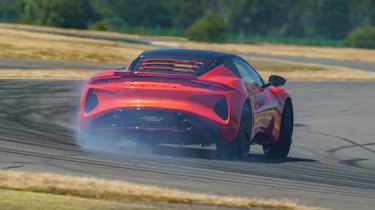
I’d played with the Emira’s balance on the road but with an empty hairpin and Dean hungry for tyre smoke, I let loose. It’s enormously playful, with 40-50mph drifts possible with its low-end torque in third or higher up in second. It’s putty in your hands, letting you roll back and forth through the rack as you adjust your throttle inputs and the car’s angle of attack.
For its handful of flaws, the Emira 420 Sport is the heightened Emira we’ve been crying out for. Whether it’s up to the GT4 rival billing might require a direct comparison.
Price and rivals
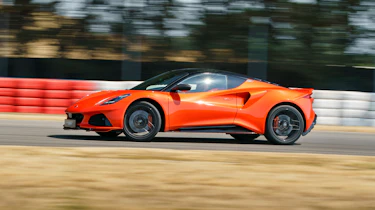
The Lotus Emira 420 Sport isn’t cheap. It starts from £105,900 and for that you do get the new aero and styling elements, boosted motor and bespoke fixed-rate suspension. However to fully realise the 420 Sport, you need the Lightweight Handling Pack, which includes the Multimatic dampers, lithium-ion 12-volt battery and titanium exhaust, for an extra £12,900. That raises the price of the Emira 420 Sport that you want to £118,800.
That looks like reasonable value compared to say, the Morgan Supersport 400, which also offers c400bhp and manually adjustable suspension. The Morgan is arguably the more premium product to justify its £138,883 price, however. The inevitable comparison will be with the Porsche 911, which now starts from £110,105. For £3000 more than a Handling Pack-equipped Emira, you can have the Carrera T, probably the best non-GT variant of the current 911, complete with its slick six-speed manual transmission…
There’s also the 420 Sport’s target benchmark, the Cayman GT4, which is now obviously off sale. We can’t help but draw contrasts with the also recently-discontinued Alpine A110 R, too.
Lotus Emira 420 Sport specs
| Engine | In-line 4-cyl, 1991cc, turbocharged |
|---|---|
| Power | 416bhp @ 6500rpm |
| Torque | 369lb ft @ 5500rpm |
| Weight | 1430kg (with Lightweight Handling Pack) (296bhp/ton) |
| 0-62mph | 3.9sec |
| Top speed | 186mph |
| Basic price | £105,900 |