Porsche 718 Cayman GTS 4.0 (2020 - 2025) review – a near-perfect mid-engined sports car
Porsche has killed the 718, and with it the sublime Cayman GTS 4.0. It goes out as one of the best all-round sports cars ever made

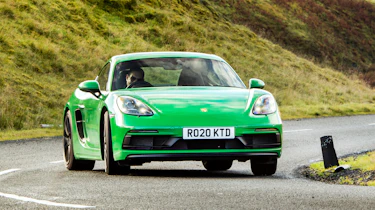
Porsche’s 718 Boxster and Cayman got off to a shaky start when they launched in 2016. Not because they weren’t dynamically stellar, supremely capable sports cars, but because of the move to smaller four-cylinder turbocharged boxer engines in place of the flat-six that had always been – quite literally – central to Porsche’s entry-level sports cars. They delivered the goods on paper and more low-end grunt than previous naturally aspirated engines, but the response, character and sonic magic had disappeared.
Thankfully, Porsche answered our prayers and brought the flat-six back in 2020, by introducing the 718 GTS 4.0. With the fitment of a detuned Cayman GT4 engine, plus beautifully judged chassis upgrades, the Boxster and Cayman were back at the top of their game, and it’s the latter hard-top model we’re covering here. It lacks the open-air thrills of the Boxster, of course, but to drive it’s even sweeter and one of the very best sports cars of its type.
Porsche brought 718 production to an end in 2025, and the Cayman GTS remained a near-unbeatable package right to the very end. Sitting above the Cayman S but below the GT4, it’s perhaps the closest a non-GT Porsche has come to delivering the thrills of the motorsport-derived flagship. The engine is a big part of this, of course, but standard fit chassis upgrades and lowered suspension also play a part, bringing the 718 to life without making it too hardcore for the road. Add in the option of a manual gearbox and you have a superb everyday sports car with much of the GT4’s appeal. One that’s – whisper it – more fun and exploitable than a 911 Carrera.
Engine, gearbox and technical highlights
- GT4-derived flat six with 394bhp
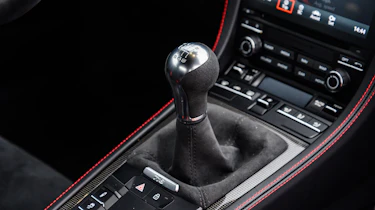
- Manual or PDK gearboxes available
- Lowered suspension, torque-vectoring differential and active drivetrain mounts among included chassis upgrades
More reviews
In-depth reviews
Reviews
- Porsche 718 Cayman GT4 (2020 - 2025) review: an instant modern classic
- Used Porsche Cayman GT4 (981, 2015 – 2016) review: a flat-six hero from £55k
- Porsche 718 GT4 ePerformance 2022 review – the electric racer you'll want to watch
- Porsche 718 Cayman GT4 Clubsport 2022 review
- RPM Technik Porsche Cayman (981) CSR review – a rival to the GT4?
- SharkWerks Porsche Cayman GT4 review – an improvement on near perfection?
Four litres and six cylinders was a combination first seen in the back of a 911 when the GT3 RS 4.0 was revealed in 2011. Back then the 911 had 500bhp at its disposal, and while the Cayman GTS’s 394bhp pales by comparison, you’re far from being short-changed. This is a truly stunning powertrain, despite the 20bhp shortfall over the GT4 and a 200rpm lower rev limit, the limiter calling time at 7800. It breathes through a sports exhaust as standard.
A tweak to the ECU accounts for the power drop, although with a seven-speed PDK gearbox the GTS’s 317lb ft torque peak is slightly higher than the GT4’s. With a six-speed manual, torque is the same across both models at 310lb ft. The 0-62mph time for the PDK model is 4sec, with the manual being half a second slower. The three-pedal GTS does have a marginally higher 182mph top speed, however, compared to 179 for the PDK.
As for the chassis upgrades, a mechanical limited-slip differential with torque vectoring comes as standard, as well as active drivetrain mounts and 20-inch light-alloy wheels. There’s also an uprated brake system with cross-drilled discs and PASM adaptive suspension that sits 20mm lower than standard. Carbon ceramic brakes were available as an option, along with PASM Sport suspension to lower the car by a further 10mm.
Driver’s note
‘The GTS delivers so much of the GT4’s thrills for cheaper bills it’s painfully difficult to decide between the two. It’s the equivalent of trying to pick a favourite child.’ – Stuart Gallagher, evo Editor-in-Chief
Performance, ride and handling
- Responsive, gorgeous-sounding naturally-aspirated engine
- Perfectly judged blend of compliance and control
- Long gearing hinders the manual, but tactile shift action makes up for it
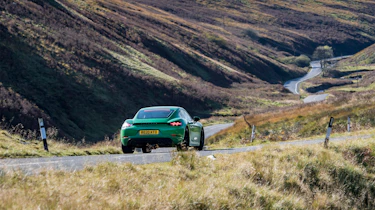
To drive, the GTS is marvellous. As a road car it leaves you wanting next to nothing and is the closest you can get to a pure driver’s car without knocking on the door of a GT4, or a Lotus. It has balance, poise, precision and ability in abundance. It rewards, excites, entertains and thrills like the very best, every drive becoming a great journey, every journey delivering a memorable experience.
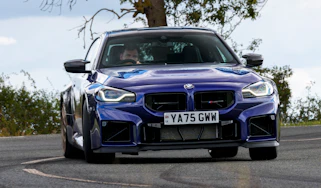
Central to the experience is the 4-litre engine. As in the GT4 and Boxster Spyder, it adores revs and feels every bit as mechanical as you would hope, serving up a full complement of evolving sounds as the power builds. If you’re used to the low-down punch of, say, a BMW M2 it might feel a little flat in the higher gears, but there’s still a healthy flow of torque and a vivid crescendo that turbo engines can’t match. It’s a peach to use and exploit.
A six-speed manual is the icing on the GTS cake, even if the ratios are comically long. The shift action is so sweet, the torque band wide enough to catch you if you drop out of the power’s peak delivery zone, which itself is wider than you expect and a joy to operate within. For what the PDK gives up in terms of involvement, its closer ratios make the engine feel more lively, and the shifts hit home swiftly. There isn’t the crisp, instantaneous whap-whap of a GT3-spec engine on downshifts, but it's still a polished and exciting drivetrain – far more so than that of a BMW M2.
Combine this with a chassis that’s fantastically judged in terms of precision, connection and compliance and it’s hard not to be completely captivated by the GTS. Its perfectly weighted steering is sharp and direct without ever being nervous, it feels compact and biddable, and there’s a sense of integrity to the car as it shrugs off poor roads. You’re always connected to the surface beneath you but the GTS deals with bumps in one clean hit, and has superb control in its stiffer damper mode.
All this means you’re inclined to push it harder, and explore the GTS’s full capabilities by turning the stability control off. Do so and there are no nasty surprises. It’s neat, accurate and grippy, but without feeling clinical. Deploy the torque from the flat-six and the GTS will scribe neat, fantastically controllable slides, while still building forward momentum by virtue of its impressive traction. Dynamically, it can do pretty much anything – including offer more fun and involvement than a more straight-laced 992-gen 911 Carrera.
Driver’s note
‘The gearing is ludicrous, and I can’t think of many who wouldn’t be prepared to sacrifice being able to do 90mph in second if it meant they have more opportunities to experience the flat-six at full chat in fourth.’ – Stuart Gallagher, evo Editor-in-Chief
Interior and tech
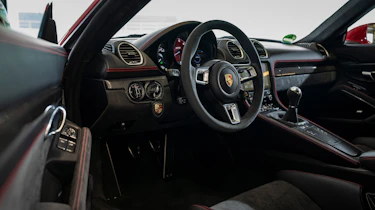
Today the 718 can’t help but feel outdated in terms of its tech, but the fundamentals of the cabin are spot on. You sit low and the 18-way adjustable sports seats are very supportive – although they did give some testers lower back pain on extended drives – and the small, suede-trimmed wheel is a delight to hold. The pedals are spot on too, and in manual cars the gear-lever is mounted high on the centre console, just a hand-span away from the wheel.
Build quality is superb throughout, and being based on an older cabin architecture means there are tactile, physical buttons for all the major controls. The 718 shows its age in terms of its infotainment system, however, which is touch-operated and lacks the wide-reaching functionality and modern graphics you’ll find in current Porsches. The dial pack is analogue too – save for a digital display embedded in one of the gauges – but clear readouts mean we don’t mind that one bit.
Price and rivals
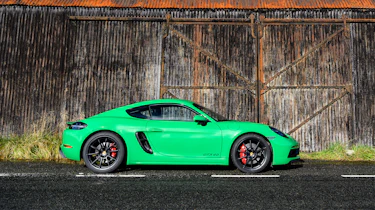
The Cayman GTS 4.0 launched with a £64,088 asking price in 2020, which rose to well over £70k later in its life. Today, early second hand examples with less than 50,000 miles on the clock cost from £50k.
Few sports cars get close to the GTS’s blend of talents, but Alpine’s A110 is equally compelling to drive and goes about its business in a very different way. Significantly lighter with wonderful fluidity and poise, you can pick up a low mileage 296bhp GT model from 2023 for similar money. For something more raw, there’s also Lotus’s Evora Sport 410 to consider.
Audi’s TT RS wouldn’t know which way the Porsche went, but its engine is equally characterful and used examples come in at a more affordable £30k. Also from Germany, the sublime previous-gen (and evo Car of the Year-winning) M2 CS is more than a match for the GTS in terms of raw excitement, but costs £10k more than the Porsche.
Of course, £50k could also buy you any number of 911s, from 997-generation GTS models to later turbocharged 991.2 Carreras.