Analogue Automotive VHPK Lotus Elise review – a McLaren F1 in miniature?
How to make a Lotus Elise even more driver-focused? Bin the passenger seat and mount the driver in the middle
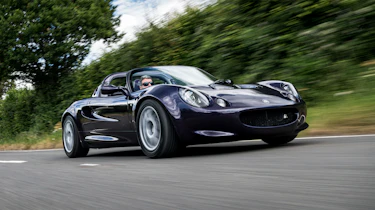
It’s a little over two years since Analogue Automotive introduced us to the notion of a £100k-plus S1 Lotus Elise. The product of company founder Steffen Dobke’s obsessive quest to improve his own car, the SuperSport’s price may have been at odds with the Elise’s affordable status, but not only were Analogue’s enhancements comprehensive and brilliantly executed, they also came from a profound respect for the original car.
Just under 12 months ago, Analogue announced an even more special Elise. One that would represent the purest, most potent distillation of everyone’s favourite Lotus. Much lighter and considerably more powerful, it targeted a sub-600kg dry weight and 250bhp for a power-to-weight ratio of 400bhp+ per ton. Price? £350,000. Plus taxes. Gulp.
Analogue Automotive VHPK Lotus Elise in detail
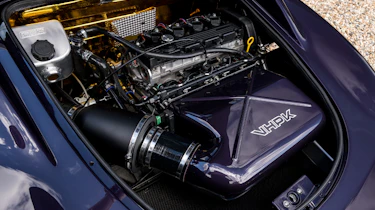
Why VHPK? Well, if you’re a student of Lotus jargon you’ll know it’s a play on the Very High Performance Derivative initialism given to the high-output 190bhp version of the K-series engine developed by Minister Racing Engines and Rover’s motorsport division, Powertrain Projects.
Rather neatly, PK is also the initials of commissioning customer Philip Kadoorie, a Hong Kong-based billionaire with an admirable and, by all accounts, incurable addiction to very special cars. Alongside his family’s extensive collection of top-tier classics and historic race cars, Kadoorie has recently commissioned some exceptional restomod projects, such as the fire-breathing, 11,000rpm, carbon-bodied 911K built by Tuthill.
More reviews
The Analogue Automotive VHPK is very much in that same vein: a lighter, fiercer, beautifully finished exercise in improvement and intensification. One driven by Kadoorie’s vision, fuelled by his prodigious spending power and realised by the leading marque specialist. It’s a compelling collaboration, more akin to the patronage of an artist than a conventional contract between car company and customer.
For Analogue it has provided a de-risked opportunity to comprehensively exceed the already ambitious SuperSport. Appropriately, given the art analogy, Kadoorie describes it as a way for Dobke to ‘step away from the canvas’ and gain fresh perspective on a car he has become so close to. For Kadoorie, the project has resulted in the ultimate canyon-carver. One he intends to use on his favourite mountain roads back in Hong Kong. Indulgent? Certainly. Enviable? Absolutely! When it comes to cars, his is the dream we’d all love to live.
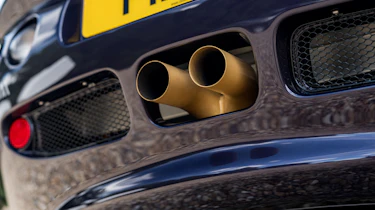
Some 1500 hours of skilled labour go into the process of creating a VHPK, starting with the strip-down of the donor car and full restoration of its bonded aluminium tub. This is followed by a full nut-and-bolt build using the VHPK’s long list of bespoke or extensively improved components. Considering the number of hours and what must be a truly formidable BOM (bill of materials), Analogue’s price tag is humungous but in line with one of Alfaholics’ gorgeous full-carbon GTA‑R 300 Giulias.

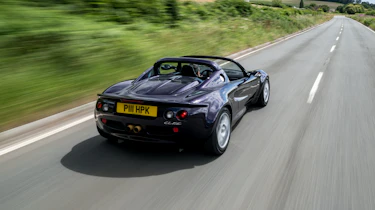
Seen in the carbon, the VHPK is cute as a button. Tiny by modern mid-engined standards, it has a toy-like quality that makes you smile just looking at it. Analogue’s original SuperSport model introduced the wide-track suspension that underpins the VHPK, the new wishbones pushing the wheels out to the limits of the standard fender profiles, +30mm at the front and +20mm at the rear.
Bigger wheels would have made the job of sourcing suitable carbon brakes easier, but in the end the VHPK retained wheels of the same 15-inch front and 16-inch rear diameter as a stock Elise, albeit with a slightly wider rim and made to Analogue’s bespoke design to save weight and evoke the original split-spoke style.\
They’re fitted with Yokohama Advan Neova AD08RS tyres – 195/50 R15 at the front, 225/45 R16 at the rear. With a decent depth of sidewall, they promise greater compliance and sit just-so within the bodywork. The result, to my eyes at least, is a perfect stance, and an overall look that works hard to unite the conflicting objectives of aesthetic style and dynamic substance.
As for the brakes, they’re dinky 300mm carbon discs gripped by four-pot AP calipers and Pagid pads. Built to Analogue’s specification, each rotor alone saves 2.6kg versus the standard Elise disc (cast iron, not MMC). Reflecting the obsessive nature of the VHPK programme, there is a lighter carbonfibre wheel option in development to further reduce unsprung weight.
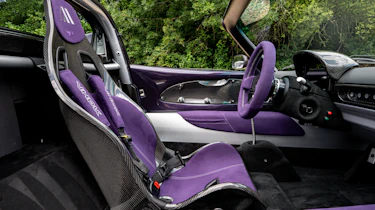
The central driving position is a defining feature of the VHPK, one that places it in elite company. It’s a modification that was first seen in the Lotus Sport Elise – a one-make racer built at the factory and a forerunner of the S1 Exige. Analogue has taken that idea and improved it with better mountings for the seat frame, while the interior has been trimmed such that it looks like it was born this way.
Driving the Analogue Automotive VHPK Elise
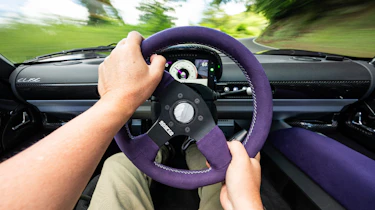
Climbing in with the roof removed is unexpectedly discombobulating. Partly because you don’t want to leave footprints on the carpet as you step in, but also because the seat is too far away to slide yourself across the sill and in, as you would in a regular mid-engined car. Once you’ve navigated your way to the seat and slipped down into position, it feels the most natural thing in the world. Centred in the cockpit with the road ahead framed in perfect symmetry by the windscreen surround, you’re enjoying a £20million view, as experienced by owners of the McLaren F1 and, more recently, the GMA T.50.
For whatever reason, I expect to find the gearlever on the right, race-car style, but with the gearbox mounted on the left end of the transverse K-series engine, the most direct route for the linkage places the lever to your left, as it would be in a right-hand-drive Elise. It’s funny to have your feet floating on the pedals, free from the confines of a footwell. There’s so much space for such a small car, though it still feels intimate. Not single-seater snug like a BAC Mono, but singular and focused. Road cars are rarely so selfishly designed around the driver, though you’ll have to remember to reach out and close the door before you clip yourself into the four-point harness.
With the rear luggage compartment sacrificed for the seriously souped-up K-series’ airbox, there’s a danger the VHPK could fall into the trap of current hybrid hypercars that have nowhere to stow even so much as a crash helmet. Kadoorie won’t be needing luggage on his mountain road drives in HK, but I can’t help but think a neat cubby on the right-hand side of the driver’s seat could be made to hold a helmet, race boots, etc. There’s some space on the left, too, not to mention the full width of the bulkhead behind the seat for a soft-shelled bag. More than enough to stash all you’d need for a trip to Spa or the Nürburgring. I’ll be sure to request Analogue build this into my car when I win the Lottery…
Despite the extensive modifications, if you’ve driven a regular Elise, much of the VHPK experience feels familiar. The engine starts with the same quick chunter of the starter, followed by a crisp bark as the pistons begin to dance in their bores. The Rover-designed engine has always been a zesty character, but in VHPK spec it’s an absolute firecracker. A slight bump in capacity from 1.8 litres to 1.9 gives it a fuller delivery, while forged internals, throttle bodies and a MoTeC engine management system give it plenty of brrapp!
Some of you will be wondering why Analogue and Kadoorie went to so much trouble and expense extracting 250bhp from a K-series when a Honda K20 swap would provide ample opportunity for far greater power and torque. The problem, for those striving to stay true to the Elise’s delicate core qualities of handling balance and lightweight construction, is the Honda powertrain is twice as heavy.
Weight of a different kind is welcome. There’s a bit more substance to the steering than in a stock S1. Likewise the gearshift, which is shorter and meatier in this short-ratio ’box. Initial impressions of the damping are of ample support with an underlying suppleness that can still filter out the worst imperfections. Thanks to the considerable weight savings, the springs are actually softer and the dampers have been re-valved compared with the SuperSport. It makes for a blend of pliancy, directness and immediacy that confirms the VHPK is a real livewire – one you don’t need to drive fast to feel connected to and fulfilled by; nor does it need racetrack-smooth tarmac to give its best.
The K-series has plenty of low-rev tractability, with satisfying muscularity at modest throttle openings. Peak torque is 185lb ft at 5800rpm, up from the original S1’s 122lb ft. It’s smooth, too, the quality of those beautifully balanced internals evident in the engine’s response and appetite for rpm. This easy speed is your first hint that, despite the focus on extreme weight savings and extracting maximum power, the VHPK is no racetrack refugee.
There’s a joy and purity to driving this car on great A- and B-roads that’s quite different to anything else. Like every Elise, it’s wonderfully compact, so there’s so much more road to play with; something you can really make the most of thanks to the central driving position. Whether you’re rushing through a tunnel of trees, dashing between the hedgerows or slicing through a sequence of corners, you have an overwhelming sensation of precision and accuracy. It’s a bit like licking a strand of cotton and sliding it through the eye of a needle at the first attempt.
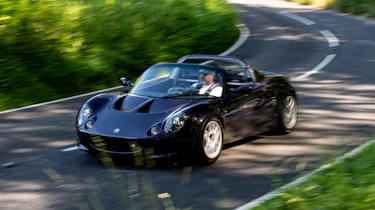
There’s brilliant front-end bite, backed up by an equally planted rear end. It’s agile and keyed in to the tarmac, but still with enough poise and throttle adjustability to really dance through corners. Added grunt and a limited-slip diff give it a more aggressive feel than a regular Elise, but there’s plenty of traction combined with progression when the sticky rear tyres finally relinquish their hold.
Work the engine harder and it changes character, the gruff voice at lower rpm and lesser throttle openings shifting to a harder and more insistent holler. It really does pull hard, too, the feeling of a rising crescendo building as you near 6000rpm and extending all the way to 8750. The induction noise is especially satisfying but stops short of the melon-twisting extremes of a Cayman RS, so it doesn’t dominate to the point of being too much. To be honest you don’t need to work it to the limiter to extract ample performance. Get anywhere near 7500rpm and you’re going plenty fast enough, though knowing you’ve got at least another 1000rpm to play with brings its own pleasure.
If the engine and central driving position are the attention-grabbing aspects of the VHPK, it’s the impressively reduced weight that permeates the driving experience most completely. It has a fabulous freeness and almost complete lack of inertia that’s magical whether you’re punching through the lower gears or flexing between corners in fourth or fifth. And braking is equally free from the effects of unwanted mass. The carbon brakes have tremendous stopping power, but perhaps against expectations, rather than threatening to lock the front wheels like an F1 car the VHPK has a firm, feelsome pedal and progressive modulation that means you can work right up to the limit of grip with the tyres chirruping at the brink of lock-up.
On the subject of weight, let us not forget that the original S1 Elise was a lesson in lightweight construction, tipping the scales at 720kg with fluids. Yet Analogue has managed to reduce this to just under 600kg – including fluids, they say – without turning it into a gutted track-only special. For context, the carbon-tubbed BAC Mono R or a high-power Caterham are roughly 50kg lighter, albeit without fluids, while an Ariel Atom 4RR is around 75kg heavier, again dry. Considering the Elise donor car is a series production model with doors and a windscreen, that’s pretty remarkable.
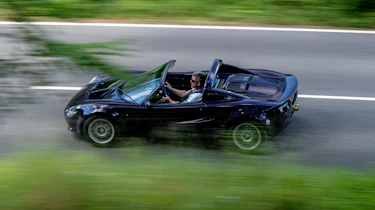
As you might imagine, the weight savings don’t come easily. The front clam, rear clam, doors, bonnet and engine cover are all made from the highest quality carbonfibre, laid into precision-made CNC-machined moulds for maximum quality and strength while weighing less than cheaper, splash-moulded panels. Sensibly, the only pieces Analogue leaves alone are the standard glassfibre sills and roll bar cover so as not to compromise OE crash safety.
In total, the new carbon panels weigh half that of the standard glassfibre. For example, the VHPK’s front clam weighs 6.5kg compared with 14kg for a stock item. Halving the number of seats was an easier win, but Analogue designed stronger seat-mounts than in the Sport Elise race car for maximum peace of mind.
Analogue’s work is as much about preservation as it is amplification. Singer neatly coined the term ‘reimagined’ as a way of describing the restomodder’s art. I’d suggest Analogue’s approach is closer to the classic culinary technique of reduction, whereby the flavour and consistency of a meticulously crafted sauce is intensified by boiling off excess liquid. It’s a considered, precise and reverential effort. One that replaces almost every key component, yet studiously avoids wholesale reinvention. In honouring the original car but taking care not to corrupt its essence, the VHPK takes the definitive millennial sports car to a rarefied level. One very few will be fortunate enough to experience, true, but an endeavour we can surely all applaud.
Price and rivals
At £350,000 before tax, the VHPK costs a pretty penny for an Elise. But then, it’s a pretty special Elise. All the same, the most obvious alternative does remain a standard S1 Elise, which could be had in perfect conditions with tiny miles for less than an eighth of the VHPK’s price. If the central solo driving position is non-negotiable, there’s always the BAC Mono. For hardcore thrills without the middle seat, an Ariel Atom wouldn’t be far from the mark, with the latest Atom 4 RR still coming in at £100k less than this Elise.