Bristol Fighter review – Britain’s troubled 210mph answer to the Ferrari 599
The 200mph British supercar with gullwing doors and an 8-litre V10 was conceived to challenge accepted supercar norms, and now it's made an unexpected return 15 years on
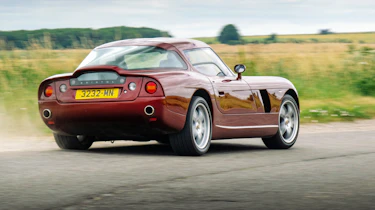
It’s been 80 years since Bristol Cars produced its first ever model, so what better way to celebrate the occasion than re-launch the brand, and its most ambitious car: the Fighter. Its original limited production run was cut short in 2011 as the firm entered troubled times, but now it’s back for a lucky few.
Over 15 years since the last Fighter rolled off the production line, the revived firm has produced a 'new' example, built on an original, unused chassis. A further four will be built in the same way, completely faithful to the original car with the same underpinnings, running gear and slick aerodynamic design.
> Ferrari 599 GTB (2006 - 2012) review: a V12 Ferrari for less than a Porsche 911
Paul King, Director of Bristol Cars, said: 'Bristol has a remarkable story, from its roots in aviation and engineering to the extraordinary and exclusive cars it crafted. We want to honour that heritage while giving Bristol a future that is every bit as distinctive. To bring Bristol back to making cars in Britain, and with Richard Hackett returning to the company, we have brought together an exceptional combination of heritage, knowledge, engineering and craftsmanship. This is the beginning of Bristol’s return, and there is much more to come.'
evo spent plenty of time behind the wheel of the Fighter in its day, and a visit to the firm as it put these new production plans into motion revealed precisely how it got to where it is today.
The tumultuous story of Bristol Cars
Bristol Cars had made its reputation in the post-war years with a series of aristocratic saloons and sports cars – elegant, streamlined machines that combined BMW-derived underpinnings with aerospace standards of construction (the car company originally being a spin-off from the Bristol Aircraft Corporation). Then in the ’60s came Chrysler V8 power and a new generation of gentlemen’s expresses – fast, discreet, and hand-built in small numbers.
But from the mid-’70s it all began to go a bit pear-shaped – or, rather, brick-shaped. The cars lost their subtle curves, sales began to decline, and eventually there was no money to develop new models, only to re‑skin old ones. By the late ’90s, Bristol was building barely a handful of cars a year for a dwindling clientele and the company was on its uppers.
Enter the young entrepreneur Silverton, whose father had founded Land Rover modifiers Overfinch but who had made his own fortune in the jet spares business and was now looking for a new adventure. ‘I’d always been intrigued by Bristol,’ he tells me. ‘When I was about 15 I was riding in a friend’s E-type and we were whistling down the M4 at a steady 110 and something was gaining on us. Turned out to be a 411, being driven by a man with white hair. And when we turned off the motorway he followed us. My friend was a pretty handy driver but the Bristol eventually sailed past with utter ease. Years later, when I told Tony Crook the story, he revealed that about that time he’d lent his demonstrator to [Le Mans winner] Roy Salvadori…’
It’s impossible to talk about Bristol without talking about Tony Crook. Wartime RAF pilot, post-war racing driver, motor dealer and one of the great characters of the British car industry, Crook took a stake in Bristol in 1960 and by 1973 was sole proprietor. A genuine eccentric, stories about him are legend: paying vagrants to hang around the motor-show stands of rival car companies; switching the door sign on the Kensington High Street showroom to ‘Closed’ when he spied Michael Winner approaching; re-enacting some of his greatest races from his office chair, sitting at his desk in helmet and goggles, steering wheel in hands, providing not only engine sound effects but also a running commentary: ‘Oh, I say! Lovely line from Crook through St Mary’s…’
From zero sales to the Fighter
But, in 1997, Bristol under Crook was going nowhere, except slowly towards oblivion. ‘I’d been bothering Tony Crook for years,’ says Silverton today, ‘but by ’97 it was pretty clear the company was failing and he needed someone to bail him out. Brian Trubshaw, the original Concorde test pilot, had worked for me for ten years and was also a good friend of Tony’s and he was able to vouch for me and that’s how it happened.’
Silverton took a 50 per cent stake and, while Crook continued to be the public face of Bristol, his new partner set about assessing the health of both the company and its current product. It didn’t look good.
‘When I came in there were no new car sales,’ says Silverton. ‘I think the previous year they’d sold one car, which was being finished when I arrived. And frankly when I saw it I was mortified because the quality was so poor. And when I drove the company’s demonstrator it was out of breath at 4000rpm and I’d be surprised if it got to 60 in less than 9 seconds. It neither rode nor handled particularly well either.
‘So to start with I was concentrating on making the car saleable, drastically upping the build quality. The Blenheim 2 was introduced within seven months with something like 700 changes and more power and torque.’ But what Bristol really needed, Silverton concluded, was a completely new model. ‘The Blenheim was still being made on the same jig they’d used to make the first 400 in 1946,’ he grimaces.
‘We had a good relationship with [powertrain supplier] Chrysler, and I got on very well with Bob Lutz, and in fact we came very close to building a Chrysler Bristol…’ This would have been a productionised version of the 1998 Chrysler Chronos concept, an extremely rakish four-door with a retro flavour and a 6-litre V10 engine. The idea was canned when Chrysler merged with Daimler-Benz, at which point thoughts turned to what would become the Fighter.
‘I liked the idea of a car that was exceptionally capable but made no outward show of the fact. The idea with the Fighter was to make something that was the opposite of a normal supercar, which is usually something that you can’t get in and out of, can’t see out of, can’t go over a speed hump, can’t park, and is totally wonderful but absolutely useless.’
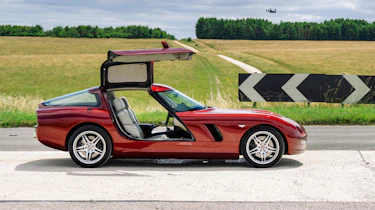
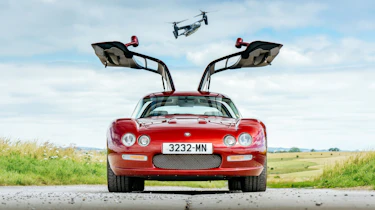
Packaging was key; the Fighter would need to accommodate drivers up to 6ft 7in (the height of one of the first deposit-payers) along with all the expected luxury accoutrements, holiday luggage for two (or a couple of golf bags), a full-size spare wheel, and the small matter of an 8-litre V10. Remarkably, the finished car was an inch shorter and three inches narrower than a contemporary 911. Gullwing doors were chosen for ease of access – Silverton himself is 6ft 4in and struggled with the high sills and low roofs of conventional supercars – with the added advantage that they could be opened in much tighter spaces than conventional doors.
Chief engineer was Bob Stevens, ex-Lotus, who had previously worked on Audi’s R8 Le Mans racer. The detail design, both interior and exterior, was by Bruce Southey, better known these days as the founder of Rocketeer. But the basic shape was determined by aerodynamics, with any stylistic flourishes coming from the pen of Silverton himself.
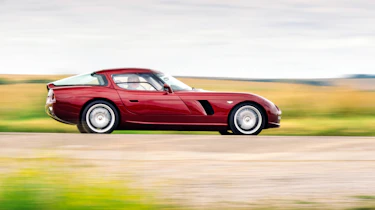
‘The Fighter’s original shape came entirely from the aerodynamics,’ he says. ‘Once the aerodynamic shape was established, I tried to make it visually polite – the bits I could alter without spoiling the aerodynamics. I designed it for a customer who, like me, wanted the styling to be as quiet as it could be on a 200mph car.’
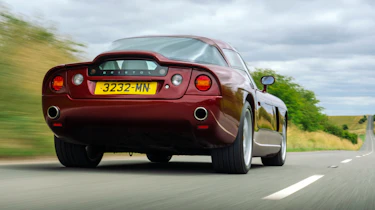
Bristol quoted a drag coefficient of 0.28Cd and the Fighter was notable for the absence of wings and spoilers. Over-pressure at the front of the car was said to promote a mild supercharging effect at the air intake, which Silverton reckoned gave an extra 25bhp ‘for free’ as the car approached its top speed.
Most of the outer skin was aluminium, with carbonfibre for the doors and tailgate, and Kevlar-reinforced plastic bumpers. Bristol investigated aluminium for the box-section structure beneath but eventually chose steel because, in Silverton’s words, it would be both lighter and stronger. A rollover cage formed part of the structure. The suspension layout was double wishbones all round, but with an extra link at the rear to cope with the torque from the engine…
Engine, gearbox and technical highlights
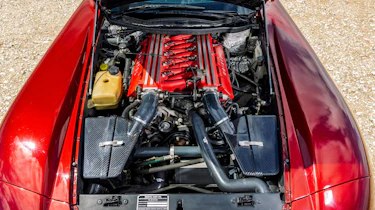
Ah, that 8-litre V10. Often erroneously described as a truck engine (though it did also appear in the Dodge Ram SRT‑10 pickup) the all-aluminium V10 was based loosely on the small-block Chrysler V8 but developed with input from engineers at Lamborghini, which was owned by Chrysler at the time. Of its pushrod, two-valve-per-cylinder design, Silverton says: ‘We were delighted the engine was what most people would call old-fashioned, because if it had twin overhead camshafts it would make the engine at least three or four inches wider, which would have meant the car would have had to be three or four inches wider and several hundred pounds heavier.’
The V10 weighed 240kg fully dressed (the Fighter’s quoted kerb weight was 1600kg, split 48/52 per cent front to rear) and sat well behind the front axle line. With camshafts to Bristol’s own spec and a bespoke, sealed induction system with two carbonfibre airboxes, it made 525bhp at 5500rpm and a matching 525lb ft of torque at 4200rpm, Bristol claiming 0-60mph in c4.0sec and a 210mph maximum. The six-speed manual gearbox was also supplied by Chrysler, the shift modified by Bristol; there was a mechanical LSD and electronic traction control, with the driver able to vary the degrees of slip before it would cut in. ‘I wanted it to be graded “mild” to “lairy”,’ says Silverton, ‘but I was told “lairy” could not be allowed in a Bristol cockpit.’
The plan was for three versions: the 525bhp base car, a 660bhp Fighter S with changes to the valvegear and intake, and a twin-turbo Fighter T with a projected 1012bhp and a top speed of 270mph. There was certainly no lack of ambition.
As the first cars began to reach customers in 2004, Bristol anticipated capping production at 20 Fighters a year, but by the time the company called in the receivers in 2011, just 14 had been built.
Of those, one was built to S spec, another was subsequently converted, and the remainder were standard cars. Alas, no Fighter T was built. According to Silverton, a US customer, a record-breaker at Bonneville, placed an order for a T with a plan to modify it and make it the first production car to do 300mph on the salt flats. Unfortunately a ‘major shake-up in his business interests’ meant he had to pull out.
‘It wasn’t the Fighter that brought us down. We designed, developed, tooled up and produced the first two prototypes for just over £2million. Which is impossible, but we did it. Even with the 14 cars we made, we were close to getting our money back.
‘The problem was that Tony Crook had taken a 14-year lease on the factory at a ridiculously high rate. It was a horrible factory – outdated and inefficient. We tried to negotiate leaving, but the landlords said if we wanted to leave we had to pay the full amount for the remaining years, and it still had something like seven years to go. I said if they didn’t agree I would put the company into administration,’ said Silverton.
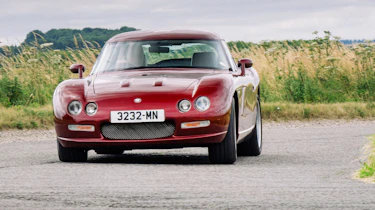
Today, in deepest Wiltshire, Fighters are officially being built again. Back in 2019, Warminster-based Bristol specialists SLJ Hackett bought the chassis for five unfinished Fighters from the Kamkcorp Group, together with a large number of parts, including several V10 engines. Spencer Lane-Jones (SLJ) has already built one new example, with a further four to bring the grand total to 19.
The price for the first ‘new’ Fighter was £350,000 (which is pretty much exactly what the original car cost when adjusted for inflation). ‘But we’ll have to charge more for subsequent cars,’ says Hackett, ‘because we’re having to make more parts. Also, the eventual price will depend on the customer’s individual specification.’
Driving the Bristol Fighter: performance, ride and handling
And now here we are, over two decades since the Fighter was first driven by evo, with the key to those extravagant doors and mighty V10 once again in our hand. Getting in is wonderfully easy – rest your backside on the sill, then slide across and slightly down onto the seat, swinging your legs in after you. The seats themselves are broad and comfy rather than winged, torso-hugging buckets. Already, the Fighter is defying supercar norms.
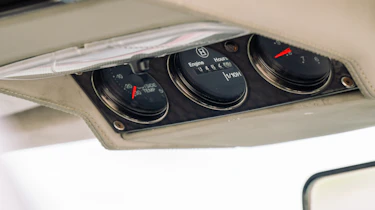
There’s brilliant all-round vision, too, from the teardrop-shaped cockpit, though the cabin architecture and much of the switchgear lacks the visual flair of a Zonda or even a Wheeler-era TVR. There’s plenty to like, though. The curious downward-turned spokes of the steering wheel allow an unhindered view of the main instrument binnacle, stacked with dials, the speedo reading to 210mph, the rev-counter redlined at 6000. Oil temp and fuel pressure are slung beneath the steering wheel, TVR-style. And up in the roof there’s another row of dials, aircraft-style, including the one for engine hours (this well-used example showing 462).
It’s a neat nod to Bristol’s aviation roots, and you half expect to have to flick open a guard over a starter button, so it’s slightly disappointing to find starting requires nothing more than the turn of a key. At which the V10 rumbles massively into life. There’s nothing particularly musical about the noise, but there’s plenty of it. This engine has enormous presence.
The gearlever is canted over towards you, which looks a little odd, and its action has a real weightiness to it, but it shifts smoothly enough – better than in the Viper. The gearing itself is inter-galactic – at an indicated 70mph the tacho is showing just 1500rpm in sixth. It’s a fairly civilised mile-eater, if not the last word in refinement, tyre roar being the dominant noise when you’re cruising (this car fitted with P Zero Rossos, 255/40 ZR19s at the front, 285/35 ZR19s at the rear).
Drop a gear, open the throttles, the long bonnet rises and the Fighter fairly flies. It’s not the mind-scrambling ferocity of today’s hyper-GTs like the DBS Superleggera or 812 Superfast, but it’s properly rapid. That 8-litre V10 doesn’t disappoint.
Line up a sequence of corners and there’s a leap of faith to be made. The steering has a slight vagueness, a wooliness as you make your initial inputs. But the further and faster you go, the better the Fighter feels. Now the gearchanges can be flicked through with fingertips, as can direction changes. The chassis, initially a little leaden-footed, starts to feel as if it’s getting onto the balls of its feet, starts to flow. It has a nice, neutral balance and you can make subtle adjustments to your line via the throttle. But it lacks the fist-tight control and the sense of connection that might encourage you to push it much further. It’s definitely more rapid GT than supercar.
The Ferrari 599 was a hot competitor at the time, but our 2007 drive revealed that Britain had indeed created something to pay attention to: ‘The chassis feels incisive, neutral and nimble with fine traction and direct, communicative steering. In fact, the Bristol handles every bit as adroitly as its front-mid-engined layout, 48/52 percent front/rear weight distribution and low centre of gravity might lead you to hope. There’s a little understeer in tighter turns and the tail will lean on the edge of oversteer if you open the taps in faster sweeps. Yet the feel and collectability of it all is inspiring.
That deliciously broad and finely adjustable band of behaviour encourages commitment and flatters mistakes. Reduced to basics, it turns in, points, grips and goes. Co-ordinate mind, hands and feet and it flies. Let your concentration spool down a tad and the consequences aren’t in the least bit dire,’ said David Vivian.
There’s a lot to like here. The fact is that other firms – notably Morgan with the Aeromax – were better-placed in the niche sports car market and the Fighter was hamstrung by its price and rather steady styling. But it was a brave attempt to breathe life into a storied British marque. And besides, it’s hard not to love a car with gullwing doors and an 8-litre V10.
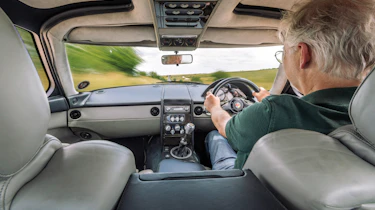
Inside the Bristol Fighter
The gullwing doors are far more practical than they sound, swinging up to reveal a deep sill that’s easy enough to negotiate with a reasonable degree of grace. The seats, trimmed in soft leather and the result of countless iterations are generously padded but properly supportive. The driving position is commanding by supercar standards, which makes the Fighter particularly easy to place in a confined space (the clearly visible extremities of the impressively long bonnet are just that, there are no hidden bulges to catch you out) and easy to thread down a twisty country lane, come to that.
There are aircraft allusions, naturally, but they’re subtly executed and fascinating rather than flashy; modular dash fittings for the main console components, an array of overhead instruments (including an ‘engine hour’ meter), and the side windows have small opening sections like a fighter plane’s. Bristol doesn’t neglect its own car making traditions, either: the steering wheel is an updated version of the kind it used in the ’50s with serrated spokes, albeit now fashioned in carbon.
Bristol Fighter specs
| Engine | V10, 7990cc, mid-front, longitudinal |
| Power | 525bhp @ 5500rpm |
| Torque | 525lb ft @ 4200rpm |
| 0-60 | 4sec (claimed) |
| Top speed | 210mph (claimed) |
| Price new | £229,125 |