BMW M240i v Audi RS3 – 400bhp German stars fight it out
BMW's M240i is one of the best value performance cars on the market. But is it worth the saving over an RS3?

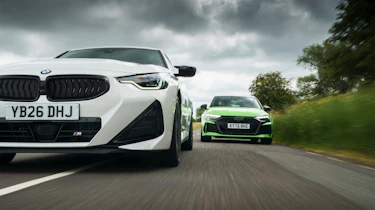
Is there such a thing as good value in today’s performance car market? Such has been the rate at which prices have been rising over the last decade, you’d be forgiven for thinking not. Porsche’s 911 Carrera is now a £100,000-plus concern, and ‘junior’ mid-engined supercars start at over £200,000. Anything at the top of the hot hatch tree will set you back more than £60,000.
I have a candidate, though. Consider BMW’s newly mild-hybridised M240i xDrive, a brawny sports coupe with a 387bhp straight-six, good for 62mph from rest in 4.3sec, yours from £50,215. It’s comparable on performance to those aforementioned top-tier hyperhatches. The question, then, is what are you giving up; what is that £10,000-plus saving losing you, and do you really miss it?
Look at the Audi RS3 and you might say a fair wedge of attitude. Next to it, the M240i is just a little bit invisible, in part a symptom of its second-string billing beneath the M2 and in part because the RS3’s Kyalami Green coachwork is little short of blinding. Ingolstadt’s five-cylinder hero wears all the great fast Audi calling cards like a suit of armour.
Blistered, vented arches, a gaping maw and voluminous oval exhausts are standard, while optional carbon bits, including a rear wing, elevate it still further. By comparison, the BMW just looks a touch awkward, its cool, almost E30-like silhouette betrayed by odd angles, weird shapes and strange line-work.
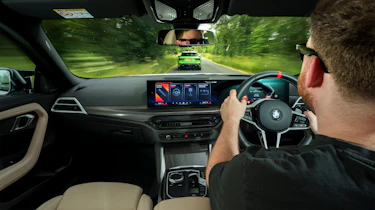
If it’s not much to look at from the outside, inside the M240i is a fine place to find yourself. Not much has changed for this recent update, but the curved display still looks modern and is reasonably intuitive, even if too many vital controls are held hostage behind pixels. The GT vibes of this car’s Oyster leather seats juxtapose with carbonfibre trim and the grotesquely overinflated steering wheel rim, here with a red strip at 12 o’clock.
Taking the CLAR platform used in BMW’s saloons, with its rear-drive bias and longitudinal engine layout, the M240i’s bones are those of a proper driver’s coupe, so you’re set nice and low and closer to the rear axle than the front.
More reviews
In-depth reviews
- BMW M240i review – a great value sports car, but better than a proper hot hatch?
- BMW M2 review – fun, but no match for a Porsche Cayman
Long term tests
Reviews
Ahead, BMW’s ubiquitous silky six, the single-turbo B58, emits a full-bodied if not overly textured bellow as you press the starter button. It wasn’t exactly a peaky motor before, or ever particularly breathless, but a jolt of electrification courtesy of a 48-volt mild-hybrid system has widened its reach still further. The 18bhp increase in maximum power to 387bhp isn’t as noticeable as the fact that the peak now arrives 300rpm earlier, from 5200rpm, notably lower than the 5600rpm at which the RS3’s greater 394bhp arrives.
Maximum torque is up from 369lb ft to 398lb ft, making it 29lb ft torquier than the Audi. That slug of grunt arrives in full sooner too, from 1900rpm versus 2250rpm in the RS3. The sacrifice is an extra 65kg, bumping the M240i’s kerb weight up to a portly 1755kg, some 190kg more than the Audi. Yikes.
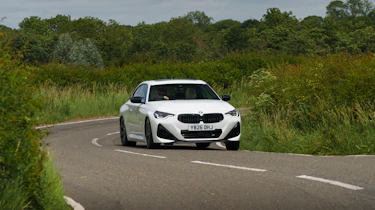
The eight-speed torque-converter ’box is as responsive (if not DCT-sharp) as ever and xDrive hearteningly willing to indulge your requests for throttle adjustability. There is scope to choose individual settings for the suspension, steering and powertrain, but full ‘Sport’ works well, tautening the M240i nicely but not to excess, even on craggier-than-ideal country roads. My initial miles have me wondering whether the RS3 might have a real fight on its hands.
The Audi’s technical makeup is curiously almost opposite to the BMW’s. Its bones are more conventional family hatch but with a high-performance steroid shot (or seven). So yes, while you open the Audi’s door to reveal a set of truly spectacular, more supportive, but optional (£2500) bucket seats, you still feel like you’re sitting higher. Aside from the seats, clues to the RS3’s flagship positioning inside are fewer and further between than you’d perhaps like for its £60,000-plus price.
The oddly shaped steering wheel (complete with infuriating haptic controls) does at least have two bright red buttons, one for putting the RS3 in its most aggressive dynamic mode and the other a shortcut key to your own preferred settings. Unlike in the BMW, the wheel rim doesn’t appear to be in anaphylactic shock. But otherwise it’s relatively standard A3, which is to say reasonably solidly put together with nice materials but lacking a bit of theatre.
However, from the moment its 2.5-litre five-cylinder engine guffaws into life, you know it’s something special. There’s a naughtiness to it, an anger and attitude that has you wondering how it wasn’t outlawed sooner.\
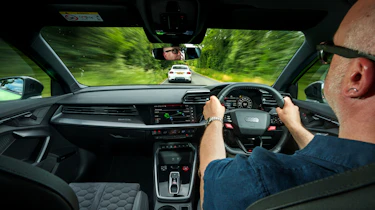
It’s a more old-school motor than the B58, its rev-range requiring more management to keep it on full boost and in the torque and power bands. It’s seriously loud on the outside too, though not a lot of that intoxicatingly obnoxious character makes its way inside. A bit more of the attitude that’s disturbing the rural English village peace for the cabin occupants to enjoy wouldn’t go amiss.

The seven-speed dual-clutch ’box feels a hair snappier than the BMW’s eight-speed auto, though it’s not the point of distinction and separation I was expecting. As with the BMW, you need to be in the right gearbox mode, with an ‘M’ emblazoned on the digital dash, denoting that the gearbox won’t act independently of your paddle pulls.
My expectations for the RS3’s dynamics were lukewarm going in. ‘We were impressed with how well the RS3 performed regardless of which supercar we had just climbed out of, but it lacked the feedback and the absolute responsiveness that mark out a really great hot hatch,’ was our conclusion at eCoty 2025. Editor-at-large John Barker was especially harsh, saying: ‘After driving a 911 GT3, its steering feels like dragging a spoon through a bucket of freshly mixed plaster.’
I also anticipated an uncouthness and harshness to its ride, an overwroughtness that’s easy to default to when squeezing the pips of performance from a flagship that takes a conventional car as its base and slaps it on big wheels, fat tyres and tough suspension. On the contrary, the RS3’s optional adaptive damping is beautifully balanced, ironing out all but the harshest imperfections while keeping the car keyed into the road and encouraging ever-increasing pace.
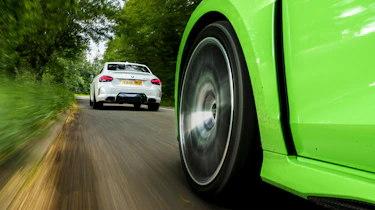
Ian Eveleigh, the RS3’s custodian, admits he was pleasantly surprised by the subtlety of its damping, having been traumatised before by a rough-riding long-term stint in a TT RS: ‘Even in their firmest setting the dampers are relaxed enough to absorb most B-road imperfections without subjecting your spine to an osteopathic ordeal, so you can maintain an impressive point-to-point pace regardless of the surface you’re driving on.’
It’s not magic carpet by any means. Everything the suspension contends with is telegraphed to you through your backside, but it’s a controlled communication for the most part, save for the occasional kick from the tail end over crests.
The optional carbon brakes bite intensely and aggressively and can catch you out initially with their sharpness compared with the more modulable BMW, but they have an obvious strength advantage the more you dig into them. The weak link is the steering. Even in the Audi’s most aggressive RS Performance mode, there’s a dearth of weight and feel. That said, while the handling’s not overly subtle, it is effective.
The all-wheel-drive system can send up to 50 per cent of the engine’s punch to the rear axle, the RS Torque Splitter differential then passing that between the rear wheels at will, up to 100 per cent to the outside rear in extremis. It’s a transformative piece of equipment for the RS3’s agility, whipping the tail around and almost pushing the nose on-line as you power through the exit of tighter corners. But given that its keenness to send torque to the outside rear wheel is almost directly linked to how much lock you’ve got wound on, it’d be nice for some commensurate resistance and texture from the RS3’s rack.
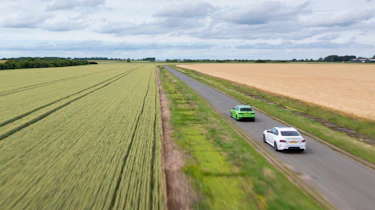
The Audi’s got sharp responses and raw mechanical grip on its side, though. After the giant 265-section Pirelli P Zero Rs on the front of the RS3, the 225-section Goodyear Eagle F1 Asymmetric 6s of the BMW have much lower limits on turn-in and can’t manage the same pace. Nevertheless, these limits are clearly articulated and, once you know them, easy to drive around.
By comparison to the Audi’s Pirellis, which claw into the road with increasing fervour, the Goodyears start to smear under pressure. Instead you learn to tuck the nose in at measured pace and use the rear axle to pivot the M240i. It’s not as fast or precise as the Audi, but its balletic, almost finger-tippy driving style is its own reward. Strange to say that of a near-1800kg coupe…

A straight comparison with the RS3 along the same challenging, varied piece of countryside road reveals more about the M240i’s strengths and shortcomings. You’re reminded that rich dynamic potential is more inherent in this platform than the RS3’s family hatch genus, but approaching the sort of pace the Audi revelled in reveals what the BMW is missing in terms of top-tier performance hardware.
It lacks the added tension and that next level of pace and focus that you’d get with a full-blown M-car. The damping is good, with effective body control as you contend with undulations and bumps, but the damper strokes, while measured, are longer than in the Audi, with less controlled anti-roll characteristics.
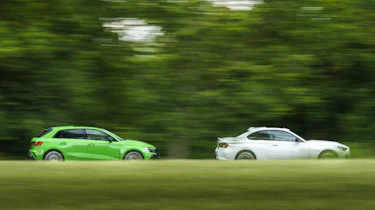
It’s just moving around that little bit more on top of itself, reminding you too of the extra weight it’s carrying. Stride too much beyond what you’d call a fast flowing pace and the M240i starts to feel a tad disconnected, lacking the cohesive, locked-down feel of the RS3. In the end, the Audi only gets sharper with pace, where the BMW starts to lose fidelity.
I find it perplexing because the M240i feels the more intuitive machine when not chasing tenths. Its steering is nicer and more natural in weighting, the balance more predictable and linear, the rear-biased xDrive system only sending power to the front wheels when needed, giving the coupe an almost Skyline GT‑R‑like keenness and agility when flowing at a pace it’s happy with. Ev is in agreement: ‘The BMW is a really sweet road car. Fast, fun and compliant.’
By comparison, you box with the Audi, trading blows as you slingshot from corner to corner, inhaling straight sections on a wave of five-cylinder blare and DSG exhaust cracks, then diving into the ceramic brakes, kneading the nose in and powering round. And yet even though the RS3 is that much more of a bunched-up fist than the BMW dynamically, it’s the engine that remains its defining feature.
The RS3’s five-pot is a joyous thing to exercise; it also brings into focus just how smooth the powerband is in the new BMW. Where running the Audi through the revs is like conducting a real accelerative crescendo, the front tyres hunting furrows as the torque load they’re tasked with transmitting builds, the BMW is more linear, giving you everything sooner and, actually, also revving more enthusiastically out to its red line. Ev agrees: ‘It feels more measured, less brutal in its responses than the Audi’s five – but not necessarily in a bad way.’
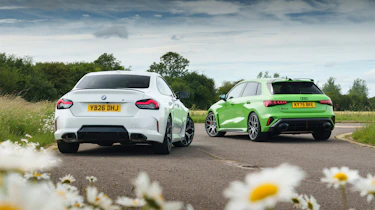
It’s not as exciting or special an engine as the RS3’s though, with less all-out personality or sense of bespokeness. Along with the more serious chassis hardware, more aggressive rubber and the extra degrees of point-to-point performance these afford you, this is where the extra money goes with the RS3: it’s a real flagship, not a flagship-lite.

Back in the BMW, I need to extricate the M240i from the shadow of the RS3 in my mind, revel in what it does well rather than lament what the RS3 does better. It takes a few more miles, a twist of my internal dial back from 11 to about 8, and a reminder of the saving it represents, to find clarity on the BMW. Along these winding roads, I think the M240i’s natural balance holds greater appeal and is more approachable than the Audi’s grafted-on anger and sky-high limits.
In the moments when you find yourself in tarmac rally mode and funnel heat into its Pirellis, the RS3 is an almost infallible point-to-point weapon that, frankly, the BMW can’t live with. The rest of the time, the M240i xDrive can feel sweeter, with a more accessible window to the thrills it offers.
The RS3 is an extraordinary machine and uniquely thrilling, but whichever way you cut it, the M240i xDrive is extraordinary value for what it offers in today’s market. It should give anyone thinking about shelling out an extra £10,000 or £20,000 on more exotic, expensive hardware real pause for thought.