BMW M2’s toughest test might be its half price predecessor
The old F87 BMW M2 Competition was a start sports car. At around half the price of a new M2, it represents the G87's toughest test


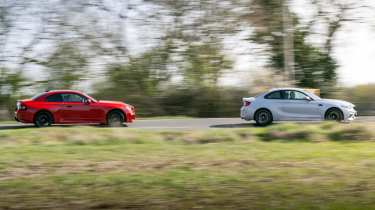
Back in 2018-19, I spent eight months with a previous-generation M2 in Competition form. It still ranks among my favourite long-termers that I’ve run, which begs the question: how does the G87 BMW M2 measure up? To find out – and rather than relying on potentially rose-tinted memories of that older car – we got an F87-generation M2 Competition together with the G87 M2 we ran on Fast Fleet for a back-to-back drive.
The Hockenheim Silver F87 you see here was kindly brought along by owner Stuart Dott. Standard right down to its Michelin Pilot Super Sports and with just 15,000 miles on the clock, it’s an example of the model in its prime, so is perfect for our comparison.
There’s no avoiding the inevitable first impression upon clapping eyes on an F87 again, namely how compact it looks. Not small necessarily, but just right. And perfectly, purposefully muscular too. Parked alongside, the newer car lacks the same tautness of form and appears to show every one of its additional 150kg. Longer, wider, chunkier, it’s almost as if you’re looking at a car two generations further down the line rather than just one.
It’s a similar story inside. Everything in the F87’s cabin is smaller and nearer, and often simpler too. The classic BMW instruments behind the wheel are the most striking case in point: round physical dials in plain black with simple white markings. The new, squarer M font may have snuck onto their faces for the Competition, but they remain superbly legible, unlike the chevron-shaped digital bars that represent revs and speed in the current car (which will no doubt age terribly). If only M offered a setting to call up a digital recreation of its traditional instruments in its latest clusters…
Press the red start button to bring the needles to life and the older straight-six sounds a little thin compared with the deeper, more gurgly voice of the newer car, which always starts with its exhaust in its Sport setting (there’s no such trickery in the old car). Once on the move and with the engine up to temperature, however, the F87’s engine gains a harder, grittier edge to its note as it reaches into the upper part of its rev range. Much like in the latest car, it’s not a noise that dominates the experience, and I can appreciate why so many Comps have aftermarket exhausts fitted, but it provides all the encouragement you need to chase the red line.

As does the performance. Although on paper the 404bhp F87 and 454bhp G87 have similar torque highs – 406lb ft from 2350rpm versus 406lb ft from 2650rpm – the newer car feels more forceful low-down, even despite its weight penalty. Perhaps the rest of the torque curve, away from the peak, tells a fuller story.
More reviews
Group tests
In-depth reviews
- BMW M240i review – a great value sports car, but better than a proper hot hatch?
- BMW M2 review – fun, but no match for a Porsche Cayman
Reviews
Once up and running, however, the performance gap closes, although in this case that’s partly because the older car is equipped with the optional, snappy-shifting seven-speed DCT ’box, while our long-termer has the slightly ponderous six-speed manual. With the eager eight-speed auto instead I’ve no doubt it’d be pulling out a gap again. That said, I’d still lean towards the manual option for both – particularly in the F87, which has a more pleasing shift action than the G87’s rubbery offering.
It’s funny how just a few years can give you a new perspective on how a car rides and handles. I remember thinking my old Competition long-termer felt pretty darned firm on its passive dampers. Yet after the current M2, with its adaptive dampers set to their middle Sport setting (which you’ll need for a tough B-road), the older car feels much lighter on its feet, almost as if it’s gliding along the road where the G87 thumps its way over the same surface.

I also remember thinking how keenly the Comp used to turn into a corner, but at first it feels less determined than the G87 with its massive front tyres (275 section versus 245 on the Comp). It’s not understeery as such, but there’s more incentive to balance front and rear through a turn, rather than letting the front-end grip do all the work. No bad thing, as it’s a more rewarding way to make progress.
At the other end of the chassis, the newer M2 displays one of its strongest leaps forward. Where the F87 Comp used a reduction in low-end torque to tame the spikiness the same engine displayed in the contemporary M3/M4 , supported by an effective but not exactly subtle traction control system, the G87 deftly trims whatever is being thrown at its rear tyres thanks to a TC system that’s claimed to be six to eight times more precise in its torque management. The result is that it mostly feels like it’s helping you go forward rather than holding you back, and if you still want more freedom, there’s also the ten-stage M Traction Control system you can play with to fine-tune how much help (or otherwise) you’d like.
- BMW M5 CS (F90, 2021-2023) review – still the undisputed king of supersaloons
- BMW M3 (G80) review – still the best reason not to buy a Mercedes C63
- BMW M3 CSL (E46, 2003-2004) review – Munich's answer to the Porsche 911 GT3
In theory the newer car is the better everyday option: more tech, more space, a more flexible engine. Yet in reality the older one has everything you really need, while its smaller size makes it more wieldy in urban environments. And a better fit for many a B-road, where it’s less intense than the new car, but arguably more satisfying overall. It feels like it sits on a sweet spot in the transition from the analogue to the more digital era of cars – asking a little more of the driver, and giving a little more back in return.
It perhaps explains why this is the fourth F87 that Stuart Dott has owned. They’ve been interspersed with some other modern-day performance heroes, but it’s the F87 he keeps coming back to, with no hankering to upgrade to the latest version. That a new G87 started at £65,830 at the time of writing in 2023, that’s now risen to £71,645 in 2026, while a car like Stuart’s can still only just about be picked up from around £35k, only strengthens the case. As Stuart said: ‘What else offers so much for that kind of money?’
| Total mileage | 9273 |
| Mileage this month | 964 |
| mpg this month | 24.4 |
| Price when new | £76,855 |
This story was first featured in evo issue 323.