Eagle Lightweight GTR review – Jaguar's iconic E-type turned into a raw thriller
Eagle’s latest, lightest-ever E-type promises ultimate road-racer thrills, albeit for a mightily steep price

The handbrake fulcrum. It’s a small, inconsequential piece of metal, one you’d never see unless you pulled the gaiter off and dismantled the mechanism, but somehow this ordinary component has been made into something you’d almost call beautiful. At first it looks like the original part, but up close it’s exquisite, with crisp, precisely machined edges, excess material shaved away where possible, and a lightly brushed finish.
It’s made from titanium, giving it a distinctive muted grey sheen, and there’s a strange disconnect between how it looks – solid, precisely hewn – and the weight of it, which is more like plastic than metal. You’d quite happily have one as a desk ornament. In many ways this single piece perfectly reflects Eagle’s latest E‑type build, the Lightweight GTR, as a whole: recreated with obsessive attention to detail to be as beautiful and lightweight as possible, no matter the cost.
That cost is quite a lot. Stratospheric, in fact, starting at close to £1 million, reflecting the thousands of hours it takes to design, develop, produce and finish every element of the car to the highest standards possible, and according to the customer’s wishes. Eagle has been in the game of modernising E‑types since 1991 and has built a number of reimagined Special Editions over the years, including the roofless Speedster, the Low Drag GT coupe and the Lightweight GT, designed as a homage to Jag’s aluminium-bodied Lightweight E‑type racers from the ’60s.
This latest has the ‘racer’ bit turned right up. ‘A customer wanted an even more lightweight and extreme version of the Lightweight GT, with a more pronounced nod to the original race cars,’ explains managing director Paul Brace. ‘You can still tour in it, but they wanted to go for the racy theme, to build more of a “go out for a blast” kind of car.’
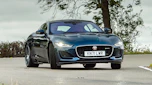
Our date with the GTR isn’t in ideal circumstances. Fog has rolled in over our rendezvous point near the foothills of Snowdonia and the rain has been unrelenting, with patches of standing water and streams streaking across the road surface. Not the conditions in which you want to be driving a seven-figure one-off, not least when its (very generous) owner has waited years for the build and has yet to take delivery. No pressure.
More reviews
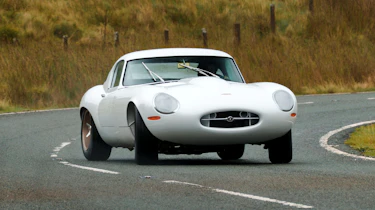
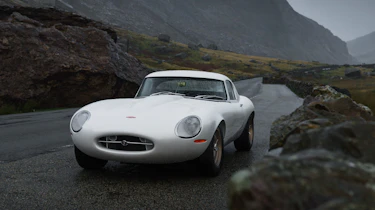
But even in the haze and lashing rain, the GTR looks utterly sublime as it backs out of its trailer. The tail peaks out first, the exhaust hugging the underbody with slashed tips shooting upwards at an angle. Then the swell of the rear haunches appears, stretching around wider magnesium wheels and blending seamlessly into the main fuselage.
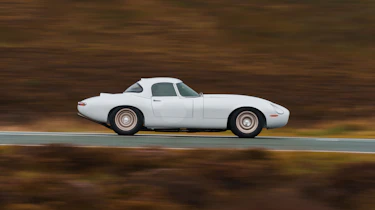
The cab is stubby, like the bubble canopy of a fighter plane, and the gently rising bonnet line goes on and on and on before swooping around the front wheels as they roll into view. Wow. It’s unmistakably an E‑type but the aluminium panels have been gently massaged into an even more beautiful, flowing form. It’s as dramatic as a supercar but effortlessly so.
> Eagle Jaguar E-type Lightweight review
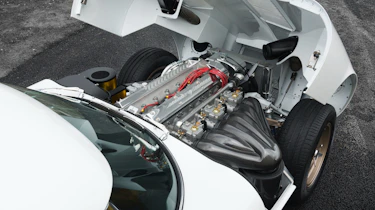
Eagle doesn’t set out to build the absolute fastest E‑types, but the GTR’s specs are pretty tasty, with its all-aluminium 4.7-litre straight-six producing 385bhp. That’s about the same as the Lightweight GT, with which some of the bespoke internals are shared, but more important is how the GTR’s performance is delivered: titanium conrods raise the red line by 500rpm (although at 5500rpm it’s still no screamer), and a big-valve wide-angle head has been chosen to bring it to life at the top end.
It’s fed by a carbonfibre intake plenum and triple Weber carbs. If top end was the priority, why not use the E‑type’s smaller, more rev-happy 3.8-litre motor? ‘You’d miss out on torque,’ says Paul. ‘We did think about it, but in the end it’s difficult to give away cubes.’
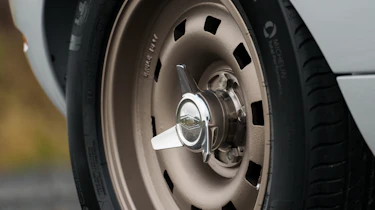
As much as the engine is the heart of the package, the GTR is all about weight saving, and the approach has been forensic. Titanium is used across the car, from the wheel hubs to suspension spindles and general fixings and fasteners, while the engine sump, gearbox casing and rear hub carriers are magnesium. The steering column is a lightweight item, so too the flywheel, alternator and brake servo, among many more.
Even the rear anti-roll bar has been removed to trim 2kg, and the gorgeous magnesium wheels (with knock-on spinners) have been pocketed out to reduce unsprung mass. The result is a 100kg saving over the Lightweight GT, bringing the GTR down to just 975kg with fluids – 30 per cent lighter than a standard E‑type roadster, and little more than a passenger heavier than a late Lotus Elise. For a car with a 4.7-litre engine and a fully trimmed, air-conditioned interior, that’s mightily impressive.
Being awkward to climb in and out of is another common thread between the GTR and Norfolk’s finest. Hoist one leg over the tall sill, fold yourself through the small door aperture, and it’s a swivel/drop into the seat – and a soft, fuzzy world of black Alcantara.
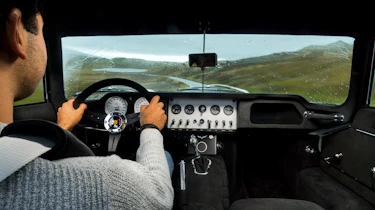
No leather here, nor a wooden wheel – that’d be too quaint for the road-racer vibe – but there are still jewel-like details throughout. Quite literally, in fact. The lightweight treatment involves the removal of the centre console, in its place a floating binnacle with auxiliary switches made from platinum and iridescent mother-of-pearl inlays. Overkill? Probably, but proof that the customer’s imagination really is the limit.
At first I don’t quite fit, the black Nardi wheel fowling my knees and being too far away, but the column can be adjusted and I soon find the perfect driving position: leaning back into the lightweight buckets with the wheel at my chest, looking out at the vast expanse of bonnet and wondering where it ends. Rather than inertia belts the owner has gone for four-point harnesses, which are a faff but add another element to the start-up ritual.
Click them in, pull the straps tight, twist the key, listen for the tick of the fuel pump (it sounds like a woodpecker against the firewall), push the starter. The engine catches and settles into a grumpy, throbbing idle, the transmission chattering lightly in neutral. The GTR has a lighter sound insulation package but it’s more carefully targeted around the car, and the balance feels spot on. Just enough fizz and mechanical noise without feeling hollow or harsh.
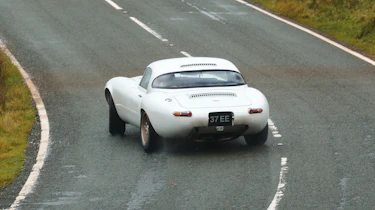
Some cars flatter your abilities from the moment you set off, and the GTR is one of those. I wasn’t expecting that. It’s at once totally alien if you’re used to modern stuff, but remarkably intuitive and approachable, even in these conditions, even with the threat of bankrupting evo if things go wrong. The controls operate with a finely honed slickness and you can flow along effortlessly, the engine tractable and giving hints of its serrated edge as the revs pick up and fluids warm through.
And then you realise how much room you have on the road, the Eagle’s wider wheel tracks still leaving plenty of space between the white lines. The brakes are carbon ceramic with AP Racing calipers and need a solid push due to a smaller servo, but power and modulation are excellent. It may be more extreme but the GTR is on your side, easy even, once you’re past the initial intimidation factor.
This means you can quickly get to the good stuff, and boy is there plenty to indulge in. Drive it with more intent and the GTR becomes a concoction of fabulous sounds and raw feedback. It’s a cliche but it really does feel like two cars in one: docile and mild mannered, but taking on a much more vivid, hard-edged character when you up the pace, mostly because of how the engine comes alive. At 3500rpm the response cleans up, the power curve takes a sharp turn skywards and the rush to the red line is intoxicating.
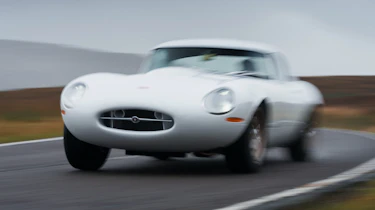
With the Webers fully cracked open there’s layer upon layer of noise, deep and guttural from the intake up front and a howling rasp shooting through the titanium exhaust behind. A shorter rear-axle ratio is part of the GTR package but it’s still long-legged and the run through the rev range is drawn out, allowing you to savour the changes in tone before grabbing the next gear. The shift itself is lovely, abnormally wide across the gate but direct and mechanical, the small ball-topped knob – titanium, of course – fitting snuggly in your palm.
> Jaguar E-type Zero review - is this electric E-type be the future of classic cars?
The GTR’s sense of connection keeps you constantly hooked and engaged too. The controls are reassuringly beefy, the steering being a particular highlight – firmly weighted and bristling with life without being too active in your hands. It has the feedback you’d want from an old car with none of the slack or waywardness. The suspension geometry has been revised to work with modern radial tyres (this car is running on Michelin Primacys) rather than the cross-plys the E‑type was designed for, gaining negative camber as you turn in, where the original set-up goes positive.
There’s still a torsion bar up front and the rear is supported by lightweight tubular wishbones, with damping by Ohlins and the same spring rates as the Lightweight GT. The GTR’s lower mass means that the stiffness has effectively gone up, but the ride is nicely judged. As you sit almost on the rear axle you bob around over the roughest sections, but it settles into a calm, controlled flow at speed, and rounds off imperfections that your eyes tell you should thwack through the car.
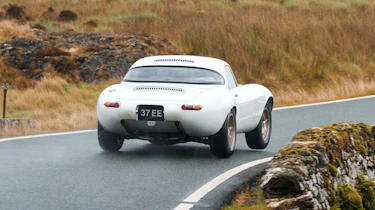
All this gives you confidence to take liberties with the GTR, and it rewards you for getting stuck in. It’s a physical car to drive and requires a firm hand to hustle along at pace, and in that sense it doesn’t actually feel as delicate and lightweight as you might imagine. But pick off a series of bends and the tell-tale signs of low mass are there: how it sheds speed effortlessly on the brakes, how poised it feels mid-corner, how it snaps forward when you get on the throttle. Everything about the GTR is more vivid because of it.
You may be a long way from the front tyres but feedback from the treadblocks is right at your fingertips, and even in these conditions you can drive up to the limit and guide the nose with confidence. It doesn’t snap onto line but follows your inputs faithfully, the body leaning onto the outside front another clue to how hard you’re working the car.
Once it’s settled, you turn your attention to the rear and dictate the attitude with your right foot, within the short arc of throttle travel. The GTR is totally transparent in this phase, helped by the fact you’re so close to the back axle and in tune with what the rear is doing. It’s as biddable and easy to read as a Caterham.

The modern rubber and suspension geometry means there’s plenty of grip to lean on. I thought the GTR would feel like the genuine Lightweight E‑types you see racing at Goodwood, on tiptoes and four-wheel drifting from turn-in to exit, but it’s locked down and precise rather than flighty.
It will slide with provocation but you need quick hands to catch it, and also when straightening the wheel as the rear Michelins regain grip. Playing with smaller angles is more satisfying, feeling the car sit back, squirm for traction and occasionally lift the inside-front wheel under full power, as the race cars tend to do (incidentally, they don’t run rear anti-roll bars either).
The only snag is that the peaky power delivery makes these moments more fleeting than they could be. Slot the right gear, keep the revs up and you can tweak the balance minutely with the power, but unless you constantly upshift near the red line you can find yourself dropping out of the engine’s sweet spot and missing out on that livewire response and adjustability. The standard cylinder head’s broader torque band, or perhaps shorter gearing, would help.
As it is, the GTR is a long-legged car by nature, and on more flowing sections it’s at its spellbinding best. The engine spins freely as the road meanders, and you revel in the intensity, the constant stream of feedback, the poise of the damping at speed, the noise…
Man, the noise. It makes this rainy day in Wales feel like the Targa Florio, trees blurred in the side windows as you attack, slip and slide through the weather for corner after corner.
That’s the magic of the GTR. To look at, sit in and drive it’s unforgettable, almost from another world. Its astronomical price makes it hard to relate to for most of us, but at the same time it captures everything we hold dear as enthusiasts: the essential thrill of driving.
Prices, rivals and specs
There are many alternatives in the restomod space to the Eagle Lightweight GTR, if not in direct comparison, then as an experience. Quite unlike when Eagle first debuted the Speedster over 15 years ago, such is the amount this market has expanded. Your £1million might get you into a 911 reimagined by Singer or an Alfaholics GTA-R and a Kimera Evo37.
| Engine | In-line 6-cyl, 4700cc |
|---|---|
| Power | 385bhp @ 5500rpm |
| Torque | 380lb ft @ 4000rpm |
| Weight | 975kg (401bhp/ton) |
| Tyres as tested | Michelin Primacy |
| 0-62mph | <5.0sec (est) |
| Top speed | 170mph |
| Basic price | £975,000 |