Cars that ended production in 2025
From Porsche’s Cayman to the Nissan GT-R to Ford’s Focus ST, these are the iconic performance cars that bow out in 2025


If this year’s evo Car of the Year test is anything to go by, 2025 has been a bumper year for performance cars. But as the concluding weeks of the year count down, our minds turn to the models we lost in 2025. Some losses are procedural – limited production cars of which only a few were to be built over a short amount of time, like the GMA T.50 and Bugatti Bolide. Other losses run a lot deeper – names that have been around for all if not the majority of evo’s very existence.
The last couple of years have seen many key models leave configurators and price lists, from the Ferrari Roma and Jaguar F-type, to the Audi R8, and Hyundai i20 N. These key models follow their lead and will not live to see the second half of the decade.
Audi RS4
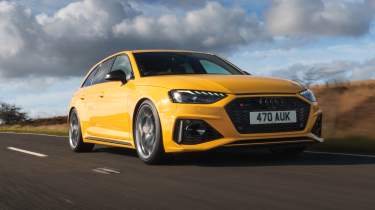
Audi Sport’s move towards electrification begins with the death of its all-ICE performance cars, beginning with the Audi RS4. Production of the B9-generation super estate was winding down towards the end of last year, though carried on into 2025 with the RS4 Edition 25 Years run-out model.
The RS4 has been a bit of a dark horse over the last couple of years. Had BMW not joined the fast load lugger party with the M3 Touring, the RS4 Competition with its manually-adjustable coilover suspension and Audi Sport differential might have gotten more airtime. In truth though, the Competition was what the RS4 should have been all along – a more engaging, rewarding driver’s car, as well as being brutally effective across ground.
The RS4 badge is dead for now, falling as the only victim to Audi’s strange and short-lived ‘odds ICE, evens electric’ naming strategy, now revoked. As a result, the RS4’s successor will be the hybridised RS5 Avant and Saloon. Soon following the RS4 in discontinuation will be the RS6 and RS7, Audi’s beloved M5-rivalling monsters getting a stay of execution due to last-minute demand.
BMW M8
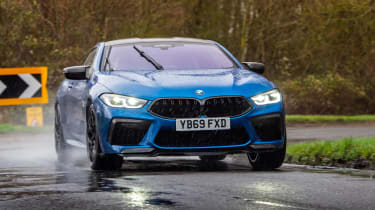
While the new hybrid M5 has dominated headlines, BMW’s flagship GT, the M8, has continued to simmer along quietly in the background. In service since 2018, the M8 finally bowed out in 2025, the coupe finishing up in the first half of the year before the Gran Coupe and Convertible followed in Q4. Slow sellers throughout their lives, the M8 and 8-series in general are not expected to get successors.
The two-door coupe cousin to the previous F90-generation BMW M5, BMW’s M8 was best viewed as an alternative to Mercedes-AMG’s SL and the Lexus LC, rather than as a pretender to true high-end super GT status. It was neither special enough inside or dynamic enough to drive to serve as a valid alternative to Aston Martin’s DB11, Ferrari’s Roma or Bentley’s Continental GT. Nonetheless the heavy hybrid M5 does aid one in appreciating the M8, for its simplicity and low(er) weight. Everything’s relative, right..?
Ford Focus ST
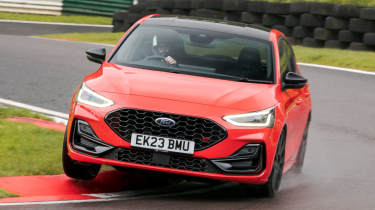
One of a couple of really big blows to come this year, the loss of the Ford Focus ST and apropos that, the Focus as a whole. With us for almost three decades having shaken the family hatch segment to its foundations on its arrival, the Focus has become a household name. Its history as a performance car is profound too, not just through the three generations of Focus RS but through the more relatable Focus STs that have regularly served as fantastic alternatives to Volkswagen’s Golf GTI.
It wasn’t always great – the third generation ST springs to mind – but it goes out on a high, the fourth-generation ST arriving strong and only getting better in Edition and Track Pack specifications. The 276bhp from its 2.3-litre turbocharged four-cylinder wasn’t as important as its 310lb ft, giving this family hot hatch a barrel-chested feel.
At a time when the Golf GTI was on its worst form and the Honda Civic Type R had proven too expensive for many, the Focus was the ideal compromise. Or it was before production ended in November 2025.
Porsche 718 Cayman/Boxster
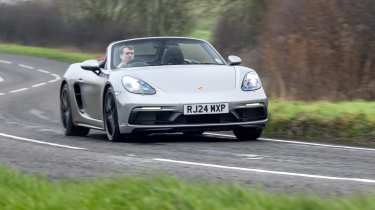
Arguably the greatest loss in 2025 but not one that surprised anyone, the Porsche 718, in both Cayman and Boxster forms. For the first time since the Boxster’s introduction, you can’t order Porsche’s mid-engined sports car. Its demise has been put off, with last-minute demand buoying the 718’s halcyon months and years. But the time has finally come, as regulations (around cybersecurity) catch up with it.

That it’s survived this long where regulations are concerned is impressive. The 718 has been around for almost a decade, first being revealed in March 2016. But actually, this platform dates all the way back to 2012. The 718s, especially in 4-litre GTS form with a manual transmission, have only gotten more appealing over the last couple of years, in a market of performance cars that are growing larger, heavier, more convoluted and less focused by the day – it was the antithesis car to a 2.5-ton electrified M5.
The 718s were set to receive electric replacements next year, though Porsche is now reconsidering its position on electrification, with the next-generation sports cars now set to receive combustion engines. Praise be.
Nissan GT-R
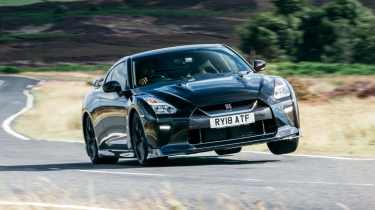
You’d read all the stories before of the Nissan GT-R bowing out, but none had true finality. Yes it went off-sale in the UK a while ago, yes production has stopped and started on occasion in later years. But now, it really is gone. The last R35 GT-R has been produced and the book is closed after 18 years.

It’s a car we sorely miss and have dearly loved over its years, the GT-R scoring an evo Car of the Year win back in 2008 and staying relevant in group tests over the years since thanks to numerous updates. Never content to leaving it alone, Nissan nipped and tucked its supercar slayer giving it more power and refining its chassis.
Arguably, it’s the single biggest threat the Porsche 911 Turbo ever faced and a car that fundamentally changed the segment it elbowed its way into. What a thing. And judging by Nissan’s financial health, it won’t get a successor for a long while yet.
Maserati MC20
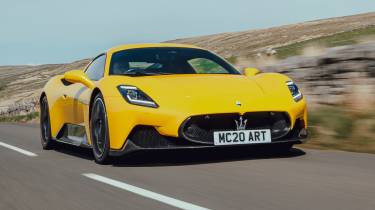
This one is probably the smallest loss on this list. Not because the Maserati MC20 isn’t a wonderful, deeply lovable supercar. But because its replacement is a replacement almost in name alone. The MC20 very much lives on in the MCPura, which only looks marginally different to the car it replaces and utilises the same steering, suspension, chassis, engine and transmission.
Nonetheless, the MC20 was a significant car, bringing Maserati back into the supercar fold and winning evo Car of the Year in 2022 in the process. It showed us, in concert with the McLaren Artura and Ferrari 296, that supercars can have the charisma one expects for their price with only six cylinders to power them. That Nettuno V6 engine remains a masterpiece some four years on from our first introduction to it. Definitely for the best given it’s been subbed in for a second stint in the MCPura.
Mercedes-AMG GT four-door

Less profound as an engine of change, the Mercedes-AMG GT four-door, which has now ended production after seven years. Arriving as a sort of two-in-one flagship, to both its saloon and GT car range, the GT four-door was a niche of a niche Mercedes first birthed with the original CLS.
Though a brilliant car in its own right - better in ways than the last-generation two-door GT - it struggled with identity, positioning and pricing. It was a great alternative to the BMW M8 and Porsche Taycan but was difficult to market as a car in its own right, given it shared so much of its name with Mercedes-AMG’s iconic Porsche 911 rival.
It will return for a next generation, albeit in a very different form. Mercedes-AMG is preparing an all-electric AMG GT four-door super coupe, with next-generation F1-inspired battery and motor technology. It’ll be faster, more powerful, with better range and efficiency than anything in its segment and probably make the Porsche Taycan look a little old hat. Whether an AMG without an engine, let alone a V8, will actually sell? That remains to be seen.
Lexus RC F
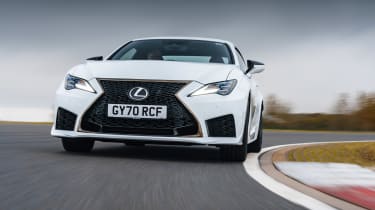
We called its demise early last year but the Lexus RC F lingered on into 2025 with the last few cars rolling off the line in the first few months of this year. It was never a group test darling. In its nine years on sale, it didn’t put the F82 BMW M4 or Mercedes-AMG C63 Coupe behind it in the standings, subjectively or objectively. It couldn’t outshine an M car to drive and the equivalent Mercedes always had more muscle. But it was one of those cars that charmed and beguiled as you covered miles in it.
Its singing 5-litre 470bhp DOHC V8 already felt like a powerplant from a bygone era when it debuted in 2015, let alone as it departs now. Far from an anachronism, it was always a reminder that many other engines traded character for brute-force performance when turbocharging took over.
That the RC F lived as long as it did is a bit of a surprise because it was never a big seller. It was always the alternative choice; the car you give a knowing nod to on the rare occasion you see one in the wild. The same goes for the beautiful Lexus LC with which it shared showrooms and that wonderful engine, which also left the company’s line-up earlier this year.