Lotus Esprit (1976-1987) review – from James Bond's icon to the Esprit Turbo
The delicate but delicious Esprit was a supercar like no other. Here's everything you need to know and our drive of the Esprit Turbo
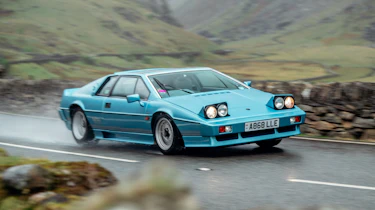
Born in the mid-1970s when Lotus was a world-beating superpower in Formula 1, the arresting purity of both the Esprit’s origami lines and its mid-engined handling balance made it an instant icon. Today, it’s still a car like no other, with an appeal all of its own.
It can be considered one of the most significant Lotus models of all in that it moved the company upstream into a whole new market and, in Turbo form, could truly be called a supercar. Also making it a significant part of the Lotus story, the Esprit would remain in production for four decades. This page concentrates on the first half of the Esprit’s life: the S1, S2, S3 and Turbo derivatives up to 1988.
Lotus Esprit in detail
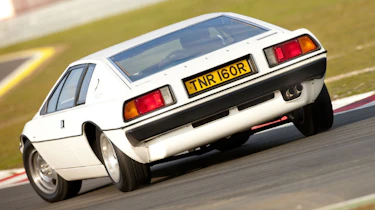
Given the travails of Lotus in recent years (if not decades), it’s easy to forget what a phenomenal force the company was. The dominant team in F1 for so many seasons, Team Lotus beat Ferrari to become the first to take 50 Grand Prix victories. Keen to capitalise on this landmark success, Colin Chapman wasted no time pushing his road cars upmarket, launching the Elite, Esprit and Eclat models between May 1974 and October 1975.

Lotus technical director Tony Rudd was charged with seeing the new models into production, with the aim of transforming the Hethel manufacturer into a serious rival to the likes of Lamborghini and Ferrari. Project M50 was to be the new four-seater Elite; Project M70 would be a two-seater mid-engined coupe to replace the popular but aging Europa.
The latter was born after a chance meeting between Colin Chapman and designer Giorgetto Giugiaro. The famous Italian stylist had recently penned the mid-engined Bora for Maserati, and an impressed Chapman gave him the nod to work on a brand new design for Lotus. Initially based on the Europa’s chassis, an early version was displayed on Giugiaro’s Ital Design stand at the Turin motor show in 1972. It received a hugely favourable reaction from both the press and the public. Soon after, Lotus began working with Giugiaro to refine the styling into what would eventually be unveiled at the British motor show three years later as the Esprit.
Meanwhile Tony Rudd headed up the ‘think tank’ team based at Ketteringham Hall in Norfolk. Here the basic mechanical layout was agreed, engineered and refined before the designs were passed to chief development engineer Roger Becker for translation into production-ready cars at nearby Hethel.
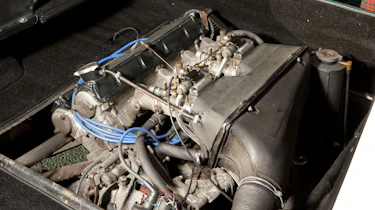
Project M70 utilised Lotus’s own Type 907 2-litre, 4-cylinder, 16-valve engine, already tried and tested in the Jensen Healey. In the Esprit it would have 160bhp in European specification with twin 45 Dellortos. It was mounted longitudinally behind the occupants, and despite a tendency to leak oil (which became apparent later) it was a robust and compact unit. The Europa’s Renault-sourced five-speed transmission was simply not up to the bigger power output of the Esprit, so instead Citroen’s five-speed gearbox/final drive, as used in the Maserati Merak, was employed.

Roger Becker remembers well the occasion when Colin Chapman took the first prototype Esprit, finished in orange, from Ketteringham Hall and out on the public road for the very first time: ‘Chapman came to see me, handing me the keys and commenting that the rear suspension was weak and that he required a report the next day as to why. As it turned out, the car was about 100 miles away at the side of a road, and when I arrived it was obvious the suspension had actually broken since the rear wheel was hanging off as a result of the car sliding into the kerb. In my report I cited a catastrophic failure of the rear suspension. I didn’t dare tell Chapman he’d simply been driving too fast!’
The independent rear suspension was in fact typically Colin Chapman – very simple, it even utilised the driveshafts as part of the suspension, which was later to cause premature wear issues in production cars. Combined coil spring/damper units were also used, steering was unassisted rack- and-pinion, and the dual-circuit Girling brakes had solid discs front and rear.
The first production Esprits appeared in July 1976, and the price tag of £7979 compared favourably with the £11,660 Ferrari 308 GT4 and £11,500 Porsche 911 Lux. Lotus claimed a top speed of 138mph and 0-60mph in 6.8sec, and while Motor magazine could only extract 7.5sec for the latter, it praised the road-holding, brakes and gearchange. Noise and vibration came in for criticism, though, as did rear visibility.
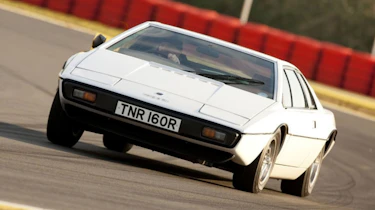
Early sales were good if not outstanding, but the Esprit was about to be propelled into the worldwide spotlight when United Artists were to request the loan of a pair of cars to feature in the 1977 Bond film The Spy who Loved Me. Quite by chance, Roger Becker ended up doing most of the stunt driving in the film. ‘It was pure coincidence to be honest,’ he remembers. ‘I drove one of the Esprits to Sardinia, the other, PPW 306R, arriving later by train. The second-unit director was unhappy with the performance of the stuntman, who just couldn’t get comfortable with the car as he’d never driven anything mid-engined before. I’d tried to coach him, but he still wasn’t comfortable with it.

‘When the director called for the car to come up to the top of the set, the stunt driver wasn’t around, so I jumped in and drove the Esprit sideways up the hill and pulled in next to him. He obviously thought I was the regular driver since he shouted, “Why the bloody hell can’t you do that all the time?!” From then on I did all the driving…’ The film was an enormous success at the box office and the resulting exposure not only resulted in sales of the Esprit rocketing, but also saw Lotus’s new sports car firmly entrenched in the public’s affection.
The S2 (for Series 2) arrived just over two years after the first of the 718 customer S1s were delivered. The lift-reducing chin spoiler was integrated more neatly into the nose, new rear lights were fitted along with Speedline wheels (in place of the original Wolfraces), and side intakes were added behind the windows along with an ‘Esprit S2’ graphic on the rear quarter panel.
An Esprit 2.2 model was launched in 1980, fitted with the larger, torquier 912 engine. After 1148 S2s had been built, the S3 was launched in 1981, with a stiffer chassis, chunkier bumpers and the 2.2 engine as standard. It remained in production until 1987.
Driving the Esprit S1
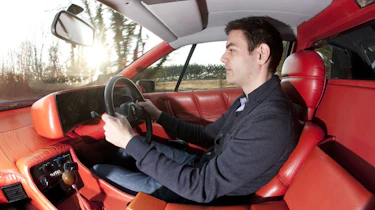
Jethro Bovingdon got behind the wheel of the S1 at Lotus’s Hethel test circuit alongside five other generations of Esprit in issue 171 of evo. Purity sums up the driving experience: the steering wriggles over contours, even on smooth tarmac and becomes light with speed while retaining plenty of detail. The brakes are unservoed, and firm but responsive. While the four-cylinder engine is not exotic in feel or sound, it’s a hard-working, pure experience.
Handling balance is toward understeer but responsive to steering, throttle and brake inputs, making the driver very much in control.
‘The S1 really does feel like the progenitor for all the Elise and Exiges that I’ve ever driven. You drive it with your fingertips, gently up to the limits of its front tyres and no further, and with a smile as wide as Giugiaro’s lapels in 1975. Of course it’s dated by a lack of grip and body-roll that you just don’t compute with a driving position so low and a chassis of this configuration. And the performance is no more than modest. However, I’m delighted and amazed by the S1.’ – Jethro Bovingdon, who tested the S1 Esprit at Lotus’s Hethel track
Lotus Turbo Esprit: the first Lotus supercar
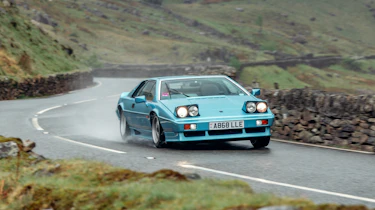
It was the introduction of the Esprit Turbo (or rather Turbo Esprit, to give the original model its correct name) as an addition to the naturally aspirated S2 Esprit in 1980 that signalled its arrival as a serious supercar.
The 0-60mph time tumbled to 5.6sec, the top speed climbed above 150mph (officially 152mph; independent magazine testing saw 148mph) and the already-striking Giugiaro bodywork gained skirts and spoilers, and a whole new attitude overall.

While the original Esprit was a car which embodied the style of the 1970s, it was apt that the Turbo Esprit arrived in 1980 as it was a car firmly in the spirit of the decade. The upgrade to a forced-induction engine captured the zeitgeist, with ’80s F1 and World Rallying being shaped by wild turbocharged cars. Its engine was the 2.2, converted to a dry sump initially before being changed back to a wet-sump arrangement in 1983. Peak power was 210bhp – a rather ordinary figure today but a significant uplift from the 2.2-litre Esprit S1’s 160bhp. Price had increased too, to nearly £17,000.
While the starring roles in The Spy Who Loved Me (1977) and later James Bond flick For Your Eyes Only (1981) had given the Esprit and subsequent Turbo enviable exposure, a deepening global recession and increasingly stringent US emissions and safety regulations got the ’80s off to a stumbling start.
Chapman had begun the process of restructuring before his sudden death to a heart attack in December 1982 exposed the full extent of Lotus’s financial plight. The Chapman family handed over control of the company to David Wickins, founder of British Car Auctions, who formed a consortium of investors, then restructured and stabilised the company before overseeing the eventual sale of Group Lotus to General Motors, all within the space of three years.
Driving the Lotus Esprit Turbo
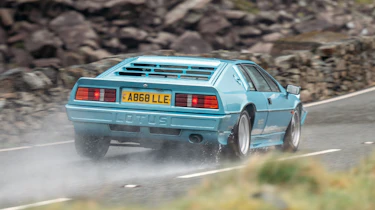
Getting behind the wheel of a Turbo Esprit in the here and now is a real joy. The interior is as ’80s as it gets. The high sills and plump seats are super-supportive, and you sink into the car, hips and shoulders squidged in place and left elbow sitting nicely on the padded cubby lid. Swathed in soft ruched hide, Hethel’s trim shop is clearly where Tony Hadley’s leather trench coats went to die, but the plush environment must have felt pretty special if you’d just dropped £21,605 on your new Lotus supercar, as was the price in 1984.
Smiths instruments are housed in a stylish boomerang-shaped enclosure that seems to float above the dashboard. The pedals are offset to the left and the steering wheel is weirdly skewed, so the left-hand side of it is closer to you than the right. This somewhat makeshift feel is certainly not unique to the Lotus, but it does highlight how little consideration supercar makers gave to locating the driver nicely within the cockpit.
We’re testing a high-mileage 1984 example, in magnificent bright Ice Blue metallic paint with criss-spoke BBS alloys, kindly supplied by owner Kevin Wheeler. It has clearly seen some action but the very fact he has used it regularly throughout his 13-year tenure confounds the Lots Of Trouble Usually Serious reputation gained by Lotus products of the era.
Aficionados scanning the picture gallery will spot that this car features a later HCi or High Compression engine, fitted to replace the original that was buzzed on a trackday in the over-enthusiastic hands of a previous owner. The HC lump features a better cylinder head, Mahle high-compression pistons, a recast alloy manifold and larger Dell’Orto carburettors to make more oomph, with power rising from 210bhp at 6250rpm to 215bhp at 6000rpm along with a useful bump from 200 to 220lb ft at 4250rpm.
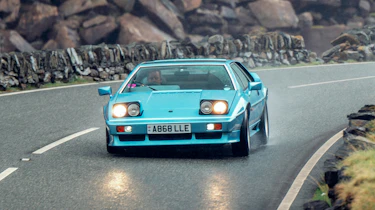
The essential character of the Esprit’s turbocharged 2.2-litre ‘slant-four’ engine – so-named because Chapman tilted it at 45 degrees to mount the engine as low as possible – remains very similar in both specifications. That’s to say a surprisingly frisky delivery accompanied by a unique combination of cammy, revvy four-pot and a delicious swell of boosty, torque-rich shove once the single Garrett T3 turbocharger is spooling.
Period road tests clocked it at 146mph all-out (Lotus claimed 150) with 0-60mph in 5.6sec and 0-100 in 15sec. Definitely rapid but not in the same league as the Big Guns. It sounds like a predictable cliché, but the Esprit really does do things differently. The Lotus way, if you will. There’s a lightness and freeness to the way it makes progress that’s highly refreshing.
Where heft was a defining attribute of ’70s supercars and remains present to a greater or lesser extent in their ’80s successors, so the Esprit prioritises flow over physicality. This said, the unassisted steering is heavy at low speeds, but quickly lightens so you can guide it from your wrists and forearms rather than shoving it from your shoulders.
The Citroën-sourced gearbox doesn’t like to be hurried – a result of a long and doubtless awkward linkage and a rather vague gate – but the ratios are bespoke to the Esprit. They suit the delivery of the engine nicely; short enough to feel urgent but with enough reach to exploit the building torque.
‘From this time and distance, it’s more obvious how similar the Esprit and Elise are than it was back in the day.’ – John Barker, evo Editor-at-large.
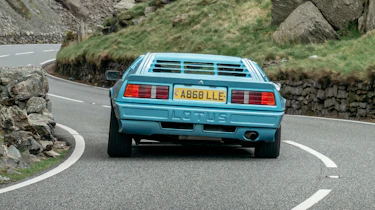
It’s a deceptively quick car, thanks both to the punchy engine and lightweight build, which sees the glassfibre-bodied Esprit weigh in at just 1148kg, which was 80kg more than the flyweight naturally aspirated S3 Esprit.
The Turbo benefited from the S3’s stiffer chassis structure and uprated rear suspension and was praised in period for apparently limitless grip. Times have changed but the Turbo’s poise and ability to commit to corners make it pleasingly playful. Even allowing for this car’s somewhat tired dampers, the quality of the chassis engineers’ work and the philosophy they were following are clear in the way it steers, reacts to throttle inputs and absorbs road imperfections.
Charging up and down a mountain pass shows the Turbo at its best, minimal mass making direction changes a cinch, and the car punching impressively out of tight corners so long as you keep it on the boil. Being light and grippy means you approach corners differently rolling out of the power and carrying speed rather than having to brake harder before the initial steering input. It’s a satisfying and cerebral process that bears all the Hethel hallmarks.
‘It’s light, communicative and responsive. You can turn in with one precise input, whereas some of the other cars require more patience to guide through a corner. True Lotus DNA right there.’ – Yousuf Ashraf, evo Senior staff writer.
The Esprit after 1987
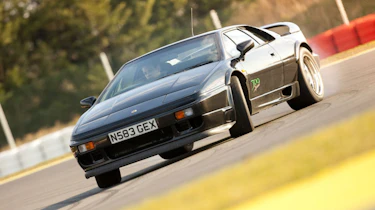
With the Peter Stevens-redesigned X180 version introduced in 1987, the Esprit Turbo (now with the running order in its name swapped) became a supercar which exemplified intellect over muscle. With just 2174cc and four cylinders, the turbocharged S4 developed a nominal 264bhp, although if running conditions were cool, the engine management allowed up to 280bhp – around 120bhp more than the original, naturally aspirated S1.
With a power-to-weight ratio of 232bhp/ton, the S4 could accelerate from zero to 60mph in around 4.7sec – faster than a Ferrari 512TR. The S4’s chassis had been further refined, with cornering abilities a leap ahead of the S2 Turbo’s.
In its latter years, the Esprit was powered by a lightweight twin-turbo V8 and finally acquired the engine to do its brilliant chassis justice. Straight-line speed now had drama to match the cornering and braking forces. A flat engine note and clunky gearchange were the downsides.
At the very end of the Esprit’s lifespan with the winged Sport 350, you only had to sit in one to know it was an old-school supercar with scattered, cheap switchgear, offset pedals, a cramped driving environment and poor visibility. But the Esprit was all about driving dynamics, with handling and steering feel so pure they could serve as a benchmark for any rival.
Values and buying checkpoints
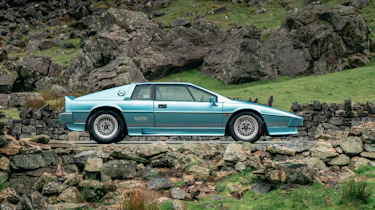
Esprits which are well looked after and used regularly can belie the reputation for fragile reliability (as evidenced by the Ice Blue Turbo driven on this page, which has been in regular use for 13 years) but prospective buyers should go in with their eyes open.
Much may depend on how well or otherwise a car has been looked after by its previous owners, as regular maintenance is key. Putting plenty of hours into research will pay off too, and there is a wealth of knowledge on specialist forums and club sites.
Engines are strong but regular cambelt services are essential and should be documented. More than most cars, ensuring the engine is properly warmed up and avoiding short journeys from a cold start is important. Air-conditioning systems can suffer if a car isn’t driven regularly.
Engine mounts are a key checkpoint in an inspection. Watch out for a slipping clutch on a test drive as replacement is a big job, since the gearbox must be removed. Look out for play in the steering too, as racks can wear prematurely. Replacing or refurbishing fuel tanks is a particularly onerous job and it’s worth checking if a car has already had this work done in the past.
When deliveries began in June 1976, the S1 was priced at £7883. At the time of writing in 2026, S1 prices can range from less than £40,000 to more than £100,000. Pre-’89 Turbos can vary from £25,000 to £100,000 for special-edition models such as Essex Commemorative Editions.
Specs
| 1976 Lotus Esprit S1 | 1984 Lotus Esprit Turbo | |
|---|---|---|
| Engine | In-line 4-cyl, 1973cc | In-line 4-cyl, 2174cc, turbo |
| Power | 160bhp @ 6200rpm | 215bhp @ 6000rpm |
| Torque | 140lb ft @ 4900rpm | 220lb ft @ 4250rpm |
| Weight | 900kg (178bhp/ton) | 1148kg (190bhp/ton) |
| 0-60mph | 6.8sec | 5.6sec |
| Top speed | 138mph | 150mph |
| Price new | £7,883 (£73,652 in today's money) | £21,605 (£72,500 in today's money) |
| Value now | £40,000 - £100,000+ | £25,000 - £100,000+ |