Ferrari 550 Maranello Prodrive: behind the wheel of a V12 Le Mans icon
This sensational Ferrari 550 Maranello Prodrive competed at Le Mans no fewer than five times. Now it’s our turn to get behind the wheel
And so the real reason that the Tsar was overthrown was…? Smith…? SMITH?!?!’ But Smith isn’t thinking about a chilly Petrograd and the fate of Nicholas II in 1917. There is a window open in the classroom and carrying on the warm breeze is another voice, an Italian-British one, that is instead transporting Smith to the Mulsanne circa 2003. A distant shriek is rising above the usual lazy summer sounds of a Tuesday morning in Surrey. At this remove of several miles, the side-exit-symphony is little more than the volume of a sleepy summer wasp, but it’s intoxicating. Smith’s attention has as much resistance as Odysseus to the sirens.
Thirty years ago it was me in that classroom in the school just down the road from Dunsfold. There was no danger of hearing a V12 exercising its vocal cords at that time because the airfield had yet to become the test track for a TV show and instead was still a home to Harriers of the jump jet variety. In all honesty I’m not sure if the sound would quite have carried anyway, but from where I’m standing it feels like the whole of the South of England must be aware of our presence, or rather the presence of a 6-litre, naturally aspirated V12.
> Ferrari 12 Cilindri review – has the Aston Martin Vanquish rival gone too soft?
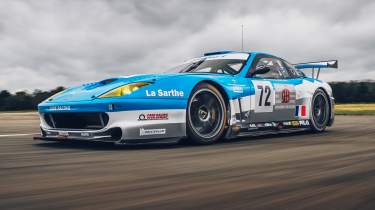
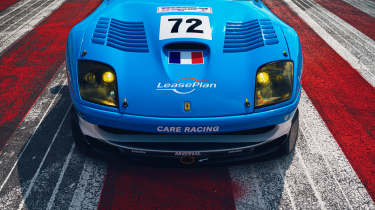
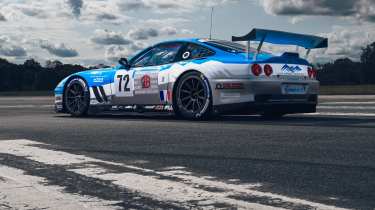
The engine is nestled under the long, louvred bonnet of a Ferrari 550 Prodrive, specifically chassis CRD03, which features in Adam Towler’s excellent deep-dive below. It looks slightly different today because since it last graced these pages the Peter Stevens-sculpted carbonfibre bodywork has been swapped from its red 2004 livery, with the names of McRae, Turner and Rydel above the door, to its 2003 form.
That year it was driven by Frédéric Dor (the Frenchman behind the whole 550 Prodrive story), Jérôme Policand and Luc Alphand. That last name is the reason for the mountain graphics on the side of the car because, as well as competing in endurance racing (finishing third in the GT1 class at Le Mans in 2006) and the Dakar (winning outright in a Mitsubishi, also in 2006), Alphand had an earlier life as a downhill ski racer, taking the overall World Cup title a remarkable three years in a row.
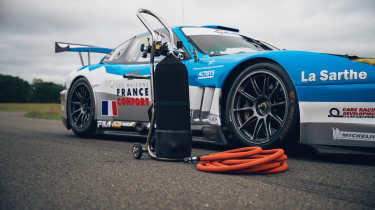
While I love the red (apparently perfectly matched to the Scuderia’s all-conquering F1 cars of the time), there is something equally striking about the cool blue, white and grey colour scheme. It also helps highlight just what a storied life this car has lived, because no other V12 Ferrari has competed at Le Mans more times – five in total. Open the passenger door and there is a very graphic representation of this history on the rear bulkhead with a scrapbook of slightly yellowing scrutineering stickers from Le Mans and many other places plastered across the metal.
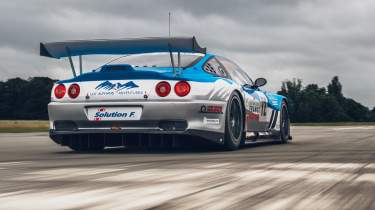
And whether rosso or blu, the Ferrari 550 Prodrive really is incredibly loud. Old F1 car loud. The sort of loud that means no matter how much you love the sound, you will have to put your fingers in your ears when you’re close and the throttles are wide open. But the sound is also utterly, spine-tinglingly glorious. It creates the sort of reverberations that echo in your memory for weeks afterwards, reigniting goosebumps when you think of a single yelping downshift. It is the sort of sound that you feel must be preserved in perpetuity; if the future of cars 10, 20, 30 years from now does turn out to be electric then this has to continue to exist somehow, somewhere to show what music humanity once created with internal combustion.
It’s also so loud that, after an anxious call from Track Control first thing, we’ve had to agree to limit our running to a set amount of time every hour to avoid a ticking-off from the council and a potential circuit ban for the day. Heathens. Luckily we’ve got the whole day and therefore plenty of opportunity to stretch the legs of this Prodrive prancing horse.
Stretching my legs is not something I’ll be doing while driving the car, however. Being at the other end of the queue to Dickie Meaden when the gene pool was dishing out height, it’s a bit tight in the cabin. It’s not a claustrophobic place to spend time, in fact it’s positively light and airy. Some race cars feel like you need a head torch as you post yourself into the dark depths of their cockpits, but the 550 is actually quite welcoming in that regard. However, the beautiful trio of lightly scuffed pedals seem to have quite a lot of footwell left behind them for some reason and so I’m forced to sit a bit scrunched up with knees splayed. Obviously it’s not enough to stop me driving, but if the Lottery balls fell well for me (and we’re talking EuroMillions, not just five and the bonus ball) and I purchased this car then apparently there is now a modification that tall people can opt for, using the later Aston DBR9’s pedals set further back. Good to know.
The person in the car at the moment fits rather more comfortably. Czech racing driver Tomáš Enge is possibly the most skilful pilot the 550 Prodrive has ever had, having put one on pole at Le Mans no less than three times, including this very car in 2002. Perhaps his greatest lap was in 2004 when, with minutes to go before midnight in the final session, he pipped the 64 Corvette C5‑R of Gavin, Beretta and Magnussen that had looked to have had everything sewn up. What made the lap especially remarkable was that the number 66 Ferrari had been crashed heavily by Enge the day before. It had missed the third qualifying session entirely as the Prodrive team raced to get it rebuilt in triple-quick time so that Tomáš could sneak back out just in time to do his thing right at the end of the fourth and final session.
Today he seems joyfully at home. When the car needs turning round to head back out onto the track he eschews the careful three-point turn that I employ, instead dialling in a yelp of revs, dumping the clutch and applying a touch of steering lock, thereby smoking the rear Michelins and spinning the car in a perfect 180-degree arc, the black lines continuing all the way out of our nominal pitlane.
Chatting to Stuart Gale from Venture Engineering (whose crew are running the car for this test and many of whom ran the cars in period), he says that Enge is one of the most naturally gifted drivers he’s ever seen. His feel for a car was – and still is – apparently second to none.
‘He’d change the handling of the car mid-stint,’ recalls Gale, ‘Too much understeer? He’d just overwork the rears to bring the balance back to where he needed it.’
It’s wonderful listening to Tomáš wring the car’s throttle bodies for a few laps but I’m itching to have another crack. When he returns, I hop in and set about adjusting the belts. First thing this morning the race engine had to be pre-warmed before it could be started, but now it’s ready to go. There are carbonfibre facsimiles of the road car’s dash, so that there is a sort of blank-eyed familiarity to the cockpit. The mirror adjusters have even been retained on the transmission tunnel’s carbon plinth that’s home to bewildering rows of fuses. Luckily the necessary little black buttons have already been pressed and so I can just check the master and the lift pump, then toggle down the ignition switch with the helpful fluorescent yellow circle round its base before pressing the small green button below.
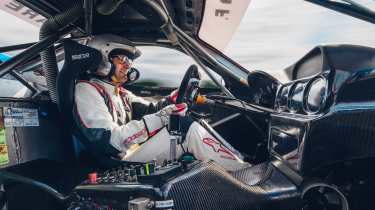
After a brief spin of the starter motor and with no throttle input, the two exhausts protruding from the sills parallel with my backside explode into life. Pull back for first gear and check the red ‘N’ has changed to a red ‘1’ on the little, one-line digital display. Then, still with no throttle, slowly bring up the clutch pedal before feeding in the right-hand pedal as the car starts to roll forwards. Easy. Ish.
Unlike many race cars, it actually doesn’t feel too grumpy about being driven at less than ten tenths. Within reason you can short-shift and ease yourself into the experience. However, with a big wide runway at your disposal there is also a certain freedom to get quickly up to speed with some Mulsanne-aping acceleration runs.
The tall shift lever has a black cylindrical handle that is curiously open at the top, like an uncorked wine bottle. The reason for this is connected to the small red LED down at the bottom of the lever; it’s an optical flat shift. In both principle and practice, performing a flat shift is really very simple; you just keep your right foot pressing the throttle pedal all the way down and pull back the lever with your right hand for an upshift. Yet that first one still feels nerve-wracking if you’re not used to such things. Long-accrued mechanical sympathy murmurs in your mind that not lifting (let alone not dipping the clutch) will result in some sort of horrible meeting of metal, like a fist bump greeting a handshake.
But it won’t, and of course once you’ve performed one, it’s like you’ve unlocked a new world. It’s wonderful having something more analogue than a paddle to pull and something more visceral than a DCT in the character of the shifts, yet also capable of creating the sort of long, seamless, sustained shove of acceleration that an H-pattern car could never match. Just remember that you do need to use the clutch for all the downshifts as you brake for the next corner, and if you want to keep things as smooth under decel as they were under accel then some rocking of your right foot will be required to blip the throttle and match the revs each time you stab the gearlever forwards.
So paper-cut sharp is the response of the right-hand pedal that it takes a few laps to tune in my sensitivity and get the timings of feet and hands just so, but in the meantime the 550 is actually very forgiving. With 553lb ft of torque it has plenty of flexibility and feels fine if you choose to leave yourself some leeway and stay a gear higher than might be Enge-optimal.
Once you get comfortable you realise that it doesn’t rev quite as astronomically high as you might think from the sound, with all the shift-lights lit at around 7000rpm. However, it’s also worth saying that the 550 Prodrive feels genuinely quick in a straight line. Some GT race cars of recent years can actually feel a touch tame compared with their often significantly more powerful road car brethren, but with 600bhp and a mere 1100kg to propel (some 590kg less than the road car), this Ferrari definitely has enough performance to feel exciting in the bits between the corners.
At first the 550 Prodrive didn’t have any power steering, but after requests from drivers with presumably pumped forearms and aching hands, assistance was fitted. It’s actually surprisingly light now, to the point where it’s initially tricky to feel how hard you’re pushing, and combined with a nose that you can’t see from the low seating position, it all feels a bit remote at first. Add in all that power and it could be pretty intimidating. However, such is the innate balance of the 550 that it encourages you to keep pushing, keep increasing the pace, keep loading the sidewalls of the tyres with more and more force.
Locked tightly into the Recaro, you and the car move as one, so that even if your hands don’t have much to go on at first, you nonetheless sense how the car is behaving, how the weight transfers are happening, how the car is rotating. Confidence builds. There is a tiny bit of understeer in the quicker corners, which is nicely reassuring, and then, if you get greedy with the throttle on the exit of lower-speed turns like Chicago or Gambon, the front-engine rear-drive balance feels easy to catch and hold in a slide on the limit with the light steering. It’s nice having a normal round wheel as well.
As such you find you can start to hustle the 550 Prodrive. You can stay committed even when you feel the car buck over the surprisingly big bumps in Hammerhead, the period-correct Koni dampers struggling to control the sudden impacts but the car tracking true even as the revs flare. And the more you push it, the more it talks to you, and so the dynamic picture starts to build in your mind. And what begins to emerge as you explore is that this race car retains more than a little of the friendliness that made the road-going 550 such a winner back in the early days of evo, albeit with a sense that half the mass has been emptied out.
In fact it was because the road car had such fabulous fundamentals, both from an engine and chassis perspective, that Prodrive took on the project in the first place. This is no silhouette racer; it is genuinely a 550 underneath. The first two chassis were based on cars bought from a dealer on the King’s Road in London, while this third one took Frédéric Dor’s personal road car as its basis. I love the idea that this car lived a normal life before retiring from the road, casting off its number plates and going racing.
As well as making the podium at Le Mans in 2004, CDR03 also won at Road America, Laguna Seca and Miami. Speaking to Oliver Gavin, who competed against the 550 in a Corvette, he tells me how much the Prodrive car pushed them on as a team to learn and develop the C5‑R. He also recalls the incredible experience of racing wheel-to-wheel with the Ferrari when the Corvette had no side windows. With both cars having side-exit exhausts there would apparently be this incredible mix of sounds, high and low, yowling and rumbling, reverberating in the gap between the doors of the two cars as they hammered along next to each other. Magical.
Although built and developed in Banbury rather than Maranello, the 550 Prodrive does have the full Ferrari Classiche rubber stamp of approval, complete with a big red book, as though it’s been surprised by Michael Aspel at some point. That recognition from the factory certainly feels right and proper. Not just because the ten race cars achieved incredible results, but because the experience they provided, whether up close sitting in the driver’s seat and pulling flat shifts or hearing that piercing V12 soundtrack carried on the breeze from afar, is pure prancing thoroughbred. – Henry Catchpole, evo issue 339
Anatomy of the Ferrari 550 Maranello Prodrive
Few combinations in motorsport history are more evocative than ‘Ferrari’ and ‘Le Mans’. The company made its name there, in part, by winning the first post-war race in 1949, and Enzo Ferrari considered a good performance by his cars in the 24 Hours vital throughout the ’50s, ’60s and into the early ’70s. From there the marque played more of a supporting role, with Daytonas and then Berlinetta Boxers in the GT class; when it returned for outright glory it was as an engine supplier to the factory Lancia squad in the Group C era of the 1980s.
When Group C fizzled out in the early ’90s, GT cars returned to front sportscar racing as a more affordable, privateer-based formula, and early contenders included 348-based and then F355 racing machines, as well as crowd-pleasing F40s at the front of the field. However, as the emergent BPR series and the Le Mans 24 Hours evolved into the FIA-run World GT Championship, the recipe soon soured, first after Porsche’s appearance with the 911 GT1, and then Mercedes-Benz with the CLK GT1. In particular, the Merc, effectively a pure racing car and backed by a colossal budget, was beyond what any rival factory team or privateer squad could afford to compete against. Even Ferrari, who had begun development of an F50-based GT1 contender, was deterred from a direct confrontation and quietly sold off the F50 test cars.
So for 1999 the short-lived GT1 category would be axed, and the GT Championship effectively run with GT2-spec cars as its premier category. For series promoter Stéphane Ratel and his SRO company – the former the ‘R’ in the BPR series – running an international championship with little more than Dodge Vipers and turbocharged 911s at the front of the field was not appealing. Ratel went on the offensive, arguing to the FIA that rather than waiting for manufacturers to homologate cars for racing, teams should be able to apply for a technical passbook for a particular vehicle, effectively a reversal of the traditional procedure. The FIA agreed and, after drawing up a list of viable cars, gave manufacturers 15 days to protest against their inclusion.
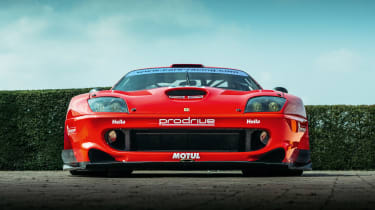
What Ratel and his investors really wanted, though, was a Ferrari towards the front of the grid, and the firm’s flagship of the time, the 550 Maranello, fitted the big GT car template perfectly. Which is why in early 2000 a project to develop the 550 into a GT machine was begun at Turin-based engineering firm Italtecnica, the car being known as the 550 Millennio. Developed in double-quick time, it featured an enlarged, 6-litre V12, hit the minimum weight limit at 1100kg, and looked as formidable as it sounded.
Sadly, the results in that 2000 season, or rather the lack of them, suggested it was anything but formidable, the 550 suffering in particular from dismal reliability. One of the project’s backers was French industrialist Frédéric Dor, who had long campaigned rally cars prepared by Prodrive, including in 1999 a Subaru Impreza WRC that the year before had been one of Colin McRae’s regular mounts. With one eye on the car’s hitherto poor results, Dor shipped his 550 to Banbury before it had even turned a wheel in anger, and the prognosis from Prodrive’s George Howard-Chappell was not encouraging. To put it bluntly, if it was to have Prodrive’s name on it, they’d rather start from scratch thank you very much. Which is where the Prodrive 550 project really began.
Complicating the task, sportscar racing was going through one of its significant periods of change, and emerging from the entanglement came two significant power bases: the FIA-sanctioned GT Championship, but also the American Le Mans Series (ALMS) in partnership with the ACO (Automobile Club de l’Ouest – the Le Mans 24 Hours organiser and promoter of the European-based Le Mans Series), which meant that cars racing Stateside and at Le Mans ran to a slightly different rule-set depending on where they were racing. This meant that teams had to test and develop subtly different permutations of their cars if they wanted to be competitive in both championships.
Body, structure & aero
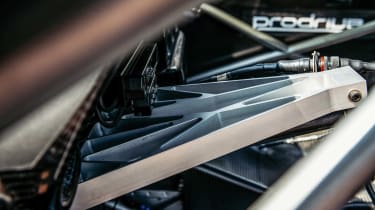
While GT regulations at the time allowed for substantial changes to a donor car, the fundamentals still remained very much in place. In the case of the 550, this was largely good news. It had a large-capacity engine of sophisticated design and, crucially, the gearbox was a transaxle unit (rear mounted), not up at the engine end, to the great benefit of weight distribution and traction. Double-wishbone suspension was ideal for a racing car, and the body design presented pleasingly low air resistance when viewed from the front. Large overhangs front and rear promised plenty of space for the crucial additional aerodynamic elements to do their stuff.
‘The championship-winning [2000] Mondeo touring car we’d built for Ford was a beautiful racing car made from a road car, and that was the standard we were after,’ says Howard-Chappell today, reflecting on why the Italtecnica machine was never going to be good enough for them. ‘The Ford BTCC project positioned us from an engineering and design point of view to make a car like the 550.’
Still, as he notes, it wasn’t another McLaren F1, neither did it have the inherent benefits of a Saleen S7R, one of the 550’s rivals and a mid-engined car virtually purpose-built for the track.
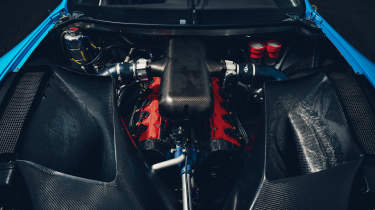
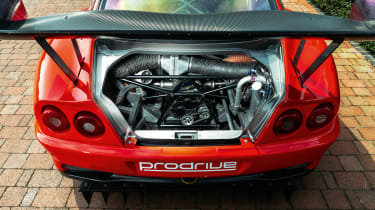
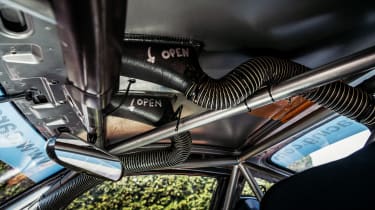
In light of that, getting the 550’s weight distribution and centre of gravity as balanced and low as possible was vital. The engine was extensively lightened, via its internals and also by binning the variable intake system (worth 20kg alone), while a dry sump set-up allowed it to be positioned much lower in the car. It was then moved back towards the bulkhead as far as possible, even to the point where the cam covers were cut away on the ends and a new steering rack had to be run between the cam belts drive and engine block to find a path to the front wheels. The original steel monocoque centre section was extensively strengthened by a substantial roll-cage, which not only provided the required crash protection but gave the car the majority of its required rigidity.
Due to the tight deadlines, there was no scale-model wind-tunnel testing. A limited full-scale programme was carried out at MIRA, checking rear wing designs and the overall shape, but the front splitter and underbody aero could only be developed on the track with a moving road underneath. Nevertheless, this was the era when teams could still develop their cars as they saw fit, and Prodrive would evolve the aerodynamic package of the 550, as they did many other details on the car. When setting it up for a race, the angle of the front splitter, along with the car’s ride height and subsequent underbody aero effectiveness, were crucial to its overall performance.
Yet Dor still wasn’t quite satisfied. He wanted his racing Ferrari to look beautiful – like a factory-built racing Ferrari in the finest tradition, so Prodrive boss David Richards approached Peter Stevens to finesse the package that the engineers had come up with. ‘I was doing lots of work for Prodrive so David asked me to take a look,’ recalls Peter today. ‘I felt it was important that it looked like a Ferrari – that it didn’t just have a race car look imposed upon it; there’s no excuse for racing cars not looking good. It’s a big car, so I didn’t want it to look even bigger, and I wanted it to look voluptuous. We did a clay model, and even took great care with the air intakes to get them looking right.’
Engine & transmission
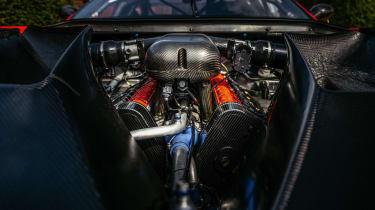
GT rules decreed that the block and head castings remained the same as on the road car, and that the engine had to breathe through an air restrictor that limited power to what the organisers hoped would be around 600bhp. Once inside the engine, Prodrive’s engineering team found the design and quality of components to be extremely high – so much so that the steel crankshaft and titanium rods of the Maranello were initially retained. To negate the effects of the restrictor as much as possible, the displacement was stretched to 5853cc (from the road car’s 5474cc), but the cylinder head received a lot more attention and the valvetrain was entirely new. For added complication, the FIA rules insisted on the same material here as the road car, whereas the ACO/ALMS regs allowed titanium to be introduced.
In FIA GT spec, the car was originally raced with a 32.1mm restrictor, which soon shrank to 31.6mm at the next race, and then 31.1mm after the car showed dominant form. After that, the FIA insisted the airbox was redesigned, despite not deeming it illegal; the ACO, meanwhile, didn’t have a problem with it.
For Le Mans in 2002 the displacement of the V12 was increased to 5983cc through enlarging the bore to 92mm and there was a whole host of other improvements. This spec of engine was good for at least 600bhp and 553lb ft of torque.
The final spec change came much later, with an ‘EVO’ engine known as the ‘low cost engine’. It ran on normal fuel and used standard cylinder heads and a simpler airbox design, all with a view to cutting costs and increasing mileage. It’s one of these engines that currently sits in ‘03’ today as you see in our photos, which explains why the glorious full carbon airbox and individual butterfly throttles of the original engine are absent.
The road car’s six-speed synchro gearbox was replaced with a six-speed sequential racing ’box designed by Xtrac. However, the ACO initially demanded H-pattern manual ’boxes, so as with many other detail items, the car had to be reconfigured for those races. The original Prodrive design had the ’box installed transversely, which the FIA didn’t approve of, so a longitudinal layout was adopted.
For the time, the 550’s Pi Research ECU, data-logging and electronic display were cutting edge, but, like its traction control set-up, are obviously crude compared with the sophistication of modern electronics. The sequential gearbox had a flat-shift facility enabled by an optical sensor on the back of the gearlever.
Suspension, tyres & brakes
The Prodrive 550s used Koni fully adjustable racing dampers. Early cars had unassisted steering, but electric power assistance was adopted later. The 550’s double-wishbone suspension was a nice starting point: ‘With the repositioning allowed within the regs we got something pretty decent,’ says Howard-Chappell.
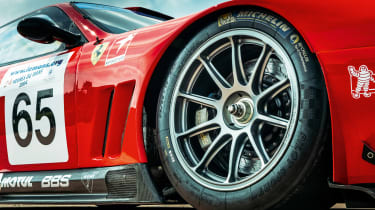
The team started on Dunlops, but after a couple of race wins switched to Michelins and ran on them from that point. Iron discs were run in the FIA GT series, but ACO rules allowed carbon brakes.
Racing history
The first season, 2001, was very much a development year for the Prodrive 550s, with three rounds of the FIA GT Championship and one ALMS round. The following year a single Prodrive 550 entered Le Mans, but while it may have retired on lap 175, it qualified on class pole and took fastest lap in the race – a clear warning of its speed to the class-dominant Corvettes and Vipers. The FIA GT Championship was contested by BMS Scuderia Italia and the factory Care Racing teams, with BMS earning 4th overall by the end of the year, while three rounds Stateside netted fifth overall in the ALMS.
It really came together in 2003, with the dream GTS class win at Le Mans for Peter Kox, Tomas Enge and Jamie Davies, who also scooped class pole and finished 10th overall. BMS Scuderia Italia were also FIA GT champions that year (including the class win at the 24 hours of Spa), while Prodrive fought an epic battle in the ALMS against the factory Corvettes, narrowly missing out on the GTS title.
By 2004, the Saleen S7R was becoming a formidable opponent, Ferrari’s factory-blessed 575 GTC was also in ascendancy, and the Maserati MC12 made its debut. However, 3rd in class at Le Mans, another FIA GT championship for the BMS team along with the drivers’ title for the team’s Luca Cappellari was a measure of the Prodrive 550’s class and staying power. Labre Competition’s 550 won the inaugural Le Mans Series in Europe.
Prodrive’s focus had switched to all things Aston Martin by 2005, but its 550s continued to compete in private hands, with 4th and 5th in class at Le Mans for Larbre and Cirtek Motorsport respectively. Larbe managed another drivers’ championship crown in FIA GT with Gabriele Gardel, and third overall as a team behind the Maseratis, while BMS took the Le Mans Series. By 2006, the car was in the twilight of its career, but still a capable machine in the hands of privateer teams, and always a thrilling sight on the track. – Adam Towler
Ferrari 550 Maranello Prodrive specs
| Engine | V12, 5983cc |
| Power | 600bhp |
| Torque | 553lb ft |
| Weight | 1100kg |
| Power-to-weight | 554bhp/ton |
| Tyres | Michelin Pilot Sport |
| 0-62mph | c3.5sec (est) |
| Top speed | c200mph (depending on track/gearing) |