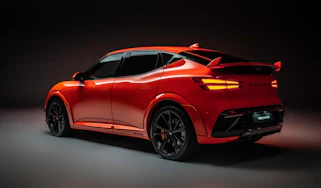
Genesis GV60 review – a cut-price BMW iX?
Top-class refinement and high-end powertrain tech make the Genesis GV60 a competitive alternative to more expensive German offerings, if the package appeals…
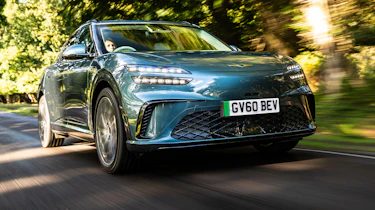
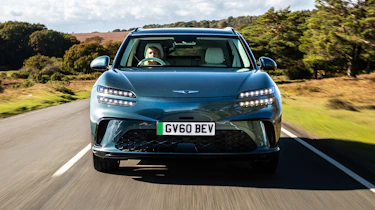
Genesis has been bolstering its range of premium alternatives to BMW and Mercedes in recent years, and while some of the brand’s models target specific rivals, the GV60 tries to tackle them all at once. This high-riding electric crossover-cum-coupe has a strong 483bhp dual-motor powertrain, a plush and luxurious interior, and for some reason, a ‘Drift Mode’ too.
The GV60 is a car that has been developed with genuine care and a level of attention to detail that’s often absent from much more expensive alternatives. It’s been built from the ground-up as an electric car and it feels that way, taking advantage of all of the benefits of an EV powertrain to make it a pleasant car to live with day-to-day. The only question is, who is it for?
> The Genesis GV60 Magma is an EV that sounds a bit like a Porsche 911
Powertrain and technical highlights
GV60s start at £54,115 and climb all the way to £66,900 for the top-spec Performance model, until the 641bhp Magma goes on sale with its Ioniq 5 N-derived powertrain. Regardless of trim, each model sits on a foundation of Hyundai/Kia’s e-GMP bespoke electric platform with an 84kWh battery pack at its core. The suspension is of a relatively simple MacPherson strut front and multi-link rear design, paired with coil springs and adaptive dampers.
Entry-level GV60 Pure models come with just one 226bhp motor mounted on the rear axle, with the mid-level dual-motor, all-wheel drive Sport lifting output to 314bhp, and the Performance getting 483bhp thanks to an upsized rear motor. The incoming GV60 Magma promises the most in terms of performance with 641bhp in boost mode to match the output of the Hyundai Ioniq 5 N and Kia EV6 GT it shares a platform with.
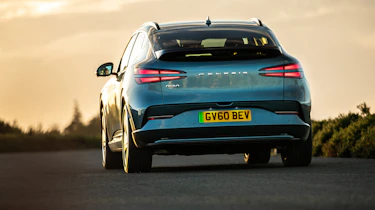
In Performance trim the GV60 is not a slow car, reaching 62mph in 4sec, but it does lack that stomach-churning kick of more focused rivals if that’s what you’re after. Range is nothing to write home about either, as while it’s estimated at a reasonable 311 miles WLTP, we saw no more than 250 miles on a charge in a mix of urban and motorway driving. Average consumption sat at around 2.5mi/kWh, which is quite some way from the 3.4mi/kWh we saw in the more potent Tesla Model Y Performance during our test. A high-tech 800V electrical architecture and charging speed of up to 350kw do help matters, but achieving those speeds will require you to find the battery pre-conditioning menu within the GV60’s seemingly endless infotainment system…
Performance, ride and handling
When it was first introduced, the GV60 lacked some of the dynamic polish you’d expect from a car at this price point, but things have changed in the years since. Not only has it gained the larger 84kWh battery pack as standard, it’s also been given a much more compliant chassis setup even in Performance-trim. The result is ride quality that matches its premium cabin well, with slow spring rates making long-distance, high-speed motorway cruising more comfortable and refined than in the likes of a Tesla Model Y.
Tip into a corner on your favourite B-road and those slow spring rates do make the GV60’s 2145kg weight figure immediately known, but electronically controlled adaptive dampers help it maintain more composure than you might expect. There’s a huge amount of grip on offer on the rare occasion this car inspires you to push on, but there’s no hiding the fact it’s not a performance-oriented EV. That’s reserved for the incoming Magma.
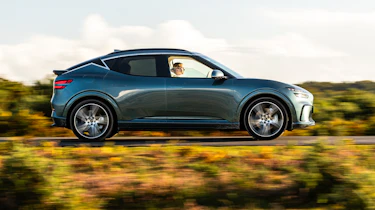
Steering is what lets the GV60 down most, as while weighting has good initial heft, you soon find that this doesn’t result in the response you’re looking for. Weighting is unusually inconsistent throughout the range of motion which leaves you completely in the dark as to precisely what the front wheels are doing. Impressive NVH only makes matters worse, as you can’t rely on other senses for a clue of load and traction levels in the same way you can in other cars of this kind. This won’t be a deal breaker for most GV60 buyers, but serves as a reminder that the ‘Performance’ name doesn’t mean you’re buying into a luxurious Ioniq 5 N.
Throttle response is well measured and easy to modulate, which is handy when there’s 483bhp and 513lb ft at your disposal – each of the drive modes have a noticeable impact on throttle response and change the GV60’s character as a result. There’s not one mode that gives you that sharp kick of electric torque we’ve seen in some other cars of this kind though, and while some may prefer this instantaneous power delivery, the linear, gradual power curve is refreshing in our eyes, adding a real premium edge.
There’s an electronic limited-slip differential to properly distribute power on the limit, too, and while it is effective, the traction control light on our test car was very eager to flash away well before we’d expect it to.
Interior and tech
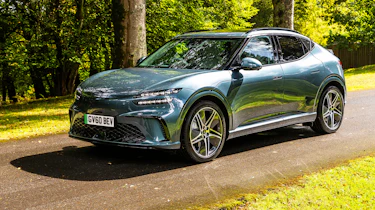
As you walk up to the GV60, it can be a little tricky to contextualise size-wise as its overall dimensions are just so strange. It’s shorter than a BMW 2-series Coupe, about as wide as an X3, yet has a comparatively long 2900mm wheelbase. These don’t correlate to any rivals, but do seem to liberate plenty of space inside the cabin – something that’s accentuated by the handy flat floor and good forward visibility.
In the case of our test car, the GV60 feels (and even smells) opulent, with quilted Nappa leather, soft-touch faux suede and a number of high-end materials usually reserved for models in the price bracket above. The cabin itself is also full of quirky details – some of them clever, such as the draw-like glovebox, some of them not, such as the rotating spherical gear selector.
You certainly won’t be bored by it, more importantly the quality is good and the ergonomics make it pleasant to use day-to-day. The doors have a sturdy, premium sound and weighting that is completely absent from much more expensive models like the BMW i4, and the tight tolerances on just about everything inside more than help justify its price tag.
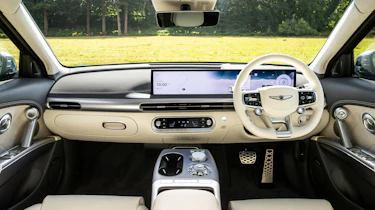
A huge, single-piece 21-inch OLED infotainment display is the centrepiece of the cabin, and where you’ll find most of the vital controls. The menu system is full of nifty features that have clearly been given plenty of thought, but there are perhaps a little too many of them – finding precisely what you’re looking for can be a time-consuming process. Thankfully, the GV60 does come with dedicated physical controls for climate just beneath this display, which takes a good degree of frustration out of the equation.
One gripe we do have is that while build quality is great, software quality control might not be quite as strong. With a late-night, 130-mile journey ahead of me, the central infotainment display crashed completely, and no amount of locking the car, leaving it and returning fixed the issue – the reset procedure listed in the manual didn’t even rectify it. Upon further research this is not an issue limited to this car, and while it might be rare, it’s a good reminder that software isn’t bulletproof.
Price, specs and rivals
The entry-level Genesis GV60 Pure is priced from £54,115, rising to £59,325 for the Sport model and £68,525 for the Performance. This pricing puts it right in-line with a few electric rivals that are different in shape, but similar in versatility. It’s well equipped from standard, with a high-resolution display and both physical and touch controls, giving you plenty of ways to interact with the systems. For a glass sunroof (£1180), adaptive headlights or a high-end B&O stereo (£1340) you will need to tick a few boxes, though – our test car was optioned to £73,135.
The Tesla Model Y is one of the biggest rivals in this segment and starts from a much lower £41,990. As a result, the range-topping Performance model is much cheaper than the fastest GV60 at £61,990, and it also happens to be quicker on-paper. On the road though, it's less resolved than the Genesis and has a much less premium cabin.
If ultimate refinement and luxury is what you're looking for, the BMW iX is the model that comes closest to the Genesis GV60. The BMW is a bigger car and starts from a higher £75,405 price point, but if you can stretch the budget that far you'll have yourself one of best EVs in its class. You will lose some performance in the process though, as while the entry-level iX comes with a reasonable 374-mile WLTP range, its output does stand at a lower 402bhp than the GV60 Performance.
Genesis GV60 Performance specs
| Engine | Dual-motor, all-wheel drive |
| Power | 483bhp |
| Torque | 513lb ft |
| Weight | 2145kg |
| Power-to-weight | 225bhp/ton |
| 0-62mph | 4sec |
| Battery | 84kWh |
| Range | 311 miles WLTP |
| Top speed | 146mph |
| Basic price | £66,900 |