One-off Eagle GTR is the ultimate lightweight Jaguar E-Type
Bespoke build for an Eagle client weighs only 975kg with fluids

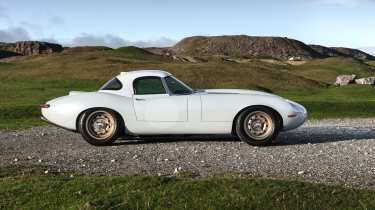
Even an Austin A30 can look exciting tearing around Goodwood, but you’d need a stone cold heart to watch some historic racing and not come away wanting a Lightweight Jaguar E-Type. Given the factory built only a dozen in period, it’s a dream not many people get to realise, and while Eagle’s latest creation, the GTR, might not be any more accessible for most (in fact less so, as it’s a one-off build for a client), there’s also an argument to be made that it might be the most desirable Lightweight E of all.
Eagle, as you’ll be well aware by now, already have a long list of deeply covetable E-Types in their back catalogue, having restored and modified the British icons for decades and having been featured in TV, film, and even video games.
> Eagle Jaguar E-type Lightweight review
The GTR is something truly special though. For something paying homage to the Lightweight E-Type, the headline figure is clearly its weight: 930kg dry, or 975kg with fluids – nearly a third lighter than a standard E-Type roadster, or to put it another way, somewhere between a Lotus Elise and an Alpine A110.
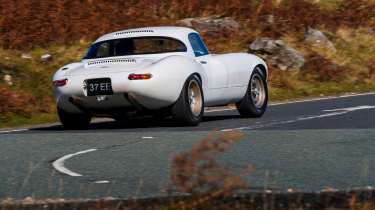
Name a lightweight metal and it’s probably been used in the GTR’s construction: the car is a collection of aluminium, magnesium, titanium, and Inconel in the shape of an E-Type, with some carbon and lithium thrown in for good measure. Actually it’s not exactly E-Type-shaped either, since the windscreen is more raked than usual, the roofline lower, and the panels sculpted to accommodate chunky wheels and tyres. The rear screen is flush bonded, the weather seals hidden, and even the badges are painted on before the car is lacquered.
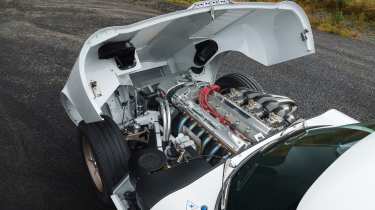
Then there’s the engine: a 4.7-litre all-alloy inline six with titanium conrods and triple Weber carbs, with an Inconel and titanium exhaust system bolted to the exhaust ports, and a gearbox with a magnesium casing cosying up to the lightweight flywheel. Eagle doesn’t quote an exact output but says the GTR has a power to weight ratio of more than 430bhp/ton, so with that 975kg kerb weight the 4.7 is developing somewhere north of 420bhp.
Eagle has revised the suspension geometry and virtually everything is unique to the car, from the titanium hubs to the adjustable Öhlins dampers and bespoke-rated springs. There’s a set of carbon-ceramic brakes with AP calipers, though there’s not a great deal of weight here to stop.
The cabin meanwhile is stripped back, walking a fine line between racer and road car, with wall-to-wall black Alcantara, lightweight low-back seats with four-point harnesses, and brilliantly, a floating binnacle whose switches are, in the words of Eagle, ‘hewn from platinum with mother of pearl inlays’. Modern conveniences include a magnetic mobile phone dock, heated glass, air con, and of course the cabin has also been insulated from sound and heat, so the E-Type’s grand touring credentials remain intact.
The GTR’s commissioning client went to Eagle with the brief of designing a car that was the antithesis to today’s ‘big and heavy’ performance cars. Mission accomplished, we reckon.