Rallying a V12 Jaguar and being rescued by Prince William: Ed Abbott’s story
Currently causing a stir by competing in historic rallying in a V12 XJ–S, Abbott worked under Norman Dewis at Jaguar before successfully tackling saloon car racing with Ford, Saab and DJ Mike Smith

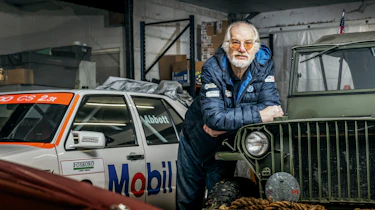
I was born with a spanner in my hand. All I ever wanted to do was fix things, even as a toddler,’ says Ed Abbott. ‘Growing up, it was my brother Lionel, myself and my mother. I went to a piddling little primary school in Harwich. When I was eight the headmistress said to my mother: “Edwin needs a better education than we can give him.” I think she recognised I was slightly dyslexic and dyspraxic, that there’s a good brain working there but held back because it couldn’t understand certain things.’ With a little help Ed passed his 11+ exam and went to a boarding school, but he hated the academic work. ‘All I wanted to do was fix things and that was never on the curriculum.
‘None of my family were petrolheads, so nobody bought magazines, nobody said, “Let’s go to Snetterton,” which was just up the road. My early memories are of playing with tractors. My stepfather bought a motorcycle outfit with a scooter engine and we borrowed that to tow the Triang police [pedal] car that Lionel got for Christmas around the fields, with the pedals going 10,000rpm and Lionel hanging on to the steering wheel. Then I had a field motorbike and a totally rotten Morris Cowley Isis van.
> Engineer Chris Porritt on working with Elon Musk, Apple cars, Aston Martin and a life in cars
‘I clearly wasn’t A-level material so somebody suggested I get a job in the car industry.’ Ed sent off letters and got invited to interviews by Vauxhall and Jaguar. A while later he was in possession of two offers. Vauxhall were paying more but Jaguar had the name, so he decided to go there. ‘My first day, I got to the training school at the Radford plant and thought, f*** me, this is all right. We had a year there learning to weld, turn, machine, arc weld, gas weld… You know, blowing each other up and stuff. At the end of the year they started us around the factory on three-month placements. We all wanted to go to Browns Lane where the cars were built, but that had to wait.’
The Radford plant produced engines and axles and was mostly dark, grim machine shops, but Ed got a placement in the Internal Transport department where they looked after the forklifts. ‘I could do all the jobs, so I was changing clutches and electric cells while they sat on their arses, taking the piss out of my long hair. Eventually, I said I want to go and test these. They said, no way; you need an internal driving permit. Eventually they agreed I could have one but said, “Whatever you do, don’t pick anything up because it will create a strike.”’
Ed’s next placement was Vehicle Safety, where he got to drive an XJ‑S (codename XJ27)… sort of. To test the 5mph impact bumpers they’d built an XJ‑S with a speedo on the roof and a steering wheel on the bootlid, so they could push the car into a wall on the right line at the right speed. ‘My claim to fame was I drove one the first XJ27s down the main Radford drive…
‘I’d got to Coventry in 1970 with no transport, so I bought a Bantam in Colchester and rode it back to Coventry, which took six hours. That blew up going down the M1 a few months later. Then I got another motorbike for £2.50. That blew up on the Coventry bypass because I was just ragging the arse off all these things. Then I inherited an A30 that had been standing so long its cross-plies were bursting faster than I could change them.’ He replaced the feeble 803cc engine with a 1098 and fitted an A40 back axle, then bought a set of Weller wheels and shod them with 185 x 13 Goodyear G800s and made some aluminium arches in the training centre to cover them. It survived about as long as the motorbikes.
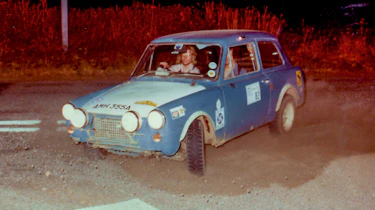
‘I braked too late for a corner, went up the bank and ended up going down the road on the roof, covered in two years of fag ash. My biggest concern was my socket set had fallen open and about 2000 sockets were rolling down the road. It was curtains for the A30. What I needed was an A40 because I already had a lot of A40 gear on the A30. I eventually found one for £14. It was rotten as a pear but I welded it all back up and turned it into a rally car, with a 1275 engine and Midget front discs.
‘I’d joined the Jaguar Apprentices Motor Club and realised there was a thing called motorsport. My introduction was a 12-car night rally. Unfortunately, after half an hour I had no brakes at all. We went straight on at a bend near Burton Dassett and got utterly stuck, had to sleep in the car. At about five in the morning a milk lorry towed us out.’
Worse was to come at work. Apprentices were employed to ferry sales cars from the back of the factory to the front, and bobble-hatted Abbott was reported for speeding past the trim shop. He lost his driving permit for three months. ‘I was crestfallen. After two months I built up enough confidence to go to the head of training and said, “You don’t realise how much I appreciate driving; driving is my life and I’m very sorry and I’ll never do it again.” To my amazement, after a couple of days they gave my permit back to me. I think saying driving was my life struck a cord because six months later I went to work in Experimental Road Test, for Norman Dewis.
‘His office was a poxy 12-foot-square shell inside the workshop. In there were Peter Taylor and Richard Cresswell. The revelation was being with them as they drove V12 Series 1 XJ saloons from Browns Lane to MIRA, and thinking, even by my standards, this is mental and we’re gonna die. They were very talented drivers, successful racers, but Peter was supremely smooth and I’ve always tried to emulate that.
‘In mid-’75 we did all the early development on fuel injection, which was a huge deal because suddenly there’s a thing called fuel consumption to worry about. We needed a 50,000-mile economy certification programme and I showed a bit of initiative, I suppose, creating a system to organise cars, shifts and drivers – three shifts a day, 24/7.’ The four of them were also running-in press cars and developing the XJ27, which involved uncomfortable miles at MIRA on the pavé, non-asbestos brake pad development and high-speed testing in Belgium, which resulted in the chin spoiler.
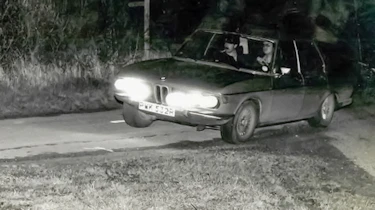
For a number of years Ed’s daily was a bright red BMW 3.0 Si that had originally been bought as a competitor car and totally stripped. ‘I bought it for 600 quid and got it up and running. It went sideways everywhere. I sold it in 1982 to help fund the racing.’
That’s one-make Fiesta XR2 racing. Brother Lionel was a salesman at the Ford main dealer in Coventry. The XR2 was being launched at the end of ’81 and he fancied racing one. ‘He said: “Why don’t we do a prospectus saying you’re a clever Jaguar engineer and I’m a racing driver, and get Whitley Garage to give us a brand new car?” So we gave them this drivel that we’d win races and they’d sell more cars, and, amazingly, they gave us a brand new XR2.
‘Ford gave you a kit of stuff: cage, seat, springs. We went testing, because obviously I was obsessed with testing. At the fourth race at Oulton we were seventh. Clearly the suspension that Ford gave us was totally wrong, so I was getting my head around that. Also, in one-make racing you just don’t need power loss. So after asking, I put automatic transmission fluid in the gearbox, oil instead of grease in the rear wheel bearings and looked into driveshaft angles too. Lionel emerged as a very talented, intuitive driver and we won our first race at the Nürburgring, about the fifth race, which was pretty amazing.’
They won the ’82 championship and off the back of that got the testing contract from Ford to come up with an equivalence formula to allow the new CVH-engined models to race with the Kent-engined XR2s. Also, there was a new driver who needed mentoring: Radio 1 DJ Mike Smith. Ed got that role too, running him with Lionel in two-driver races. ‘As Smithy’s fortunes went up, so did the budgets. I’m doing all this while being employed at Jaguar, of course. I’d go out on road tests and go to Snetterton for the day.
‘By mid-’84 I had an alternative career beckoning. I left vehicle proving in July ’85, when Norman retired, and set up Abbott Racing. We were setting up Fiestas for people, then the first Escort RS Turbo came out. By then I’d got my head around front-wheel drive. We won the Willhire 24 Hour race in ’86, which was a major, major break. In ’87 we were racing a Sierra Cosworth with Mike Smith and started working with Saab GB too. They’d decided they should have a one-make championship for eight-valve Turbo two-doors. We got the contract to build and race them.
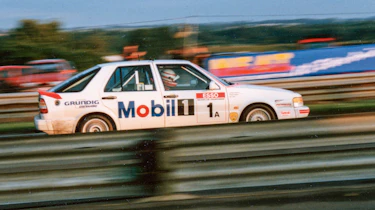
‘We raced our own Cosworth again in ’88 and won the Uniroyal Production Saloon Championship, and won the 24 Hours again. By then, Saab had had enough of the one-make series and wanted to get into saloon car racing with the 9000. Having won every race in ’88, to try and do the same in ’89 with the 9000 and not quite the power but with front-wheel drive was a big challenge. The best we could do was top five, which did Lionel’s head in a bit. I was happy that we were punching well above our weight but it took us until 1992 to win the championship.
‘I was lucky to have a very talented fabricator, Neil Peck, because, as we all know, there’s lots of grey areas in motor racing. If you want to make production cars handle, invariably you’ve got to move suspension mountings, 10mm here, 20mm there. It’s far more common than you think. Another thing is, I realised my brain thinks in 3D – a benefit of being slightly dyslexic and dyspraxic. We had CAD here years before anybody else: Cardboard Aided Design. I still make stuff now with cardboard and masking tape: bend it, shape it, and there it is.’
When Saab funds ran out in 1998, the Abbotts took time out. ‘Between ’82 and ’98 we’d done 340 races. We were burnt out.’ Ed developed a deep interest in WW2, rebuilding a Willys Jeep, travelling to the Normandy beaches and delivering lectures, so he wasn’t much interested in a couple of old Jags – a Mark 2 3.4 and a Mark V – someone gave him. However, after a Jaguar Owners Club trip to France, his interest in the marque was rekindled.
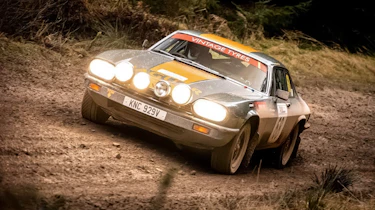
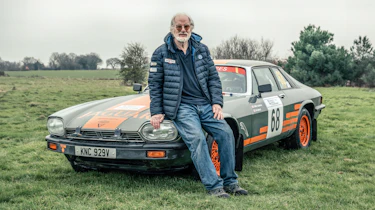
‘Jaguar came third on the Monte Carlo Rally in ’52 with a Mark V, so I decided to rally it.’ A small mistake on a Welsh event in 2012 saw it upside down in a river. ‘We both should have drowned but we were rescued by Prince William and his helicopter because he was based at RAF Valley on Anglesey at the time. So I exist by royal appointment. And that was that… until four years later when I saw an advert for a rare XJ‑S. For one year only they made a V12 with a 10:1 compression ratio and the shorter diff. It was bonkers quick, fastest auto in the world in 1979.’
He bought it and decided to rally it. ‘People said, “You can’t rally an XJ‑S.” Why not? If you get the weight down, get rid of all the rubber, mount the steering rack properly and do lots of other things, they can be a very rewarding car to drive.’ Encouraged by its performance on regularity rallies, he decided to take things to the next level.
‘In 2023 they had 160 cars out on the Roger Albert Clark Rally, and the footage was brilliant, the sounds were amazing: Seb Perez in a Stratos, Chris Ingram in a TR7 V8… I thought: I need to up my game, do some stage rallying, because what they want is a V12 making a nice noise. Jaguar homologated the XJ‑S for Group A in 1977 so it’s all been done, but nobody’s ever rallied one.’
Last year he took part in the inaugural Rally Anglo Caledonian. ‘It was pretty tough going. A hundred cars started and we finished 35th, which I’m quite pleased with. I could have gone faster but I just wanted to finish. I realise I now need a lower axle ratio because gravel tyres absorb so much power; the only way you can really do stage is to have the rear wheels constantly spinning because you can just move the car about so much easier.’ Steering from the back, then, just like the first time, only a fair bit quicker. And hopefully without the impact…
This story was first featured in evo issue 332.