Lamborghini Countach 5000 QV review – the ultimate version of Lambo’s defining supercar
All Countach's are special, but the 5000 QV of the 1980s is the most dramatic of all – and the most intense to drive
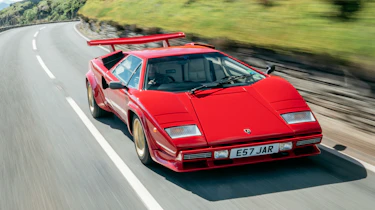
Mention the word ‘supercar’ to anyone with even a vague interest in the subject, and the image that will flicker into focus like a Derren Brown mind-plant will almost certainly be that of the Lamborghini Countach. As it was at its launch in 1974, it remains the shape that defines the genre, though by the time the fussier and over-embellished Anniversary edition appeared in 1990, Lamborghini had perhaps forgotten how outrageously perfect the unadorned original design was.
Indeed, it was conceived as a styling exercise, then adapted for use on the public highway – but its genesis was hijacked (thankfully) by people with an obsession for high performance and, for better or worse, motorsport. Its tubular steel chassis was delicate but light and strong, as was the alloy body. The questionable space-efficiency of the Miura’s transverse motor was ditched in favour of a longitudinal orientation for the V12 and from each corner hung a pair of wishbones. By the time it had morphed into the best version of all, the Quattrovalvole (which we’re focusing on here), it had grown taller but become more habitable too, allowing grown adults to sit upright in the cabin.
The quattrovalvole engine generated 450bhp, making Ferrari’s rival Testarossa feel slow by comparison. To drive, the QV lives up to its wild looks and reputation – it’s an intense, physical and uncompromising supercar that challenges you in every aspect, being as memorable as you’d hope – for (mostly) good reasons.
Engine and performance
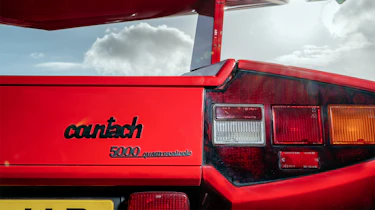
- Engine uprated to 5.2-litres and 450bhp
- Heavy clutch and gearshift require finesse
- Fabulous noise from the downdraft Webers
More reviews
Climb into the Countach and the rake of the windscreen and depth of the dashboard are still a shock. The clutch, steering and gearshift are all a bit of a workout, so there’s a sense the Lambo gets in the way of itself a bit. Familiarity leads to a degree of finesse, so you do find yourself driving with more confidence and fluidity with time, but it always demands attention and effort.
The engine is a real force of nature. With four valves per cylinder (hence the quattrovalvole tag) and displacement up from 4.8 litres in the original LP400 to 5.2, it is topped by a bank of six downdraft Weber carburettors, which required the engine deck to be raised to accommodate the stacks. It roils and rumbles behind the bulkhead, making all kinds of wonderful mechanical and respiratory noises as it works through its rev-range. It’s a full orchestra back there, bass and cymbals and strings and all sorts.
Load intensifies the symphony, so if you have the space and are confident no one is around, slotting a high gear from low rpm and keeping it pinned for as long as you dare treats you to the full aria. Lambo did build fuel-injected QVs for the US market, but they were down on power compared with cars like this Euro-spec model. For full fire-and-brimstone, a fully lit downdraft QV is hard to beat.
Ride and handling
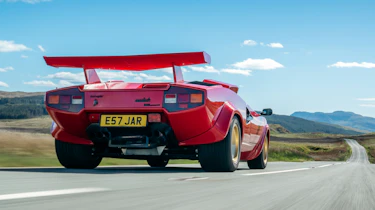
- Heavy steering is relatively precise for a 1980s supercar
- Rose-jointed suspension gives it a raw edge
- Braking is a weak point
The QV isn’t a car you dance through a corner. Rather you plan ahead, get it slowed and turned in, then hold fast against the building steering weight and scribe a smooth line through the curve. You can hustle it, and there’s decent grip and feel from both ends of the car, but the limit isn’t a place you freely work up to as you might in a modern supercar. Then again, you’re working pretty hard and going pretty rapidly to run at seven- or eight-tenths on a challenging road. It’s more than enough to give you an adrenaline rush and sweaty palms.
The brakes are a limitation. The cotton-reel wheels look fabulous, but there’s no room for big rotors, and cooling must surely be compromised. The Countach’s middle pedal has meaty resistance and delivers decent stopping power in general use, but if you find the right road to mount a sustained charge, the pedal gets a bit squidgy and the brakes begin to grumble. Better to ease off a fraction and find a less frenetic flow. Then make a load of noise when someone’s watching. It’s the Lambo way.
Price
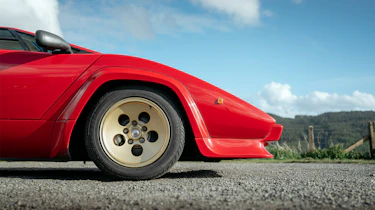
Around fifteen years ago you could pick up a tidy Countach QV for as little as £70k, but those days are long gone. Now you’ll pay at least £500k, if not a whole lot more for exceptional examples maintained to a high standard with good provenance. That’s around four times more than its chief rival in period, the Ferrari Testarossa, owing to the Lambo’s unparalleled icon status.
Specs
| Engine | V12, 5167cc |
| Power | 450bhp @ 7000rpm |
| Torque | 369lb ft @ 5200rpm |
| Weight | 1490kg |
| Power-to-weight | 310bhp/ton |
| Tyres as tested | Pirelli Cinturato P7 |
| 0-60mph | 4.2sec |
| Top speed | 185mph |
| Basic price new | £82,000 (1985) |
| In today's money | £261,000 |