Lamborghini Revuelto SV review – the world's best supercar made even better?
The 'regular' Revuelto is already a world-beater. Now it gets the SV treatment

It’s a dangerous game, fiddling with a near-perfect formula. The Lamborghini Revuelto is the definitive modern supercar, a lesson in how modern technology and electrification can enhance, rather than detract from, the primal thrill of driving a V12 Lambo. So deft and agile by virtue of its hybrid torque vectoring while delivering the drama and adrenaline overload you’d expect, there’s pretty much nothing you’d change about it. A unanimous victory at evo Car of the Year 2025 attests to that.
It’s a worry, then, that for the new SV version, Lamborghini has turned the Revuelto upside down and changed pretty much everything that pertains to the driving experience. Every element, from the suspension and geometry to the chassis electronics, tyres, aerodynamics and powertrain, has been reworked in this latest in the line of V12 Super Veloces, with the goal of sharpening up the Revuelto for track work. Has the essential magic of Lambo’s flagship been retained in that pursuit, or even enhanced? Driving the SV at Vallelunga Circuit near Rome should provide some answers.

It’s worth saying from the outset that the Revuelto has never felt like a natural track car. It’s more agile, capable and entertaining than a V12 Lambo has any right to be on a circuit, but it’s still fundamentally a big and relatively heavy supercar with a chunky V12 behind the driver. The clever electronics and torque vectoring mask this beautifully, but there are times when the physics can’t be denied. This probably explains why the changes for the SV are so comprehensive. ‘It’s still a street car,’ says Lamborghini chief technical officer Fermín Soneira, ‘but the main purpose is to be fastest on track, so we’ve changed everything that is performance-related.’
More reviews
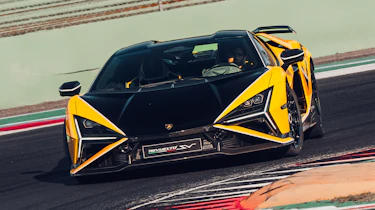
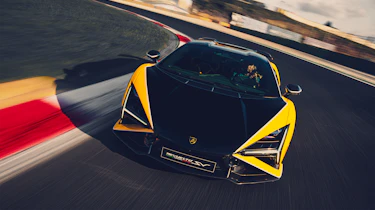
In the pits at Vallelunga, the SV looks… not much more impactful than a normal Revuelto, in truth, aside from its two-tone paint job. The standard car is so dramatic and aggressive to begin with that the SV’s aero mods and rear wing (big but not surfboard-sized) don’t stand out as much as they do on previous SVs. A new front bumper with a deeper splitter shifts the aero balance further forwards for better front grip at speed, as well as offering better cooling, while the fixed rear wing and new underbody vortex generators contribute to an 80 per cent overall gain in downforce.
Swing the door upwards and you get more hints of the SV’s track-focused brief, with carbonfibre door panels, and – in the car we’re driving – optional carbon bucket seats with fixed backrests and strategically placed padding. They’re snug-fitting and miles more supportive than the electrically adjustable ‘comfort’ seats that come as standard in the Revuelto. The rest of the cabin is largely unchanged – it’s not stripped out and caged up like a true road-racer – but with the door open you’ll notice the exposed back surface of the front tyre, with a near-slick outer shoulder that looks tarmac-rally spec. New Bridgestone Potenza Race R tyres have been developed specifically for the SV, coming in place of Potenza Sports (although you can spec these as a no-cost option).
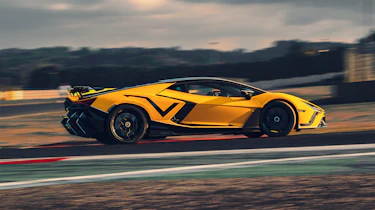
Working with the stickier rubber is new manually adjustable KW coilover suspension derived from Lamborghini’s GT3 racing programme, which replaces the Revuelto’s electronically controlled damper units. Each damper has four adjustment knobs – slow and fast compression, plus slow and fast rebound – with 14 clicks each, making for endless setup combinations to fine-tune the car for road or track. Lamborghini offers presets for the road, smooth or bumpy circuits, and wet driving as baseline starting points.
If that sounds extreme, the company promises that the Revuelto’s on-road poise and comfort haven’t been sacrificed with the SV – in fact, Soneira reckons it’s more compliant. That’s not only due to the bandwidth and ability of the new dampers, but a reworking of the suspension design at the rear, with the dampers now being mounted closer to the wheels. This new mounting position increases the effectiveness of the rear springs, and thus allows the use of softer spring rates than the standard car while maintaining the required level of support.
The rear anti-roll bar uses the same new mounting point as the dampers, so this too is now thinner and softer. The new design also brings an unsprung weight saving of 2.3kg and improved camber stiffness.
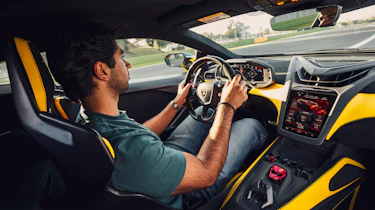
Whether the SV is just as sweet as a road car is a question for another day, but moving off in the pits its extra edge is noticeable. There’s immediately a little more heft and connection to the steering, and with the dampers in their predefined track setting it follows the contours of the surface more closely. I’m tailing one of Lambo’s drivers in a pace-setter SV, and as soon as he clears the pit exit line he’s on it, while I fumble for the switch to jump out of electric mode and wake the V12. It whaps into life instantaneously and breaks the silence with a complex mechanical buzz as we release onto the track. It’s like I’m cosplaying as an LMDh driver.
Feeding into Vallelunga’s turn one, a very quick fifth-gear right-hander, familiar Revuelto sensations come flooding back. There’s such clarity and responsiveness to how the nose follows your inputs, cutting towards the apex with a gentle nudge of the wheel without being nervous. It feels like there’s no weight over the front end at all. Feeding in the power onto the following straight, the blend of electric assist and ever-building V12 thrust is immensely strong. As with the standard Revuelto, the three electric motors – two driving the front, the other integrated into the transmission – act in unison with the engine to enhance its response and flexibility and in no way detract from its character.
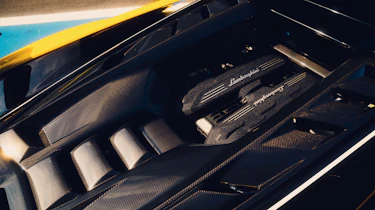
The V12 is unchanged in the SV – still 6.5 litres with 814bhp and a 9500rpm rev limit – but more has been squeezed from the electrical element, thanks to a larger, upgraded 7.3kWh battery pack. This raises peak power from 1001bhp to 1050, with torque jumping from 1033lb ft to 1051. That performance should be available for longer periods too, with the new battery offering four times more consistent energy output than before, according to Lamborghini.
With that said, the larger battery is responsible for the fact that the SV isn’t actually any lighter than the base car at the same chunky 1772kg dry, despite weight savings from the carbon seats and door panels, plus lighter 20- and 21-inch centre-lock wheels. Still, the power boost and extra traction from the new Bridgestones trim a little from the SV’s acceleration times, with 0-62mph coming up in 2.4sec rather than 2.5, and the run to 124mph being three tenths faster at 6.7sec. The top speed is a little lower, quoted at 216mph rather than 217mph+, no doubt owing to the drag from the SV’s aero pack.
I’d be lying if I said I could feel the extra punch without a back-to-back test, but the SV is rabidly fast when wound out to the red line – on Vallelunga’s back straight it hits nearly 280kph (174mph) while leaving plenty of margin to the pace car ahead. The eight-speed dual-clutch gearbox is a perfect match for the engine – fast and so much more refined than an Aventador’s automated single-clutch transmission, but with a jolt to add some drama to each shift. As for the sound, it’s quite muted from inside a helmet, but Lambo’s engineers later confirm the exhaust is unchanged and hasn’t been neutered to comply with noise regulations, so there should be no reduction in volume.
As the pace starts to pick up, so too does your reliance on the SV’s chassis systems – such as the torque vectoring from the front electric motors, variable four-wheel drive and four-wheel steering. The standard Revuelto uses two dynamic sensors to feed data to these systems, but new for the SV is a single ‘6D’ sensor located at the car’s centre of gravity to give a more accurate picture of speed, slip angles and grip levels. This in turn allows the chassis systems to be more in tune with what the driver demands. ‘Anticipation and prediction are key for these systems,’ says Soneira. ‘If you have a sensor at the centre of gravity, the car is much better at predicting what is going to happen next than if you have two separate sensors.’
Initially, however, some of the SV’s handling traits don’t feel entirely natural. Into one of Vallelunga’s bumpiest braking zones, the rear axle takes on a slight bit of yaw even before turning in, and there’s occasionally a sense that the rear-wheel steering is generating more rotation than is natural, tightening your line but unsettling your internal gyro. It picks up some understeer in longer corners under part throttle, too. Compared with the standard car, the SV’s suspension setup is similar in stiffness at the rear but firmer at the front, which makes the front end sharper and more precise but perhaps moves more grip towards the rear in steady-state cornering.
The solution? Push past these slight uncertainties, trust the SV and drive it harder. Then you realise that the electronics are there to help, and to give you better access to what is an all-consuming, extremely effective and surprisingly playful track car, one that really comes to life with more commitment.
The brakes, which feel a touch sharp at lower speeds, have incredible feel and stopping power when leaning on them hard. They’re new for the SV and use Brembo’s CCM‑R Plus carbon disc tech, and the precision with which you can step into the pedal and modulate them into an apex is among the best I’ve felt in a road car. Their power is such that you edge your braking point closer to the corner for lap after lap, marvelling at how the sticky front Bridgestones dig into the tarmac to find extra braking capacity. The gains haven’t only come from the upgraded braking hardware, but also a new Integrated Brake Control system that draws data from the 6D sensor to manage slip and prevent locking.
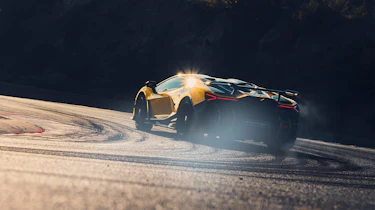
The deeper and harder you brake into corners, the more you appreciate the stiffer front suspension and the stability this provides. You’re still very aware of the big V12 behind you, but you can use it to your advantage, turning in with the weight pinned on the nose and the rear gently swinging around to aim you at the apex. Then your attention turns to the throttle, and using the four-wheel-drive system to generate maximum drive onto the next straight. Traction is tremendous, but overcoming it by holding the car in a subtle four-wheel drift is the fastest and most satisfying way. Launching from corners with the wheels gently overspeeding, V12 wailing as you pull for the next gear, is unbelievably exciting.
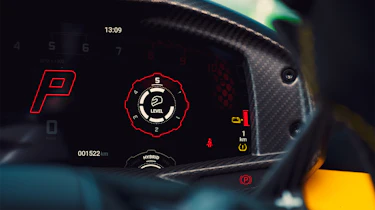
A standard Revuelto can offer similarly thrilling moments, but there’s no doubt that the SV feels much more at home on track, the combination of its flatter, more stable platform and extra stability and grip allowing you to wring its neck in places where you’d be more tentative in the base car. Aiding this is a new variable traction control system, accessed via a ‘Pilota’ mode that replaces the switch for the active aero settings on the standard Revuelto steering wheel. There are settings from one through five, with the higher numbers allowing the most slip. Initially I start in mode two but such is the SV’s corner exit traction that the safety net feels unnecessary. Within a few laps I’ve cycled up to five, which lets you play freely over the limit but relaxes the power smoothly to calm big slides.
Even with the variable TC and the SV’s more dialled-in feel, the intimidation factor of a big Lambo hasn’t gone away entirely. Start throwing the weight around or stabbing at the throttle and it will still spit you out – and you need fast hands to gather things up (the quick and relatively light steering is your friend here). At one point, going through the first corner at around 200kph, the pace car ahead doesn’t accelerate through the exit, forcing me to back out of the throttle at the apex and tipping all of the mass behind me slightly unnervingly sideways. Something a GT3 RS would shrug off without a sweat.
But then an RS doesn’t have the same bombastic thrill from its powertrain, or the same addictive blend of brutality and precision to the way it gets around the lap. The SV is endlessly entertaining and a big step up from the standard car on track – not just faster but more consistent, controlled and secure, making those thrills even easier to access. The tantalising question is whether the SV’s step up on track translates to the road, too. If it does, the best will have just got better.