Land Rover Defender D7X-R makes its Dakar Rally debut
The Defender D7X-R is tackling the world’s most gruelling off-road race, and unlike many competition cars, this one has strong ties to a car we know well
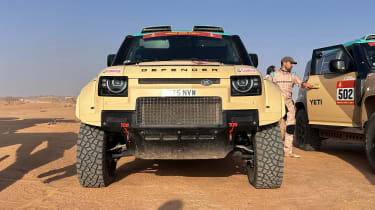
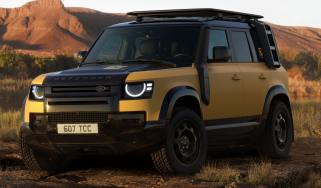
The Land Rover Defender has officially made its Dakar debut, and it's made a strong first impression with a handful of 1-2-3 finishes. Named the Defender Dakar D7X-R, this is a car that has been developed to slot into the ‘stock’ category as a production-based model with close ties to the road-going Octa we’re so fond of.
The starting point for this car is a strong one. Based on the Octa, Land Rover’s most capable road-going model yet, it shares the same underlying D7X architecture (hence the name) and 110 bodywork as the road car. To comply with the ‘stock’ regulations, each entrant must utilise an untouched production bodyshell, and so it comes straight from the ordinary Defender production line in Slovakia.
> Land Rover Defender Octa review – so much more than a ‘Defender SV’
Shared components with the road car don’t stop there, as the D7X-R also comes with its BMW-derived 4.4-litre twin-turbocharged V8 and eight-speed automatic transmission. Both the engine and transmission are production spec, but the engine produces significantly less than the 626bhp of the road car (in the region of 390bhp) due to the use of an intake restrictor to make it compliant with the regulations – torque remains the same at 553lb ft, giving it the pulling power it needs. The transmission (which also happens to be the standard base unit) also has a lower final drive to make it better suited to the lower speeds of a desert rally.
This car also features a side-exit exhaust system free of pesky catalytic converters, and as we experienced for ourselves on the start line, that makes for quite the sound. This change isn't just for this purpose though, as it also helps minimise the risk of damage to a standard rear-exit exhaust that can result in an increase in back pressure and a subsequent reduction in engine output.
Road cars are tested to their limit, but flat-out racing in the desert for thousands of miles takes things to another level. To help the Defender cope, the triple-radiator cooling setup of the road car has been swapped for an optimised, single unit with air coming from an enlarged front intake, new bonnet vents and through a particulate filter for sand. There are also four new fans to boost airflow during low-speed sections.
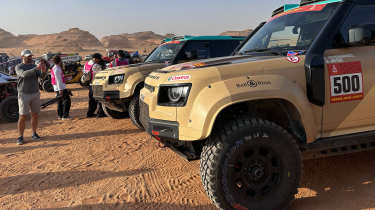
All of this is pulled together through the use of a motorsport-spec electronics control unit, allowing for finer management of parameters for the engine and transmission. One benefit of this is that it’s allowed Land Rover to incorporate what it’s calling ‘Flight mode’. This isn’t to ensure the driver doesn’t get any distracting calls, but instead optimises power delivery to the wheels while the car is airborne to make for smoother landings, thus reducing any potential shock to the powertrain that could result in mechanical failure.
The bodyshell and powertrain may be standard, but various measures have been made to the Defender’s bodywork to improve approach and departure angles, increase ride height and accommodate the weight of the huge 550-litre fuel tank. Track has increased by 60mm, which is covered by wider arches, and the sills have been modified to match extended underbody protection too. Behind its new wheels (fitted with 35-inch tyres) is an uprated rally-spec brake system, with vented discs and six- and four-piston calipers front and rear respectively to improve longevity.
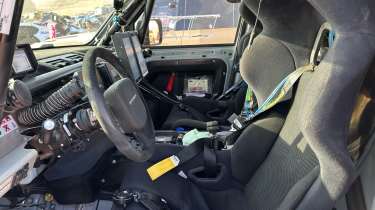
The basic dash and door card design is just about all that’s familiar inside, with the cabin stripped to allow for the fitment of an FIA-spec roll-cage, a navigation system and a head-up display to give the driver speed and heading information at a glance. Six-point harnesses are fitted to bespoke tailored seats for each driver, and where you’d usually find rear seats there are now three spare wheels, a tool kit, compressed air and essential spare parts – there are even integrated hydraulic jacks to make wheel changes less time-consuming.
Over the years, events such as the Camel Trophy and G4 Challenge are where Land Rovers were pushed to their limits. In 1971 and 1972, modified Range Rovers crossed the Darién Gap, a 250-mile stretch of what was considered impassable swampland between Panama and Colombia. The Dakar presents an altogether different kind of challenge for the latest Defender, of course, being an actual race/competition against other makes and models. Mark Cameron, Land Rover’s managing director, Defender, said: 'Dakar pushes everything to the limit and competing in a rally‑raid of this scale will authentically showcase Defender’s capability and robustness in the most extreme and harshest conditions on the planet.'
14-time Dakar winner Stéphane Peterhansel, Lithuanian rally driver Rokas Baciuška and Dakar stage winner Sara Price have embarked on this mammoth two-week, 3100-mile race behind the wheel of this new contender, and first signs are certainly good...