Mazda CX-5 review – an involving and competent SUV - Engine and gearbox
As well as being one of the best-looking SUVs thanks to a sharp line and concept-car nose, it’s also one of the best to drive
Engine and gearbox
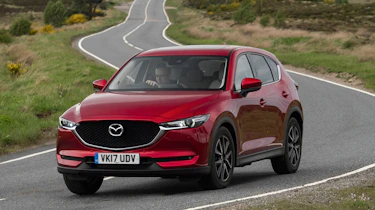
The 2.2-litre diesel engine is the only version we’ve currently tested. It’s much like the engine in the previous CX-5, but subtle changes to the internals aim to make it quieter and more refined.
Some of these gains have been made with improved sound insulation, but there’s also a device that Mazda calls the Natural Sound Smoother, which consists of a special damper that sits within the engine’s connecting rod pin.
It’s only a small change, but the results are remarkably effective. At idle, the more powerful iteration of the 2.2-litre unit emits nothing more than a muted clatter, while under load the soundtrack is more petrol than diesel. It’s not exactly exciting, but the distant growl does make you second-guess the type of fuel that’s being used. On the move, the four-cylinder powerplant also responds more crisply to the throttle than most diesels, plus it revs with impressive keenness.
Accessing the engine’s potential is made easier by the standard six-speed manual ’box, which benefits from slick and precise shift action – there’s the spirit, if not quite the accuracy, of the MX-5 roadster in this transmission. A six-speed automatic is available with the diesel engine, too.
Our test car was also fitted with the brand’s latest four-wheel-drive system, which is standard fit on the 173bhp diesel and optional on the lower-powered 148bhp version – the petrol is front-wheel drive only. Called i-ACTIV AWD, the four-wheel-drive system uses 27 sensors to monitor everything from throttle application, yaw and steering inputs to decide how best to distribute the engine’s torque. Even switching on the windscreen wipers will subtly adjust the set-up as it primes itself for wet and slippery conditions. It’s all very clever.

But, perhaps the most intriguing aspect of the Mazda’s mechanical make-up is its G-Vectoring system. It’s a system we’ve already seen on the 6 saloon and 3 hatchback, but this is the first time it has been applied to an SUV.
Essentially it’s torque vectoring, but unlike rival systems it doesn’t use the brakes to sharpen turn-in and dial out understeer. Instead, it subtly reduces engine torque as you turn the wheel, momentarily decelerating the car and shifting the weight forward and over the front tyres for increased grip.