McLaren 675LT Spider review – when a Ferrari 458 Speciale Aperta isn’t enough
It was McLaren’s first open-top LT model, and it was equally as thrilling as its coupe cousin

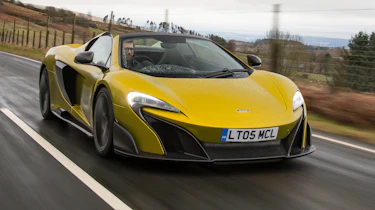
BANG! A single explosive report is swept into the damp Scottish slipstream. Nothing for the deer on the hillsides to worry about, just a gloriously angry gearchange. The upshift doesn’t quell the wheelspin, though. A battle has been raging all day between the rear Pirelli tyres and the sodden tarmac, and this current extended flaring of revs is just the latest skirmish.
During the initial exchanges there was some very clever and subtle appeasement by the ESP, but with that now turned off, my right foot has free reign to incite frictional warfare. The strange thing is that although provoking a 666bhp, turbocharged fight on wet roads ought to be terrifying, in the McLaren 675LT Spider, it’s just fun.
> McLaren McL 820 to replace the 750S next year as Ferrari-baiting supercar
When I looked at the lemon-gold (it’s a colour called Solis) Spider sitting in the rain a decade ago on the car’s media launch, I could only conclude that Chuck Norris had joined the McLaren events team. I mean, launching a convertible in Scotland in April is pretty brave. But once I had had the best part of a day in the car on sopping-wet roads, I was wondering if perhaps a soggy Scotland wasn’t the very best way to showcase the car’s talents.
More reviews
From the first slide that morning, it felt gloriously intuitive. It was a medium-speed left-hander, and the front axle, followed by the rear, broke away so smoothly and predictably that it felt like the most natural thing in the world to hold the slide with steering and throttle.
I happen to love driving in the wet, but you’ve got to have the right car for it and the 675LT is undoubtedly the right car. The first reason for this is the steering. The weighting, rate of response (slightly faster than in the P1) and feedback is some of the best I’ve felt in any car for a long time. It leaves you absolutely in touch with what the front wheels are doing, so that even when the car wants to hunt around over cambers or the grip levels drop, you still feel connected and in control.
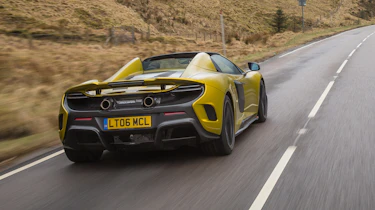
The sensation of the front of a car washing away from you in a corner is generally not a nice one. The ghostly lightening of the wheel and the pause as you unwind lock or adjust the throttle to help the weight of grip return to your hands doesn’t inspire you to push. However, when the nose of the McLaren starts to slide on a slippery surface, you still feel connected to the road. The wheel telegraphs that grip has been reduced, but there is still granular feedback – you can play with it.
You feel absolutely connected to the rear wheels as well. It might be a bit of a pain to get into the LT, as you duck-twist under the door and drop over the hurdle of the high, wide sill, but once you’re in the deep baseball glove of the driver’s seat, you feel very much part of the car. Of course, you can destabilise the rear with the throttle, but you can also throw the car into a corner and get the tail moving with momentum.
My personal favourite is the crest that you commit to in the knowledge that the unweighting will spin up the tyres on a steady-state throttle. In all these scenarios the LT feels totally with you. It feels like any guesswork in how the car moves laterally has been removed, with more solid engine mounts than the 650S’s making as much of an impact on this as the extensive suspension changes.
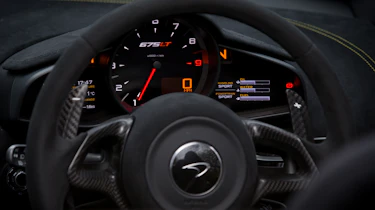
As with the 675LT coupe, the spring rates are firmer (by 27 per cent at the front, 63 per cent at the rear) and there is less sound deadening than the equivalent 650S (the car is 100kg lighter overall at 1328kg), so there is appreciably more NVH.
The LT doesn’t actually feel stripped back when you get in, but on certain surfaces, holding a conversation with a passenger is something that has to be done with a volume somewhere between a shout and the sort of raised tone you might use to confidently call out to someone that has dropped a ticket in the street.
However, if you pop the roof down – possible at speeds up to 25mph – but leave the windows up, the buffeting is minimal. Thanks to the rear buttresses and relatively high shoulder line, you still feel quite snug and cocooned, too.
Admittedly, the weather during the car’s media launch prevented the roof being down for a great deal of the day, but even with it up the rear screen can be dropped independently, allowing you to stay dry and still hear the engine’s snuffles, cracks and rumbles more intimately. In Normal mode the 675LT is relatively tame acoustically, certainly nothing remarkable.
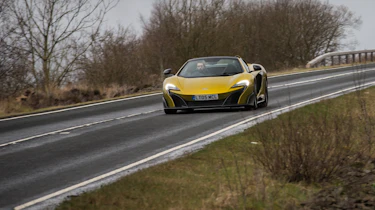
Pop it into Sport mode, however, and the titanium exhaust becomes more than just an objet d’art. Whereas in Normal the shifts of the seven-speed dual-clutch ’box are performed with an accompanying cylinder cut, in Sport the fuelling continues and the ignition is cut just as the change is made. This is what produces the percussive CRACK! like a race car, and although it is engineered, it somehow doesn’t sound artificial.
The engine sounds much better under acceleration, too, and there’s something about the angriness of the overall soundtrack that reminds me of that other iconic turbocharged V8, the F40. At 516lb ft, the 675LT Spider has 90lb ft more torque than an F40, but interestingly the engineers at McLaren ensured that this peak figure didn’t arrive until 5000rpm. The engine is capable of producing it much earlier in the rev range and sustaining it in a plateau, but in order to give a more engaging delivery the engine has a rising torque curve.
I would love to have a go in a 675LT Spider round a track – probably the only place you’d have even a sniff of a chance of noticing the 40kg weight penalty over the coupe – but a drive along the twisting, bumpy, wet tarmac of the A816 between Lochgilphead and Oban sold this car to me. It just encourages the driver all the time.
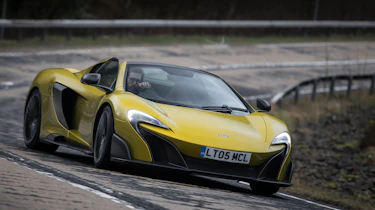
When you’re driving slowly, its feedback fills you with the confidence to push harder, and then it reassures you when you do. McLarens have always been fast (and just for the avoidance of doubt, the 675LT Spider is monstrously fast), but it is the increased interaction and sense of connection with the car at all speeds that is really the LT’s greatest achievement. Arguably that is enhanced even more by the ability to put the roof down on this Spider version.
The entire production run of 500 units sold out within two weeks of the order books opening, with 675LT coupe owners being given first refusal (to appease any who were miffed about there being another, previously unplanned, 675LT). The good news for those who missed out while searching down the back of the sofa for the £285,400 McLaren charged back in 2016 is that the Longtail range continued. While you'll now pay more than its was when new (in the region of £350,000 at the time of writing), used examples haven't skyrocketed in value like Ferrari's equivalent – a 458 Speciale Aperta will now cost you well over £1m.
The LT became Woking’s answer to Porsche’s GT cars. The next McLaren to receive the treatment was the 2018 evo Car of the Year winning 600LT, which was followed by the 765LT in 2021. Since then Woking has been a little busy fixing itself…