Mercedes C-class review – the BMW 3-series has its work cut out
The C-class is concrete evidence that long-standing engineering garners excellent results. It’s never been better

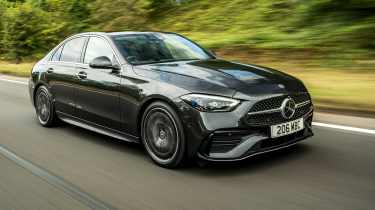
Amongst the myriad of new car varieties being churned out by the industry at large thanks to an automotive ecosystem moving towards electrification, there’s something very comforting about a model that’s been a constant for more than 40 years. The Mercedes C-class is one such car, spiritually unchanged over its lifetime, and still the ‘real’ entry point to the Mercedes range.
But to confuse this steadfastness with a lack of innovation would be a mistake, because the C-class’s evolutionary path has meant that almost all of its rough edges have been shaved off to become, in this fifth generation, a frankly brilliant compact executive saloon and estate that operate over and above their mandates, and probably their price points too. Although it won’t have escaped your attention that Mercedes now offers two very distinct and different C-class families: one that is combustion powered and the all-new, all-electric C-class. It’s the former we’re focussing on here.
> Mercedes-Benz CLA review – an electric car you can genuinely rely on available as a hybrid too
Some concessions to the combustion engine models have been made to the current automotive climate. It’s only available with four-cylinder engines for instance, and hybridisation has now been applied across all models, whether that be in mild or plug-in forms petrol or diesel powered. Yet, for the first time the use of electrification is starting to yield results, as real progress has been made in terms of efficiency and integration to a point where you would miss it if it were gone. The mainstream car world might be turning to pure electric, but right now there are few better ways of getting around than in a C-class.
Engines, gearbox and technical highlights
- W206 shifts exclusively to four cylinders
- Mild and plug-in hybrids boost performance
- Plug-in model adds range... and weight
More reviews
After two generations of the C-class being topped with V8 engines, and V6s playing a supporting role in the middle, it’s fair to say there were a few raised eyebrows when Mercedes confirmed the W206 would only be powered by four-cylinder engines. While the demise of AMG’s V8 was no surprise due to stricter emissions regulations, it was the packaging that killed off the six-cylinder motors due to switching from a V6 to an in-line six.
In order to fit the new straight-six powertrain, Mercedes confirmed that it would have required an extra 50mm of length in the engine bay, space the engineers weren’t willing to compromise for the sake of what would inherently have been a niche powertrain option.
To compensate, both of the new C-class’s four-cylinder engines are available with a choice of two outputs, with the firm’s EQ Boost mild-hybrid system applied to both petrol and diesel variants. There’s also a plug-in C300e upping the size of the electric motor and battery pack. The MHEV’s EQ Boost motor is one we’ve seen before, being an integrated starter motor and generator which adds 20bhp and 147lb ft to the figure sheet.
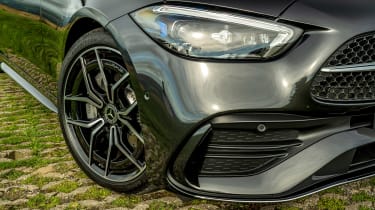
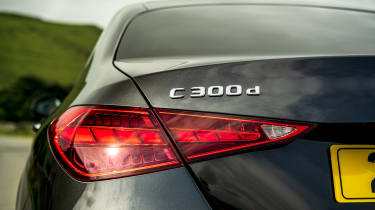
Entry-level C200 models produce 201bhp and 221lb ft of torque, and these figures increase to 254bhp and 295lb ft for the C300. Diesel engines are still on the menu too, with the C220d coming with 197bhp and 324lb ft and the top-spec C300d hitting with a very impressive 261bhp and 406lb ft. The plug-in hybrid model pairs the lesser 201bhp four-cylinder petrol engine with a more potent 127bhp electric motor to create a 313bhp combined peak power and 516lb ft, making it the most powerful non-AMG variant.
The compromise in the C300e is weight. Most MHEV C-class models weigh around 1600 to 1700kg, but this increases to a staggering 2005kg for the plug-in model, although the pay off is an impressive all-electric range of more than 70 miles. The driver of this astonishing weight penalty is the comparatively huge 25.4kWh battery pack, some 4kWh bigger than the one in an original BMW i3, for context.
Mercedes 4Matic four-wheel drive transmission is also available, with all C-class models fitted with a nine-speed automatic transmission that’s sharp, responsive and brilliantly keyed into the increasingly complicated powertrain with a calibration that’s one of the best in class. Depending on your use case will determine the best energy source. A cost to efficiency ratio makes the plug-in hybrid petrol model the best option for most, it smooths most if not all the petrol engines rough edges and provides a meaty infill to mid-range power and torque allowing the C300 to remain refined and smooth.
Power and torque delivery is consistent with no dead spots when you’re running on combustion power alone, the near 70 mile range of the battery suitable for pretty much every journey. With impressive regen when it is depleted range is consistently replenished through braking and energy recuperation.
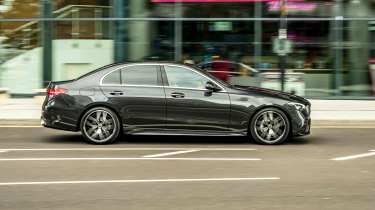
The lack of lazy six-cylinder is compensated by the C300d and 300de models. The former leans into the Germany efficiency drive of a torque heavy diesel that feels suited to every occasion the owner of a compact saloon will undertake. But it’s the plug-in hybrid variant that, even in the world of 1300bhp electric family saloon cars, SUVs that can execute tyre shredding tank turns and hypercars that no one wants despite having double the horsepower of an F1 car, impresses with a range and capability seldom seen.
Few cars provide so much breadth of capability, usability and range than Mercedes C-class that doesn’t appear to use any fuel meaning that with regular charges to the battery has you questioning when you’d need to visit a fuel station again. With a combined torque output of 516lb (the same as a 997 generation Porsche 911 Turbo), it literally wants for nothing in the pulling stakes.
Driver’s notes
‘I spent a week with a C300de and in the 30 years I’ve been doing this job it’s a car that has left an equally impressive impression on me as some of the very special sports and supercars that this job provides you to drive.’
‘With a full tank of diesel and its 19.5 kWh battery charged the total range was circa 700 miles and during a week of driving that included 160 mile round trips to evo’s Bedfordshire office, journeys into central London to Carwow’s HQ, an airport run to Heathrow around the M25 plus the family back and forth the C300de was the perfect example of all the car you ever need. A cliche, and one that I have applied to many a silly car in the past from Audi RS6 to Defender OCTA, but genuinely in the real world for those that cover above average miles the C300de, especially so as an estate, is a car of such ability that mixes a quality and refinement - not always a given in modern Mercedes models - rarely available in any car, I haven’t stopped banging on about it.’
‘It makes Audi’s new A5 feel bland and almost forgettable, despite being a car that’s easy to recommend, and BMW’s older 3-series having to work harder to keep ahead of the pack. Although the Munich icon can’t match Mercedes across the board despite being ahead in dynamic terms.’ – Stuart Gallagher, Editor in Chief, evo
Performance, 0-60mph
- EQ Boost delivers rapid performance and efficiency
- Diesel models offer the strongest performance of the range
- Electrification provides seamless and refined power delivery
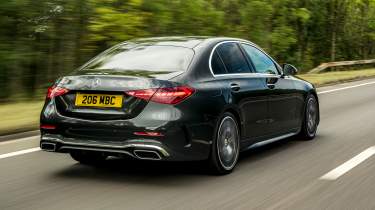
Thanks in part to that EQ Boost motor, all C-class models are fairly rapid considering their positioning and efficiency. At its slowest, the C200 petrol and C220d diesel both hit 62mph from rest in 7.3sec, with the C300 petrol dropping this to 6sec. Plug-in models are slightly slower on account of their extra weight at 6.1sec. The quickest C-class models are the diesel, with the C300d which will sprint to 62mph in 5.7sec; the plug-in hybrid completes the benchmark in 6.2. This is from a four-cylinder turbo diesel rated at over 55mpg on the WLTP combined cycle, quite remarkable stuff.
On the road, all of this electrification is brilliantly calibrated, as the mild-hybrid systems feel like integrated elements of the powertrain, rather than a parasite, dragging energy out of the system with no discernible benefit. Both the C300d models feel particularly rapid, with excellent response from the turbo and the EQ Boost motor imperceptibly filling in torque gaps at low rpm and during gear changes.
The punchy performance of both C-class diesel models makes more sense when you look at the figures, with the 300d producing 406lb ft, supplemented by an additional 143lb ft from the electric motor if you opt for the plug-in hybrid. While these two figures can’t be simply added together to come up with a huge single figure, the 516lb ft it does muster puts into perspective how effortless it feels at any engine speed. Aside from some subtle vibration at idle the powertrain is also extremely refined, with none of the raucousness evident in previous generations of C-class diesels.
Ride and handling
- BMW and Mercedes ride gap has virtually gone
- C-class trades high-speed control for suppleness
- Sharper, more precise steering than before
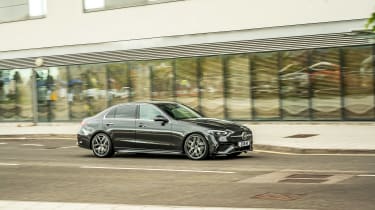
Typically, where ride and handling are concerned, the BMW 3-series has always had the upper hand over the Mercedes C-class. And while the gap has been pretty vast at points, (E46 v W203 anyone?) it hasn’t just been reduced with this latest generation, it’s almost entirely eliminated. Both have their pros and cons, and inherently the C-class does have a slightly more laid-back set-up, but that’s backed up by real suppleness and a sense of calm in its suspension tuning.
As such, the ride quality is very impressive, with only the large 19-inch wheels notifying you of rough road sections as their heavy unsprung mass stretches the damper’s frequency. At speed and mid-corner imperfections in the road surface identify themselves via a vibration through the steering wheel and into the cabin. In this respect, a 3-series’ extra lateral stability and superior wheel control have the edge, but the roles are reversed in regards to steering.
While the racks are light on both cars, the Mercedes has just a touch more accuracy and precision away from the straight ahead, plus a more natural build-up of resistance as speeds rise. The steering ratio is also much quicker than it used to be, and while it feels uncomfortable in larger Mercedes models, the C-class's impressive body control and resilient front end work with it best.
When pushed the C-class can become a little one-dimensional compared to its rival Bavaria, but it has a higher than expected limit and you can build a flow and rhythm that matches the car’s refinement and more relaxed approach. Better suited to A roads than B roads, the C-class has an organic feel to it that was previously the USP of BMW.
MPG and running costs
- Petrol and diesel models offer impressive real-world range
- C300de hybrid reaches over 160mpg claimed efficiency
- Strong residual values make for affordable leasing
Another bonus of the C-class’s total electrification is some pretty solid mpg figures across the board. At its least efficient the C300 will still claim 42.2mpg on the WLTP cycle, with the C200 rising to 44mpg.
The diesels are very impressive, considering both the size of car they need to motivate and the ease with which they do so. The C220d’s headline 61.4mpg is particularly striking, and compares favourably to the BMW 320d’s 55 to 61mpg. The C300d compromises only slightly with a 55mpg rating, and after a few days of driving on urban roads and fuel-sapping dual carriageway A-roads dotted with roundabouts, we found it drawing on 50mpg. On a constant motorway, we have no doubt it’ll reach its official claims.
It’s the C300de that delivers the headlines, its range so close to 700 miles and the efficiency of the electric motor combines to provide a 160+mpg WLTP figure. If you hate petrol stations and don’t like the idea of waiting on a charger the 300de is a remarkable proposition.
Running costs are becoming less of an issue since the advent of leasing and personal finance, but the Mercedes C-class’s strong residuals make monthly payments extremely cost-effective considering how much car you’re getting. A 48 month lease with £4768 deposit and 6000 mile per annum limit will cost £529.82 per month from our sister company Leasey*.
Interior and technology
- Shares S-Class technology and premium materials
- Persistent trim rattles and finicky controls
- Exceptional seat comfort for long journeys
Mercedes ability to trickle down cutting-edge technology to its mainstream models is nothing short of amazing. When you compare the interior of this generation C-class to that of the much bigger and much more expensive S-class, the similarities between the two are uncanny. Never has the gap between the two felt closer, and not just in terms of toys and trinkets, but material and build quality too.
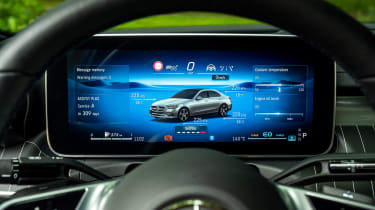
For the first time in generations the C-class’s interior’s basic layout almost directly aligns with that of the S-class, sharing the same 11.4-inch central touchscreen and 12.3-inch driver display. Both are bright, responsive and clear, and while the MBUX infotainment system can still frustrate, it’s far more usable with so much touchscreen real estate to work with. There are still some physical buttons and the controls on the steering wheel manage the functions you use on every journey (more on those in a moment), but for some the move to such a screen based HMI system will be frustrating. Although it’s far from the most frustrating system out there.
Material quality is good with synthetic leather trim on the dash, door cards and centre console feeling from a class above, making the whole interior feel much more upmarket than rivals from BMW and Audi. However, Mercedes still has quality control issues with high frequency trim vibrations still plaguing areas of the interior and while much of the material quality impresses, how it’s fixed to the car doesn’t. This has been an ongoing issue for Mercedes for more than decade and shows no sign of being rectified.
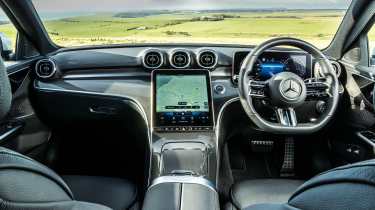
There’s also a level of tinsel that varies between mildly annoying and obstructive. The steering wheel controls take a lot of time to acclimatise to and determine how much pressure you need to apply to make them work. You can often accidentally brush the touch-sensitive controls, setting off any vast variety of functions, from increasing the volume of the entertainment or switching what you were listening to.
There’s no volume knob, instead a tiny slider does that job badly, and completing some simple tasks takes your eyes off the road for too long, despite the simplified menu structure. And if you’re a driver that likes to keep the interior dark and cockpit-light, the technicolour interior lighting combined with the sheer size of the displays makes it a glaring experience, even when the brightness is turned right down.
These issues aside, the C-class interior and seats offer rival beating comfort, as the firm always has. Some cars you find yourself constantly fiddling with the seat adjustment after a couple of hours behind the wheel, but the C-class chairs remain supportive and comfortable for as long as you need them to be.
Design
- C-class mirrors S-class proportions and style
- Grille styling a little garish and contrived
- Digital Light LED headlights offer exceptional performance
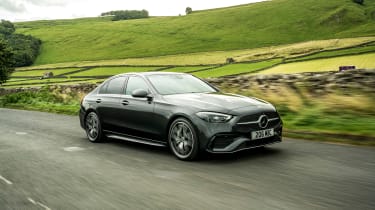
When Bruno Sacco oversaw the original W201 190E, his job was to channel the robust and hewn feeling of larger models into a smaller package. Over the last few generations Mercedes returned to this notion, and this W206 is no exception. The new C-class’s surfacing, detailing and proportions are so well synced with those of larger models such as the S-class you have to do a real double take to make sure you’re looking at the right model.
Yet in place of Sacco’s brutalist forms, Merc’s current design language (formed under the leadership of previous head of design Gorden Wagener) is perhaps less successful all-round. While the surfacing is much improved, with a simple and restrained style, the C-class’s detailing is more contrived. A majority of UK models are fitted with the AMG Line package, which features a dramatic downturn to the grille that almost pinches at its extremes – it’s more catfish than aggressor.
Mercedes’ obsession with using its own insignia as a base for patterned texture has also made its way onto UK-market C-classes, with the main three-pointed star (which also now houses the integrated radar system) joined by a grid of tiny repeats inside the grille opening. It’s all a bit garish and frankly, too over the top.
Overlook these occasional lapses in taste, though, and the new C-class fundamentally rests on its elegant proportions, sophisticated surfacing and crisp lighting front and rear. A definite shout-out must also go to the Digital Light LED headlights which are simply brilliant. The light emitted isn’t any brighter than that of other systems, necessarily, but the clarity and the software behind the anti-dazzle feature on automatic full beam is not just excellent, it’s also quite entertaining to watch from the driver’s seat at night.
Prices, specs and rivals
The C-class might only be available with four-cylinder engines, but the pricing structure hasn’t deviated from the current trend of inflated list prices due to a high take-up of leasing. As with all current Mercedes line-ups the trim lines and packages restrict the options you can have (thanks WLTP), and for the C-class this means a Sport and AMG Line trim with the latter available with additional Premium and Premium Plus packages available depending on the powertrain.
Prices for the C200 petrol in saloon AMG Line trim (the entry point) starts at £46,195, with the C200d costing an additional £1400 and the estate body adding £1750 to the price. C300e and C300d models are only available in Urban Edition trim starting at £50,750 and £53,020 respectively. All Sport and AMG Line cars come with a solid specification, including Merc’s big new touchscreen interface, digital dial pack, heated leather seats, LED headlights and a reversing camera. AMG Line cars up the exterior jewellery with new bumpers, bigger 18-inch wheels and some extra brightwork. The interior also picks up an upholstered dash and privacy glass.
AMG Line Premium models add £3,500 to the price and 18 or 19 inch wheels of your choosing, Adaptive high-beam assist, heat and noise insulating acoustic glass and a panoramic glass roof. Another £3500 gets you an AMG Line Premium Plus, which adds a different design of 18 and 19 inch wheels, Night Package (lots of shiny black plastic trim, rear privacy glass and black roof rails if you opt for the estate).
As for rivals? Well, there’s still the BMW 3-series until it’s replaced by BMW’s i3 Neue Klasse, which will be all-electric first followed by a range of combustion hybrid engines. It means BMW is in run out mode, with limited trim options with a 320i Sport kicking things off with 146bhp and a £41,945 price tag and the 287bhp plug-in hybrid offering 62 miles of electric driving costing from £47,210.
Audi’s new A5 models, available as Sportback or Avant, are arriving now with four-cylinder power across petrol and diesel engines with various levels of electrification from mild to plug-in hybrid. Prices start from £43,510 for a 146bhp 2-litre petrol Sport and £49,505 for a 292bhp e-hybrid mode.
Alfa Romeo’s Giulia is still fantastic to drive, and while it will be sticking around for longer than first anticipated, is still marvelous to look at, sit in and drive it doesn’t offer the breadth of powertrains the German do, with either a 2-litre turbo charged four-cylinder engine or the heading banging V6 in the Quadrifoglio. If you’re only interested in driving, by the Alfa.
If you’re interested in safety, there’s also Volvo’s V60 that has also been given a stay of execution.