2025 Mini John Cooper Works gets design tweaks but no more power
Following the launch of the JCW Electric, Mini has revealed its updated petrol-powered John Cooper Works
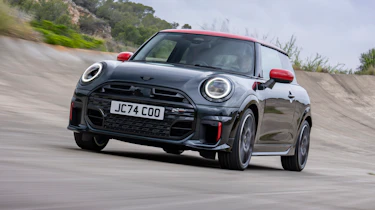
Mini launched its first ever all-electric John Cooper Works hot hatch earlier this month, but for those who still suffer from range and/or charging anxiety, or simply prefer their performance to be delivered from high octane rather than kilowatts, there is now an alternative. Receiving chassis upgrades and the same design changes as the rest of the range, the new four-cylinder petrol engined JCW is now available to order in both hatchback and convertible forms, with prices starting from £31,200 and £35,200 respectively, with first deliveries set for early 2025.
While it might look fresh on the outside, what lies under the JCW’s new skin is not. Mini has opted to stick with the same 2-litre turbocharged B48 four-cylinder and dual-clutch transmission as before, producing an identical 228bhp, 26bhp down on the JCW Electric. What it has gained is a strong 44lb ft bump in torque, not that this has enhanced it 0-62mph time, which remains at 6.1sec, two tenths slower than the electric variant – the convertible’s extra weight knocks it back to 6.4sec and 152mph (3mph behind the hatch).
> The new Mini John Cooper Works is the firm’s hottest electric hatch
Details on the exact changes to the car’s chassis haven’t been disclosed, but Mini is hanging onto the ‘go-kart handling’ term for another generation, so expect geometry changes to be at the heart of the enhancements.
The JCW's design has been updated to fit the language of the rest of the line-up, including the electric powered models. While there are similarities between the two powertrains, substantially different underpinnings make for entirely new shut-lines and subtle differences in body surfacing. At the front, the four-cylinder JCW features the same oversized oval grille as its electric powered counterpart but also includes a larger upper air intake for a more aggressive look and to feed the powertrain beneath it. The lower side intakes are also more refined in appearance than on the electric model, with separate wheel arch trims providing a presence boost.
Intriguingly, the combustion-powered JCW is less aggressive at the rear, as while it gains a more prominent diffuser section and single-exit central exhaust (inspired by the Bulldog Racing endurance racer), the unique aero-centric 'endplate' elements on the roof-mounted spoiler are gone. Wheels are 17-inch ‘JCW Spring Spoke’ items as standard, but 18-inch JCW-specific wheels are available at a cost.
The same updates have been applied to the JCW’s cabin as with other new Mini models, with the 9.4-inch circular central infotainment display carried across from the rest of the range. This new unit reacts quicker and has sharper graphics than before, and now comes with a unique JCW mode to display power figures, G-force and more. All JCW cars are ‘Level 1’ equipped as standard with the likes of a head-up display, wireless charging, heated front seats and uprated Harmon Kardon speakers, but they also come with JCW-specific black and red knitted dashboard trim – the seats are also upholstered in fabric of the same colourway, with red contrast stitching throughout.
The 2025 Mini John Cooper Works is priced from £31,200, rising to £35,200 for the convertible, making it £7220 cheaper than the JCW EV. You can order one now and first deliveries are expected to begin early in 2025.