The Lotus Elise has been revived as a 450bhp Nyobolt EV
British battery firm Nyobolt has created an Elise-inspired roadster in collaboration with Callum, showcasing its rapid-charging battery tech
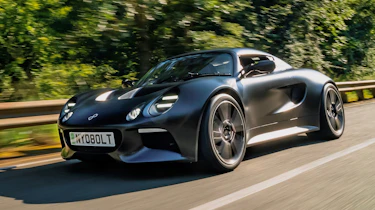
When your design back catalogue includes the Series 1 Lotus Elise and you’re asked to imagine a light, small sports car for tomorrow, it’s understandable – and totally acceptable in our book – to look back at the iconic two-seater for inspiration. Julian Thomson did just that when creating the Nyobolt EV concept last year, and the show car has now been converted into a driveable prototype to showcase cutting-edge EV battery tech.
Thomson, whose personal collection of cars ranges from a delectable Ferrari 246 Dino to a mad-hatter Civic Type R, started work on the project when he was approached by Nyobolt, the British battery-charging specialist that has given its name to the car, to conceive an electric sports car to demonstrate its ultra-fast charging technology. Using an Exige S chassis as a basis, Thomson set about sketching the EV before handing it over to design and engineering specialist Callum, founded by Thomson’s former boss at JLR, Ian Callum, which has brought the concept to life.
Beneath the reimagined lines – which retain many of the original Elise’s design identities, from the frog-eye-style front lamps to the recessed tail lights, via the tucked-in waistline and ducktail rear – sits the latest battery technology from Nyobolt, installed within the modified Exige aluminium chassis.
Testing has shown that topping up the 35kWh battery pack from 10-80 per cent takes 4 minutes 37sec when plugged into a 350kW charger, with a maximum range of 155 miles on the WLTP cycle.
The battery has been tested to the equivalent of 600,000 miles of road use, after which it retained over 80 per cent of its original capacity. The unit uses integrated power electronics and a low-impedance cell design to help achieve these figures, with Nyobolt aiming to demonstrate that EVs don’t need large, heavy batteries to perform the tasks required of them.
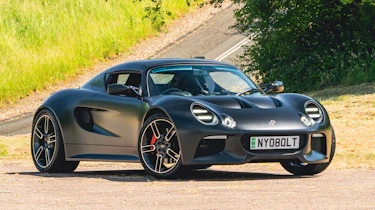
The approach has resulted in a kerb weight of 1250kg – significantly lighter than other purpose-built EV sports cars (the MG Cyberster weighs 1885kg) and only 148kg more than an Alpine A110. With estimated outputs of 450bhp and 350lb ft of torque, the power-to-weight ratio is better than that of the new Porsche 911 GTS.
Despite being designed as a showcase for Nyobolt’s EV tech, Callum has engineered the sports car to be production-ready having previously stated that a run of 25 cars per year is possible. Beyond that, Nyobolt is in talks with eight OEMs to integrate its battery systems in future high-performance EVs.