New Czinger 21C Spyder – central seat, 11,000rpm V8 and no roof
The Czinger 21C is one of the most radical and cleverly engineered hypercars available. Now there’s a roofless version

It's hard to take new hypercar manufacturers seriously these days. So many have popped up to cash in on the appetite for ultra high-end seven-figure supercars, yet very few have been able to establish themselves as genuine competitors for the likes of Pagani, Bugatti and Koenigsegg. Absurd though it may seem, hypercars have become a saturated market, and it’s all too easy to underestimate the enormous task of going from a CGI render with ambitious specs to a properly engineered, fully homologated road car you can actually buy.
Czinger is one of the few to have made that leap in recent times. Based in California, the company was established by father and son Kevin and Lukas Czinger in 2019, and it announced its first model – the 21C – a year later. With in-line central seating, a seven-figure price, over 1200bhp and a sub-2sec 0-62mph time it had all the fantasy specs covered, but this is a hypercar that’s made reality, the 21C reaching production and now being in customer's hands. Perhaps the secret is that Czinger did things in reverse, establishing a highly advanced in-house automotive engineering and production process, called BioLogic, and then creating the 21C to showcase this to the world.

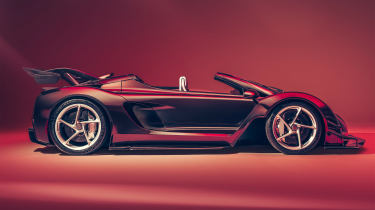
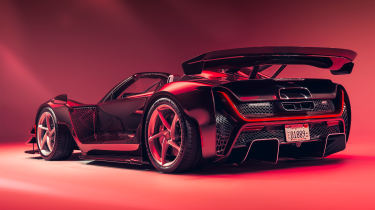
With the baseline formula established the 21C has since evolved, the second iteration being the VMax – a wingless, less track-focused version than the original with an increased 253mph top speed. Now there's a third: the 21C Spyder. An open-top model was planned from the beginning and now it's come to life in what’s tipped as the most exciting 21C of all, taking the high-downforce version as a basis and adding a manually removable roof, with refined engineering and design elements. Oh, and unfiltered access to the 11,000rpm V8 sucking in air behind your head.
Before getting into the specifics of the Spyder it’s worth explaining what BioLogic is, because everything about the 21C is intrinsically tied to the production process. The 21C is built around a carbonfibre tub (fairly conventional, apart from the fact that the driver is central with the passenger behind, rather than in tandem) but attached to this is a web of intricate, and almost organic looking metal components used for major structures like the subframes and suspension. These are a result of Czinger’s algorithm-based 3D printing process.
When developing a part, engineers feed the software all its requirements – such as size, stiffness and strength in particular directions – and a design will be generated to meet these in the most efficient way possible. This is where the organic-looking forms come from, and since they’re too complex to be produced with traditional tooling, parts are created using a 3D laser metal printer. Everything from the software to the printing process itself has been developed in house, and the result is lighter, more optimised components and more freedom in terms of packaging. This freedom allowed Czinger to come up with a hypercar that’s totally unique in its layout – a fighter jet-style cockpit with a mid-mounted V8 and hybrid drive, with an electric front axle.
The radical, ground-up nature of the 21C means that work is constantly ongoing to refine it, and the Spyder is a culmination of Czinger’s latest engineering and design developments. CEO Lukas describes it as ‘the most exhilarating’ version of the car. ‘It’s a mix of different worlds,’ he says. ‘It’s got the original 21C’s aero on it, so you get the downforce and performance of that car in an open air package. Fundamentally it’s a big evolution of the 21C.’
Basing the Spyder on the most track-focused variant doesn’t seem like the obvious choice. With its cleaner body lines (reminiscent of a McLaren Speedtail) and more road-biased setup you’d imagine the VMax would be more suited to an open-top version, but not in Czinger’s eyes. ‘For me, it was the tension between the two concepts,’ says Lukas. ‘The idea of taking the animalistic 21C with fixed aero and turning that into a roadster, that explodes your brain – in a good way.’ Quite literally, too. The high-downforce 21C uses a snorkel behind the passenger cell to feed air to the V8, and Lukas describes it as sounding like ‘it’s sucking in every molecule of air from the environment around you.’
The engine is unchanged from other versions of the 21C. The elongated cabin means the rear end is tightly packaged, prompting Czinger to develop its own compact 2.88-litre twin-turbo V8. It uses 3D-printed parts for the exhaust and intake manifolds and revs to 11,000rpm, producing a maximum of 750bhp (making it the most power-dense production V8). It’s supported by an electric motor connected to the crank and a pair of e-motors at the front for total outputs of 1250bhp and 691lb ft. The gearbox is a seven-speed single-clutch with an electrically actuated twin-barrel system, which is more compact than a DCT and uses an additively manufactured casing.
The Spyder only gains 10kg over the high-downforce 21C, coming in at 1620kg dry – perhaps not as light as you'd expect given the small engine and innovative construction. Performance figures are otherworldly, 62mph being ticked off in 1.92sec and the quarter-mile being completed in 8.7sec. Top speed is identical to the coupe at 205mph, but some way off the 253mph VMax.
A benefit of the in-line cabin is how it shrinks the car’s frontal area and reduces drag, but the 21C is also a downforce monster. At 150mph, the slippery VMax generates 576kg, while the HDF (high-downforce) variant of the coupe produces 1500kg. That latter number is unchanged for the Spyder when its roof is in place. Even with it removed it still generates 1482kg, the most of any open-top production car.
When not in use there isn’t anywhere to stow the hard top in the car (Czinger offers a stand to show it off in your garage), but there is a soft top that can be carried with you. According to Lukas, ‘It’s not Lotus Elise-spec, but installing it is a manual process. But that means there’s nothing to break or add weight.’
3D-printed components make up the majority of the 21C’s inboard suspension system, including the control arms (which are aero-optimised) and mounting points. The printing process has allowed Czinger to optimise the geometry and stiffness of these parts to a higher level, while adaptive dampers are used to give the car more bandwidth as a road car. They adjust through the drive modes – Street (which primarily runs on electric power), Sport and Track. There’s a further Track+ setting which drops the ride height 25mm and sets the dampers in their stiffest setting, but isn’t suitable for road use.
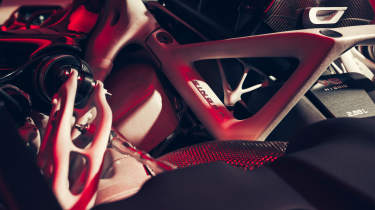
On top of this, the Spyder debuts a new braking technology, which Czinger calls BrakeNode. The nondescript name does no justice to how amazingly intricate the system is, which combines the suspension upright, brake caliper and hydraulic lines into a single unit, the parts flowing into each other in a web of aluminium alloy. It’s genuinely mesmerising to look at as well as functional, reducing unsprung mass by 0.7kg per corner and allowing more even pad pressure on the ceramic discs, reducing stopping distances by 15 per cent. New five-spoke wheels are designed to show the system off but really, you need to remove them to fully appreciate what is a stunning piece of engineering.
Climbing into the 21C isn’t an easy process (although it is made easier by the lack of a roof). The in-line cockpit means it has possibly the widest sills of any car, and you access the cabin through what are the longest doors I’ve ever seen – they span the length of the cockpit to provide access to both the front and rear seats. The correct technique is to sit on the carbon sill, swivel your body to face the cabin and aim your legs at the footwell, before sliding gracefully forward into the carbon driver’s seat.
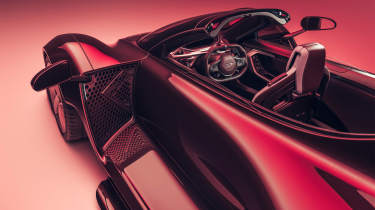
Once inside the 21C looks and feels like nothing else. That much should be obvious since you’re sitting in the middle, but having such a narrow windscreen with both A-pillars in close proximity feels alien. Strangely, sitting in the centre also makes the 21C seem much narrower than it is. The perfect symmetry, and the fact there’s only two or three feet of car either side of you, takes away the sense of width.
New for the Spyder is a sculptural dashboard that mounts primary controls (such as the start button, drive modes and climate controls) on button pods either side of the wheel. They’re wonderfully tactile, although the printed metal trims for the speaker grills on the door panels feel a bit rough to touch, and almost like plastic rather than metal. The steering wheel is rectangular with a thin rim, and integrated paddles which operate with a satisfying metallic thunk. Behind it you’ll find a digital dash with Apple CarPlay integration, with a Morel eight-speaker audio system built into the cabin. Whether you can hear it over the V8 at full noise remains to be seen.
Just 30 21C Spyders will be produced at Czinger’s Area 21 plant in California, each priced from $2.75million (circa £2million). As is the way with modern hypercars, customisation is a big part of the buying process, with bespoke paint, coloured carbonfibre bodywork and interior finishes available, and even bespoke colours for 3D printed parts. For the few that can afford one, the 21C represents something genuinely new and fresh in a space that’s become increasingly overcrowded. We’ll soon find out whether the driving experience backs that up.