Renault Mégane RS (2017-2022) review – ride and handling
The RS 300 and RS Trophy have bespoke set-ups with differing strengths and weaknesses

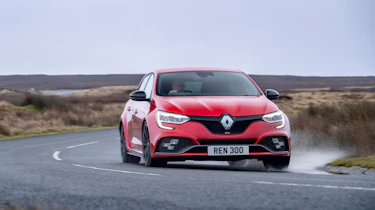
Even with many of the same attributes as previous Renault Sport Méganes, such as the strong engine, the excellent body control and the impressive traction, this model behaves very differently from its predecessors. And that’s mostly down to the all-wheel-steering system.
The Mégane is hyper alert, reacting – almost overreacting – to every steering input with real agility. Treat it like an ordinary hot hatch and it feels nervous and twitchy as you enter a corner. Play by its rules, trust that the rear-wheel steer alone will give it the capability to turn in rather than trying to improve the car’s agility yourself by braking later and deep into a corner, and what the Mégane’s chassis and systems are trying to do makes much more sense. It changes direction with such precision and ease you long for a tight and twisty road for you to lead it down, repeatedly jinking one way, then the other.
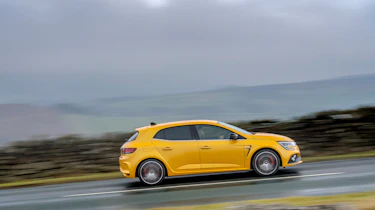
With the Cup chassis in the Trophy comes a limited-slip differential, so jump on the throttle early in a bend and you reveal the Mégane’s real party piece. The diff gives the front axle incredible bite and helps lock the tyres on the trajectory you’ve set with the steering. The rear axle engages so responsively that it makes the car feel as though you could maintain the same radius no matter what speed you’re travelling at, without the front or rear tyres losing grip. Just as long as you keep your foot on the throttle. Lift off, and in traditional hot hatch style the back end will want to break wide – but the feeling can vary markedly depending on the amount of grip available and the surface, varying between graceful and controllable to spikey and just a bit scary.
With passive dampers the ride and body control between the two models differs quite substantially, with the RS 300’s more fluid Sport chassis set-up giving it an impressive compliance and excellent composure over ridges and bumps in the road. Paired with the hydraulic bump-stops, it gives the RS 300 impressive reach into the tarmac, not feeling entirely unlike an Alpine A110, in fact.
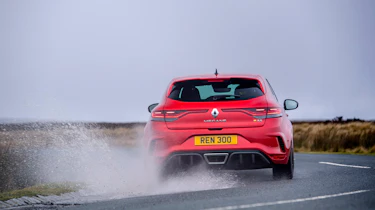
The cost of this is ultimate body control, as when you start to really exercise the chassis’ almost otherworldly agility the suspension can struggle to keep up.
This is where the Cup Chassis comes in, as its discernible reduction in compliance is made up for by the immense resilience it has to pitch and dive. Compressions and crests are dealt with without any fuss, and if the tyres do leave the tarmac the car returns to earth smoothly. There is some roll, but it’s kept to such a minimum and is so well contained that all it does is help you gauge the levels of grip, which, as it turns out, are huge.