Audi RS Q8 – engine, gearbox and technical highlights
The twin-turbo V8/eight-speed auto combination is well proven, and there’s a raft of clever chassis systems

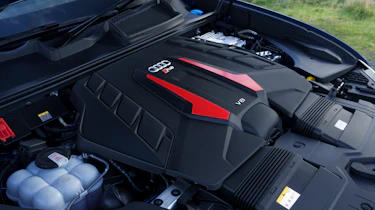
The RS Q8 is powered by the Volkswagen Group’s familiar 4-litre twin-turbocharged V8 unit, found in everything from the RS6, Porsche Cayenne, Bentley Continental GT and Lamborghini Urus. This widespread application might not make it unique, but it’s a seriously effective and rounded engine.
Like the similarly powerful V8s currently built by AMG and BMW’s M division, the RSQ8’s two turbos are situated in a hot-V layout, sitting between the cylinder banks and fed off a dramatically shorter cast manifold that runs in the reverse direction to a traditional V8 engine layout. As BMW and AMG realised, this method not only improves response, but also aids packaging between different models.
In the base car, the V8 turns out 592bhp and 590lb ft from 2200-4500rpm. The Performance ups this to 631bhp – more than any petrol Audi in history – and 626lb ft of torque. Monstrous numbers, but then the RS Q8 does weigh a minimum of 2275kg.
The eight-speed automatic gearbox is also found elsewhere in the VW Group, and it delivers power to all-four wheels via a permanent quattro system. There’s a mechanical centre differential to apportion torque front-to-rear, with up to 70 per cent sent forwards, and 85 per cent rearwards depending on which axle is slipping.
There’s more tech to harness the RS Q8’s considerable punch, and mass. Suspension is by specially-tuned air springs and adaptive dampers, with a variable ride height range of 90mm. Optionally available is electromechanical roll stabilisation, which uses electric motors integrated into the roll bars to reduce lateral body movements, as well as a quattro sport rear differential and carbon ceramic brakes (standard on the Performance). The latter comprises 420mm and 370mm front and rear discs with mammoth ten-piston calipers up front.
Rear-axle steering is standard across the range, aiding low speed agility and security at higher speeds, so too are 22-inch alloys. You can, however, specify 23-inch light-alloy items on the Performance, which trim around 5kg of unsprung mass at each corner compared to the 22s.