Bentley Mulsanne (2010 - 2020) review – the last old-school Bentley
The Bentley 6.75-litre V8 and the barges it powers span a 60-year dynasty that ended with the Mulsanne in 2020. We revisit it
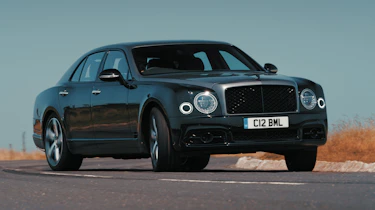
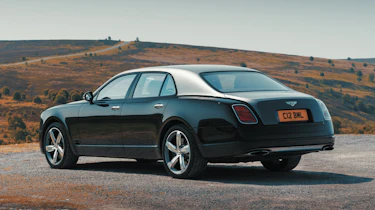
If the Mulsanne was a blockbuster Hollywood film franchise it would be less Fast & Furious, more Vast & Luxurious. At more than 5.5 metres in length, tipping the scales at 2685kg and costing upwards of £250,000, it was, until very recently, Bentley’s flagship. Sadly, after a decade and some 7300 cars built, production of the Mulsanne ceased in 2020.
With it went the legendary 6.75-litre V8. Fondly referred to as the ‘six-and-three-quarter’ by those in the know, this engine could trace its roots all the way back to 1959. In continuous production ever since, and fitted to an unbroken succession of series production models right up until the Mulsanne reached the end of the road, this record-breaking run eclipses even that most celebrated of V8s, the ubiquitous small-block Chevy.
Bentley Mulsanne history
The bones of Bentley’s venerable L-series engine may famously date back decades and decades and decades, but it has been continually refined and re-engineered. Highlights include the adoption of forced induction back in 1982 when the Mulsanne Turbo was introduced. Despite boosting power and torque by 50 per cent, the original Mulsanne Turbo had no suspension changes over the standard car, but there’s no question the cachet of a latter-day ‘blower’ worked wonders for Bentley’s otherwise beleaguered sales.
During the period when BMW owned both Rolls-Royce and Bentley there was a phase when the six-and-three-quarter looked like it was going to be axed, BMW preferring to slot its own V8 into the Arnage and Rolls Seraph. Then VW acquired Bentley and, in a glorious snub to BMW, reintroduced the 6.75 at the top of the Arnage range. Named ‘Red Label’, it proved far more popular than the unloved BMW-engined ‘Green Label’, and the latter was soon removed from the line-up.
More reviews
Given this backstory, it’s no surprise the 6.75 received its most extensive redesign under the Volkswagen Group’s tenure. Still lovingly hand assembled, but with twin turbos, a new cylinder head design, cylinder deactivation to save fuel and variable valve timing for the single-cam pushrod top end (still with just two valves per cylinder), only the most basic architecture – namely the bore diameter and cylinder spacing – of its substantially stiffened aluminium block remained unchanged. The phrase ‘Trigger’s Broom’ springs to mind.
Tenuous it may be, but this unmatched lineage forms a silken thread that runs back through almost half the automobile’s existence. That the last iteration produced is 99 per cent cleaner than the first, and could actually idle on the tailpipe emissions of its most distant forebear, is testament to a remarkable engineering evolution. If any engine’s passing deserves a requiem it is this.
Engine and performance
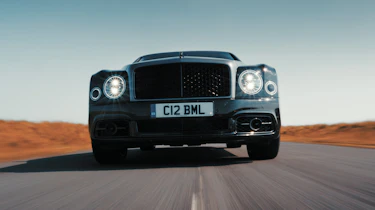
- This incredible engine delivers its performance like few others, with very few revs and zero drama
- But that performance is extraordinary – it’s a force of nature
- Just 36,000 L-series V7s were produced over 61 years
Such longevity and permanence is impressive, but what connects us to this last-of-a-kind Bentley is the manner in which it performs. Not so much the fact this Speed-badged block of flats will touch 190mph and accelerate from 0 to 62mph in 4.9sec, but more because it’ll barely break into a sweat while doing so. The Mulsanne launched in 2009 with 505bhp at 4200rpm and 752lb ft at just 1750rpm and those numbers grew only gradually over its term of service. The last-of-line Speed here produces 811lb ft of torque (that’s 1100Nm) from 1750rpm and revs to just 4500rpm, with peak power of 530bhp. All Mulsannes make use of the near-ubiquitous eight-speed ZF torque converter transmission.
I’ve long believed exceptional internal combustion engines trigger a deeper emotional and sensory connection to the machines they power. That’s why we look up when we hear a Supermarine Spitfire fly overhead, and why crowds of people flock to be near exotic Grand Prix cars, Le Mans prototypes or rally cars when they’re about to fire up. Non-sentient they might be, but these machines have their own particular life force.
The Mulsanne Speed makes no such fuss, but it’s as alive as any machine can be. Think about it. An engine, especially one as storied as this, is often described as the heart of a car. It has a pulse. But it also breathes in and out, and has vital cooling and lubricating fluids passing through a network of pipes akin to veins and arteries. And, of course, it expresses itself through the sound it makes and the unique characteristics of its power and torque delivery.
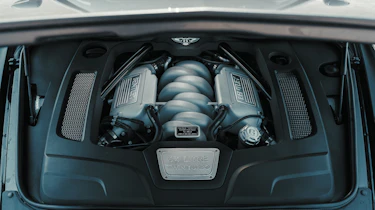
You don’t so much hear it ticking over as feel its presence pulsing through the car. Squeeze the throttle and the body rocks slightly, but you’re otherwise isolated from anything so vulgar as noise, vibration or harshness. Accelerate gently and you hear a barely perceptible purr and feel a magical sense of propulsion.

Push the throttle with a little bit more insistence and the note deepens fractionally as the nose begins to rise. It’s the perfect indicator of how hard the car’s working, even though in truth this car never feels like it’s working hard at all. At once serene and intense, it’s an epic way to be pushed down the road.
It’s this boundless sense of elasticity that’s so special. You just stretch the performance of the car that little bit more, by increments, if you like, without ever feeling like it’s reaching its limit. It’s this effortless potency and unruffled oomph that has come to define modern Bentleys. In fact you could say this car and engine combo served as the blueprint for the style of performance the VW Group’s own V8, W12 and hybrid/EVs should offer.
Sadly, the only thing which moves with greater inexorability than this majestic machine is time itself. Some might see its discontinuation as a mark of progress, but it leaves me feeling a little melancholy. Many people won’t understand why not having a version of the six-and-three-quarter under the bonnet of future Bentleys is so poignant. But in much the same way anyone who has flown on a Boeing 747 feels mournful at the prospect of the Jumbo disappearing from our skies, that engine and the cars it powered were wondrous machines.
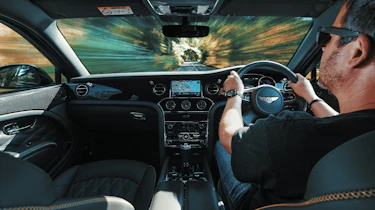
Perhaps the six-and-three-quarter’s discontinuation feels more momentous because it is symbolic of the wider auto industry’s severance with its petrol-powered past. In Bentley’s case it also feels like disavowal – albeit a reluctant one – of perceived profligacy. How better to signal an attitudinal and technological shift than by killing off the internal combustion engine that can trace its roots back further than any other?
It’s an enormous shame that Bentley has stopped producing these engines. I’m sure there are ways of replicating the 6.75’s delivery, but it would almost certainly rely on a ton of batteries, well-muffled electric motors and the synthesised murmur of that magnificent V8 piped discreetly into the cockpit. It might feel and sound the same, but it won’t possess the same warmth of character.
EV zealots will doubtless say good riddance to a gas-guzzling anachronism. In time we may well conclude they have a point. For now, though, we should pause and pay our respects to the last pre-VW Bentley and one of the great engines. One whose character and delivery was as memorable for its near-silence and locomotive-like pulling power as any screaming V12 or snorting straight-six. We shall never see its like again.
Ride and handling
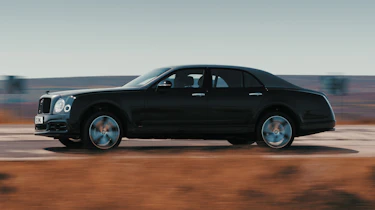
- The Mulsanne is a car you guide in slow motion, rather than pilot
- Everything from the steering to the body control is relaxed
- But there’s good inherent balance, the Mulsanne unafraid of taking a neutral stance
It’s shockingly swift across roads you’d perhaps expect it to be all at sea on. Like the engine there’s a finely judged calmness about the steering and its response. With 3.5 turns lock-to-lock, in place of the synaptic, jolting direction changes we’re used to in aggressive sports and supercars, the Mulsanne takes languid lines, its mass and wheelbase dictating a degree of decorum but doing little to blunt your point-to-point pace.
Some pre-planning is required, for this is not a car in which to smash the brake pedal, stand it on its nose and sling it at an apex, but adopting a lift-and-coast tactic into the braking zones lets the car settle and creates some vital separation between slowing, steering and throttle inputs. Driven thus the Mulsanne is impressively accurate and surprisingly entertaining.
Weight is often named as Enemy No. 1 of performance, efficiency, handling and all the other things that engineers are supposed to strive for. But weight in this context is the thing that gives the Mulsanne Speed its dynamic fingerprint. It’s an absolute force of nature in every respect, but the more you drive it and the more time you spend in it, the more accustomed you become to its way of doing things.
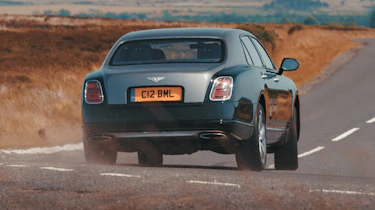
Riding on 21-inch rims puts plenty of rubber on the road. It doesn’t help some aspects of ride quality, as you do sense sharp potholes make the vertical movement of those huge wheels and tyres difficult to contain, but there’s otherwise a general sense of the Mulsanne steamrollering the road into submission. Those generous contact patches enable you to tackle tight corners with more gusto than you might expect too, while fast corners are dispatched with physics-defying aplomb. Yes, there’s some body roll, but it serves as a useful gauge of how hard the chassis is working.
Once near its limit the balance is inherently transparent, the nose pushing wide if you carry too much speed or get greedy with the throttle before the apex. However, apply some tricks learned in more overtly sporting cars and you can use a bit of weight transfer to nail the nose and bring the rear end into play. I’d hesitate to coin that racer and road tester’s favourite term and say it rotates, but it will neutralise. Better, if you time everything sweetly and give it the full Woolf Barnato, it’ll exit corners with an appropriately classy degree or two of oversteer before the stability control reins things in.
I’ll admit you do feel a little bit incongruous at the best of times – as incongruous as a near 3-ton luxury barge having a ‘Sport’ mode, that stiffens its dampers and tautens the steering. If someone happens to spot you gently drifting through a corner, even if you do your best to style it out, it’s clear there’s a mild sense of bewilderment at what they’ve just witnessed. Funnily enough there’s equal bewilderment at what you’ve just experienced from behind the wheel.
‘The surprise comes when you dive a little deeper into the ocean of power, as only then does the Mulsanne demonstrate just how far it has moved the game on from the Arnage. Everything feels more taut, be it steering response, brakes, the imperceptible gearchanges or the handling – all have been sharpened to a point where the car disguises its obvious bulk beautifully. Roll is cleverly kept in check by active dampers that stiffen the outside wheels’ responses through corners, at the same time softening those of the inside wheels. But flinging this car through corners hardly seems appropriate, as it’s effortless travel that is the trademark of the Mulsanne.’ – Harry Metcalfe, evo founder, 2010.
Interior and luxury
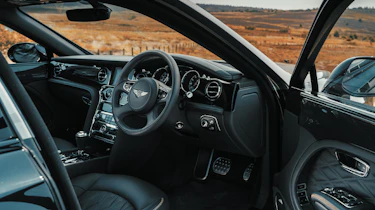
- Fit, finish and material quality is another level above Bentley’s other models
- The cabin looked and felt old when new – appealing to some, not others
- Enormously spacious, comfortable and refined, if not tech-laden
This kind of anthropomorphism might seem like a load of old cobblers, but I defy anyone to spend time in the Mulsanne Speed and not feel themselves falling under its spell. The seduction begins before you start the engine. Its sheer pomp and presence is ridiculous, as is the weight of the driver’s door when you swing it open like a bank vault in a heist movie.

All kinds of treasures await inside, from the acres of supple, aromatic hide that’s so neatly and intricately stitched, to the sparkling chrome bezels and switchgear that stud the high-gloss Piano Black dashboard and centre console. Magnet for unsightly sticky fingerprints these pristine surfaces may be, but the impression they create is breathtaking, if uncomfortably blingy for some tastes.
Once you’ve climbed up into the lofty seat you’re treated to the most majestic view out across that sprawling bonnet and down to the Flying B mascot perched atop the radiator shell. Like the motor that sits beneath it, this is a scene from the ages. One any Bentley driver would recognise, even WO himself.
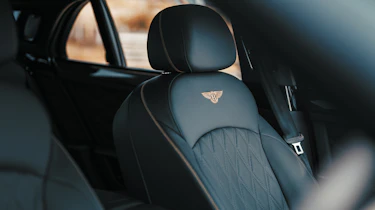
You feel the quality in everything you touch, everything you open and close. It just has a sense of being hewn; one solid thing attached to other solid things to create a monolithic build integrity quite unlike in any other car.
Considering its significance, not to mention its central role in the whole Mulsanne driving experience, the Engine Start button is somewhat apologetic in size. No matter, for once you’ve given it a respectful prod the 6.75 more than compensates.
‘If how it drives is a little unexpected, how the Mulsanne is built and put together certainly isn’t. Unlike other Bentley family members, every process in its construction is carried out in Crewe, the vast majority by hand. The inside of a Mulsanne is exactly what you expect a Bentley to be: off-the-scale refinement, unquestionable quality and such a grand sense of occasion you feel guilty when your denim makes contact with the chair’s hide and your trainers disappear into the carpet. I assume swapping the champagne in the rear-seat fridge for a couple of cold cans wouldn’t be the done thing, either.’ – Stuart Gallagher, evo editor-in-chief, 2018.
Bentley Mulsanne values and checkpoints
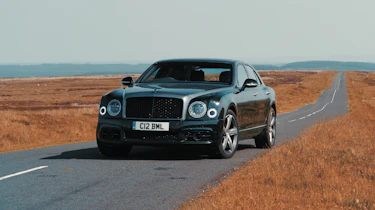
If you could in jest call a Bentley Mulsanne an ‘old Bentley’ when it was new, it certainly is now, being out of production since 2020. Launched in 2010 with a list price well over £200,000, the earliest examples are now available from £30,000, albeit with some miles on the clock too. Even later examples from 2018 and 2019 rarely crest £100,000.
Being heavy beasts, it should come as no surprise that the rate at which Mulsannes consume their tyres and brakes – and the cost to renew those consumables – is greater than the average car. Likewise things like suspension bushings, engine mounts and even dampers will be tired on the earliest cars by now. The suspension’s air springs don’t crop up as common failure points as you might expect, at least compared to large luxury Mercedes of the 2000s and early 2010s.
In fact, Mulsannes are relatively sturdy beasts, save for consumables and the occasional electric glitch. Just know that looking after what is an incredibly specialised V8, whether for routine servicing or major work, is more costly even than the typical German set of underling (compared to the Bentley) luxury models. Needless to say, as immaculate an MOT and service record as possible will stand you in the best stead.
Bentley Mulsanne specs
| Bentley Mulsanne | Bentley Mulsanne Speed | |
|---|---|---|
| Engine | V8, 6752cc, twin-turbo | V8, 6752cc, twin-turbo |
| Power | 505bhp @ 4200rpm | 530bhp @ 4000rpm |
| Torque | 752lb ft @ 1750rpm | 811lb ft @ 1750rpm |
| Weight | 2585kg | 2685kg |
| 0-62mph | 4.9sec (claimed) | 4.9sec (claimed) |
| Top speed | 184mph (claimed) | 190mph (claimed) |