The anatomy of a top-class Dakar-winning racer: Dacia Sandrider
The Dacia Sandrider is a £1million, Prodrive-built Rally-Raid special that now has an outright Dakar Rally win under its belt. We dissect it
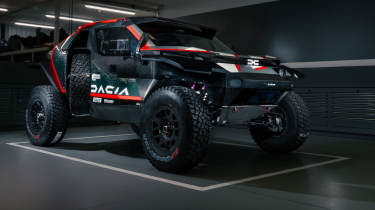
Standing in the heat of the Spanish sun, the idyllic sounds of nature are shattered by what sounds like an approaching A‑10 Thunderbolt aeroplane firing its Gatling gun. But, thankfully, it isn’t. It’s actually the sound of the antilag on a Dacia; more specifically, outright winner of the 2026 Dakar Rally, the Sandrider.
Beyond the one-make Dacia Cup series and oddities such as the N24 Logan, ice-spec Lodgy Glace and a wide-bodied Logan designed for the Swedish Touring Car Championship, Dacia hasn’t spent many of its 59 years creating motorsport contenders. The Sandrider, developed in collaboration with Prodrive, is without doubt its most significant yet.
> Land Rover Defender D7X-R makes its Dakar Rally debut
It first broke cover in 2022 as the Dacia Manifesto concept, and you would have been forgiven for thinking it was just another show car created purely to give an indication of a brand’s future design direction. Just a few years later, however, that concept has not only inspired the bold design language of Dacia’s current road car range, it has also become a very real competition car, entered in the flagship Ultimate category of the World Rally‑Raid Championship, where three examples competed throughout 2025 with Nasser Al-Attiyah, Cristina Gutiérrez and Sébastien Loeb in the driving seats. It also happened to achieve an outright win in the 2026 Dakar Rally, beating Toyota and Ford in the process.
Strong beginnings
Not only is the Sandrider the most expensive Dacia ever built, costing around £1million per car (before accounting for the team required to run it), it’s also the firm’s most successful competition car. Making its race debut at the final event of the 2024 Rally-Raid season, the five-day, 1500-mile Rallye du Maroc, it scored a 1-2 finish, Al-Attiyah and co-driver Édouard Boulanger claiming victory, Loeb and Fabian Lurquin close behind.
The Sandrider then started the 2025 season with its first Dakar and while the podium proved elusive in that event, it came out on top overall in 2026 with Al-Attiyah at the wheel. In the Abu Dhabi Desert Challenge last year, Al-Attiyah claimed another overall win, which Loeb followed with a second place at the South African Safari Rally. Then all three Dacias finished within the top seven places at Rally-Raid Portugal, Loeb the highest in third. Back at the Rallye du Maroc for the season closer, Loeb claimed another victory. At season’s end, Al-Attiyah was in second place in the driver’s championship, Loeb in fourth, while Dacia claimed second in the manufacturer’s rankings.
Engine and transmission
Prodrive is no stranger to Rally-Raid, having competed with its own car, the Hunter, from 2020 to 2024. While there are similarities between the Hunter and the Sandrider, the latter is far from a reskinned version of the former, with the fundamentals of the package reengineered entirely.
Where the Hunter used a 3.5-litre Ford EcoBoost V6, the Sandrider has a twin-turbocharged 3-litre V6 sourced from within the Renault-Nissan-Mitsubishi alliance. Developed for the Sandrider by Alpine Racing, the engine is a derivative of the VR30DDTT unit found in the recent Nissan Z sports car. It has its roots in a road engine, then, but specific changes have been made to ensure it can withstand the extremes of Rally-Raid.
First on the list is to strip it of its ancillaries. Experience has taught Prodrive that pulleys and belts and the accessories that they power simply can’t stand up to the harsh impacts and drastic changes in revs experienced during dune climbs and jumps – belts snap and fall off, and reliability takes a plunge as a result. These accessories also sap vital engine power, and when there are minutes between the top contenders over a 50+ hour race, every bhp counts. Prodrive has therefore developed electric-powered alternatives for everything from air conditioning to fluid pumps, giving them their own dedicated power source.
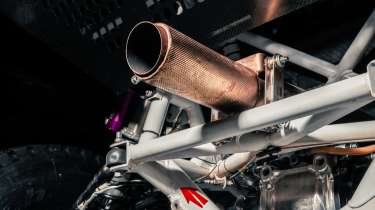
The V6 is also converted to a dry sump setup, to ensure oil gets to its destination regardless of the g-forces at play. A bespoke Bosch ECU is swapped in to allow for full tuning flexibility, along with a motorsport-spec exhaust manifold. The two turbochargers are new too, for enhanced durability but not for an increase in output: the standard Nissan Z road car produces 400bhp, yet Ultimate regulations limit the Sandrider to 360bhp, a figure it produces at 5000rpm. (A torque meter after the gearbox monitors the outputs to ensure nobody exceeds the limits set by the governing body.) Because of this, virtually none of the engine’s internals had to be upgraded; the block, crankshaft and camshafts all remain standard road spec. Turns out it’s not all unobtanium in top-level motorsport after all…
Peer behind the steering wheel and you’ll spot a lone paddle on the left-hand side, but this isn’t for changing ratios, it’s for the wipers – a regularly used item when traversing typical Rally-Raid terrain. The six-speed Sadev sequential transmission is instead operated via an elongated shifter in the middle of the cabin.
Given the huge distances the Sandrider needs to cover on a stage, it’s equipped with a cavernous 560-litre fuel tank. This is mounted directly behind the cockpit for packaging and weight distribution benefits (the fuel alone weighs over 400kg when the tank is full). Consumption varies drastically depending on the terrain, but generally sits at around the 2.5mpg mark under race conditions. The fuel itself isn’t standard either, Dacia choosing to run a sustainable formula from Aramco, with 80 per cent of its content derived from biomass.
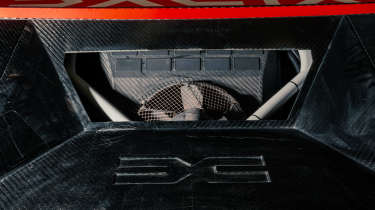
Chassis and bodywork
Front-running Dakar cars have tended to have a similar appearance in recent years, but the Sandrider takes a unique approach, with proportions more akin to an ATV than a thoroughbred Rally-Raid machine. Make no mistake, though, step up to its carbonfibre bodywork and it becomes immediately clear that this car is in a very different league to a Polaris.
Its sheer size is the first thing that strikes you. Standing tall and wide, and with a wheelbase as long as a Land Rover Defender 130’s, it’s larger in every dimension than the biggest road-going Dacia on sale. Its slightly awkward proportions are the most notable element shared with its Hunter relative, but the design is more closely linked to the Manifesto concept. Despite this, prioritising form over function was not on the cards for this project, with the Sandrider’s overarching design sculpted by the requirements of competition rather than to create a visual link to Dacia’s road cars.
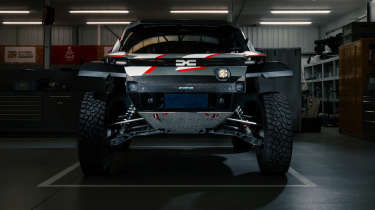
Chief mechanic Alistair Gibson says that where some teams have been bound to the constraints of an existing road-going design, such as Toyota with its Hilux pickup, the fresh-sheet approach of the Sandrider has allowed for some beneficial design choices. Large overhangs at the front and rear are simply not required, and so this car goes without them, minimising material, improving visibility and reducing weight. If an area of the car doesn’t require bodywork for any practical purpose, it goes without. So, for example, the rear-mounted spare wheels are completely exposed, which not only eliminates the need to create panels to cover them and ensure they remain secured, it makes it quicker and easier for the team to access the wheels when required. It’s this ‘less is more’ approach that defines the Sandrider – and also aligns it neatly with the spirit of Dacia’s road cars.
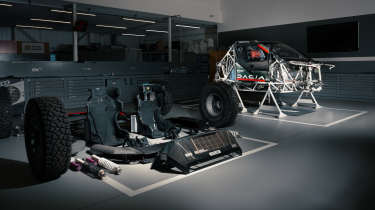
What bodywork the Sandrider does have is bolted directly to its integrated tubular chassis and roll-cage in most cases, and while the bodywork appears basic and one-dimensional on the surface, function over form again has an influence here. The rear wing and Gurney flap have genuine aero benefits, reducing drag and lift by 10 and 40 per cent respectively over earlier prototypes. ‘Because we’re so speed limited it’s more for stability than downforce,’ says Gibson, ‘and as soon as you add any yaw it’s all out of the window anyway.’
While most of these design choices led to weight savings, the Sandrider weighs in at 2010kg; that’s around 700kg more than a Dacia Duster. Don’t blame the car, though, as this figure is a minimum required for it to meet the regulations, so is one that its competitors also have to follow. In development, the Sandrider’s weight distribution was shifted forward significantly in order to improve traction on tougher terrain. Gibson says that in order to be competitive, aero is ‘not a big factor. It’s important but it’s not the biggest factor. Traction is the biggest thing.’
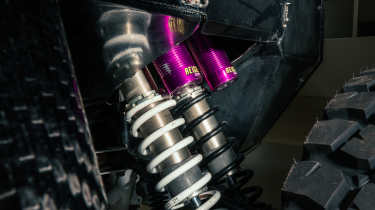
The chunky, 37-inch BF Goodrich tyres are beadlocked (i.e. mechanically attached to the rim) to ensure they don’t become unseated, while each of the four corners is equipped with two huge, remote-reservoir, individually cooled Reiger dampers costing £7k a piece. With the extreme forces at play under race conditions, the suspension system takes a real beating; on stage four of the 2025 Dakar rally, Al-Attiyah and Boulanger experienced race-stopping suspension failure before their teammates saved the day with an on-the-fly repair. Knocking a corner entirely off the car is something they’ve encountered, but the most frequently damaged part by a long stretch is the roll-cage, and this is during accidents that are no fault of the car.
While the Sandrider is designed to be as strong as possible, damage is still inevitable, so solutions to this have been engineered into the car from the outset. Just like the aforementioned A‑10 Thunderbolt, on which as many parts as possible are interchangeable from left to right for ease of maintenance and to reduce the mass of any spares that need to be carried, so the Sandrider’s front-right wishbone is the same part as used on the rear-left. This means just two parts are required as opposed to four, streamlining the spares inventory.
Cabin and unique features
Technically speaking, this is a UK road-registered Dacia (albeit it under prototype classification), and while elements of its design have been transferred directly to the current Dacia line-up, there’s not much more crossover between the Sandrider and the road. Although there is some: the handles for the Sandrider’s gullwing doors have been nabbed from a Renault Twingo, and even the Mégane RS has donated parts… for the door seals. Elsewhere, though, the rally machine is just about as bespoke as you can get.
Lift the doors (with care, as the hydraulic struts are perhaps a little too effective at lifting them) and it doesn’t take long to notice the sheer number of unique Dacia-badged components in the tight, functional cabin. The car may be built by Prodrive, but each and every bespoke part is adorned with the ‘Dacia Link’ emblem, from the suspension wishbones to the exhaust shielding and even the wiring looms. Look closer and alongside these markings you’ll spot the characters ‘41A’ – the Sandrider’s internal project number.
Numerous parts have been developed using a 3D printing process, with the first prototypes printed in-house by Prodrive, then the final components recreated in more robust materials or 3D printed using more advanced techniques at facilities in China. This approach has provided a significant boost to development efficiency and allowed for much more intricate engineering solutions than before.
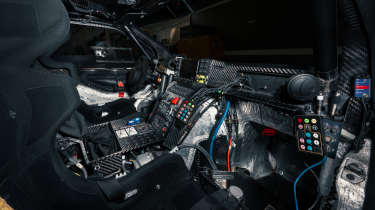
Slide through the roll-cage and into the tight Sabelt race seats – upholstered in an anti-bacterial fabric designed to self-regulate humidity – and the Sandrider’s clever bonnet design allows you to see through the aero passthrough for improved visibility when it’s needed most. Just like the seat material, this bodywork also contributes to comfort inside, with the wrapped elements coated in an infrared-reflecting layer to keep as much heat out of the cabin as possible – combine a motorsport powertrain with a tight cabin and 40-degree desert heat, and it’s easy to see why this is so important.
But as hard as Prodrive and Dacia have worked to control cabin temperatures, it still gets warm in there. As a result, the crew consumes large quantities of liquids during a race; the driver usually more due to increased physical exertion. Electrolyte drinks are the best way to stay hydrated, but with no way to cool the tanks they sit in, they can quickly become unpalatable. As a workaround, teams often run with half of the 6-litre capacity filled with plain water, and some even take advantage of the heat of the tanks and swap this for tea.
Another challenge encountered when spending days navigating a desert is bright sunlight. That’s why the dashboard – a modular affair, to allow for setup changes depending on the driver and co-driver – that’s slotted neatly onto the Sandrider’s firewall is coated in an anti-reflective paint to reduce glare from the unrelenting sun.
The violent nature of a flat-out Rally-Raid event is also an issue, but not so much for the car. Given the resilience of modern hardware, the driver and co-driver are now considered the ‘fuse’ of the package. Prodrive hasn’t seen such an incident itself, but Gibson recalls tales of Dakar drivers failing before their cars: ‘What used to happen is that the drivers would come over a dune so fast that they’d have a big landing, knock themselves out behind the wheel and spend two or three minutes coming back round before they could carry on.’ To combat this, and other injuries such as spinal compression, those Sabelt seats are not mounted directly to the chassis, but instead to a ‘seat attenuator’. Effectively a damper with a double wishbone, it helps cushion any major impacts the car might experience when landing, but doesn’t compress over lesser jumps so as not to distract the driver. The system was developed by Prodrive with Warwick-based R53 Suspension and debuted on the Sandriders, and has been met with such approval that it will become mandatory in every new Rally-Raid contender from 2027.
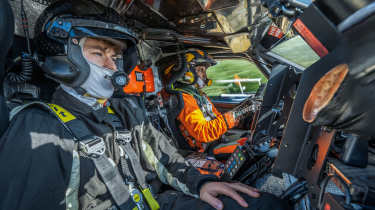
As much as the driver plays a huge role in the success of a Dakar racer, the co-driver plays an equally significant part, and not just for navigation. Boulanger, Lurquin and Moreno are responsible not only for reading the digital map, but also for the team’s nutrition and the strategy between the designated waypoints. In years gone by, helicopters were used to scout the route beforehand, but today teams are supplied with the waypoints on in-car tablets just five minutes before race start, making any such recces impossible. The sheer number of waypoints means you have to learn to prioritise those that matter most, but missing a single key point could put the team completely off course. Even in a straight line the co-driver has to pay close attention to the car’s bearing to ensure the most accurate route from one waypoint to the next. Using GPS on your phone or calling the team for assistance is off the cards too: once away from the start line, phones are locked away, and aside from a satellite phone that can be used in the event of an emergency (and only when the crew have been outside the car for 10 minutes or more), they’re on their own.
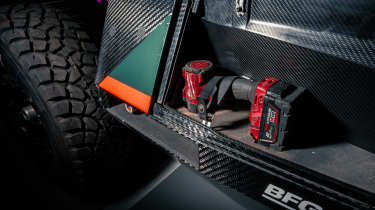
When the car does see a mechanical failure, it’s typically down to the driver and co-driver to get it back up and running. (Other competing crews may provide assistance, but outside help is not permitted.) Power tools to help with repairs are housed in slots in the car’s door sills, removing the need for a cumbersome toolbox. Those chunky BF Goodrich tyres last from 150 to 300 miles depending on the terrain, and are designed to take a beating without losing air. Based on the scars on the used tyres we’ve seen, we believe it. Should a team need to change a wheel mid-stage, a magnetic plate mounted to the car’s body can be used to retain the bolts, preventing them getting lost to the sand. Neat.
Onboard Sandrider
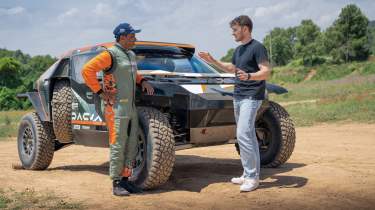
I’ve experienced an eclectic mix of machinery over the years, but never did I expect for every one of those experiences to be topped by a Dacia. We strapped into the Sandrider for a ride with Nasser Al‑Attiyah around his very own purpose-built circuit in Spain, and if you’d told me I had actually just boarded a secret physics-defying black-project craft, I’d probably have believed you.
‘Alien’ is the best way to describe the Sandrider’s capabilities. While road cars frequently target acceleration as the key performance metric, this is the least significant part of this experience. Up to speed and approaching a heavily rutted, off-camber corner with a near-sheer drop into dense woodland beyond, you’d expect any other vehicle to dig in and hurl itself into the abyss, but the Sandrider absorbs lateral loads like nothing I have ever experienced – excess energy seems to vanish without consequence. The braking forces seem impossible too, given the ashy, dry dirt the tyres have to work with, and there are a couple of sizable jumps here as well – not that you’d know it based on the way the Sandrider lands.
So otherworldly are the sensations that I even involuntarily tear up as a reflex to the forces my body is feeling. The experience has required my brain to recalibrate what it thought was physically possible on four wheels, and the effort that goes into developing such a machine, maintaining it and running it under such extreme conditions has changed my perspective just as much.
This story was first featured in evo issue 342.